
Are you looking for Erasmus Mundus programmes 2027 that can help you earn an internationally recognized master’s degree while studying in multiple countries?
The Erasmus Mundus Joint Masters (EMJM) are among Europe’s most attractive international master’s opportunities. They are jointly designed and delivered by higher-education institutions from different countries and are open to students from around the world.
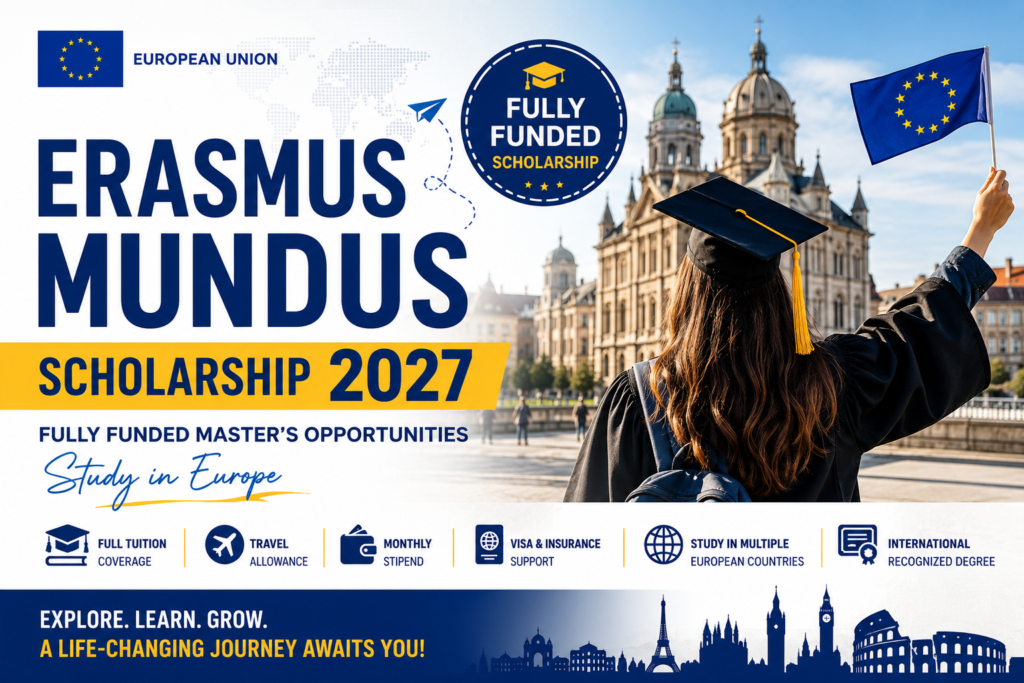
Selected programmes offer full scholarships to the best-ranked students, with scholarship support that can contribute toward participation costs, travel, visa expenses and living costs.
And there is particularly exciting news for students targeting the 2027 intake.
In July 2026, the European Commission announced the selection of 37 new Erasmus Mundus Joint Masters. These new programmes are expected to be added to the Erasmus Mundus catalogue and open applications in autumn 2026 for programmes starting in September 2027.
That makes 2026 an important year for students who want to prepare for Erasmus Mundus 2027.
Important: Erasmus Mundus programmes have individual application requirements and deadlines. Always verify the latest information on the official programme website before applying.
What Are Erasmus Mundus Programmes?
Erasmus Mundus Joint Masters are international master’s programmes jointly designed and delivered by a consortium of higher-education institutions.
An EMJM involves institutions from multiple countries and normally includes an international study structure involving different universities.
According to Erasmus+, students can study at several universities in Europe and beyond, while programmes may include study, research, traineeships, thesis preparation and defence.
Unlike a conventional master’s degree where students may remain at one university for the entire programme, Erasmus Mundus programmes are designed around international mobility and collaboration.
Depending on the programme, you may:
- Study in multiple European countries
- Attend different partner universities
- Work with international academics
- Complete research projects
- Participate in internships or traineeships
- Complete a master’s thesis
- Graduate with a joint or multiple degree
Why Erasmus Mundus Programmes 2027 Are Worth Considering
There are several reasons international students are interested in these programmes.
🌍 International study experience
Students can study through a multinational university consortium.
🎓 Master’s degree
The programmes are master’s-level degrees, generally lasting 1–2 academic years and carrying 60, 90 or 120 ECTS credits.
💰 Scholarships
Selected programmes offer competitive full scholarships to top-ranked students worldwide.
✈️ International mobility
Students may study in two or more countries as part of their programme structure.
🔬 Research opportunities
Programmes can include research and thesis work.
💼 Professional exposure
Some programmes include traineeships or connections with non-academic partners.
🌐 International network
Students become part of an international academic and professional community.
Erasmus Mundus Programmes 2027: What’s New?
The 2027 intake is particularly interesting because the European Commission has announced 37 newly selected Erasmus Mundus Joint Masters.
The new programmes cover a diverse range of disciplines, including:
- Water vulnerability engineering
- Medical image analysis
- Semiconductor technology
- Sustainable structural design
- Artificial intelligence
- Chemical nano-engineering
- Animation
- Advanced microscopy
- Law, data and artificial intelligence
- Nuclear decommissioning
- Accelerators and lasers
- Infectious diseases and One Health
The European Commission says these 37 new master’s programmes will be added to the Erasmus Mundus catalogue and will open student applications in autumn 2026, with programmes beginning in September 2027.
This is one of the most important updates to include in your 2027 article.
New Erasmus Mundus Programmes 2027 to Watch
Below are examples of newly selected programmes announced by the European Commission.
1. Water Vulnerability Engineering in Spatial Sciences
This programme is particularly relevant to students interested in:
- Water security
- Environmental science
- Spatial sciences
- Climate vulnerability
- Engineering
- Sustainable development
It could be particularly attractive for students interested in the intersection of climate change, water resources and technological solutions.
2. Medical Image Analysis
Students interested in the intersection of:
- Medicine
- Artificial intelligence
- Imaging
- Data science
- Computer science
should watch this programme as further official details become available.
3. Semiconductor Chips Integration and Innovation
This programme reflects Europe’s growing focus on semiconductor technology and technological innovation.
Potentially relevant fields include:
- Electronics
- Semiconductor engineering
- Computer engineering
- Technology
- Innovation
4. Sustainable and AI-Assisted Structural Design
This programme combines sustainability with artificial intelligence and structural design.
It may appeal to students interested in:
- Engineering
- Sustainable construction
- Artificial intelligence
- Structural design
- Green technology
5. Chemical Nano-Engineering
This programme focuses on advanced chemical and nano-engineering.
Potential areas of interest include:
- Nanotechnology
- Chemistry
- Materials science
- Engineering
- Advanced manufacturing
6. European Master in Animation
Students interested in:
- Animation
- Digital media
- Film
- Visual storytelling
- Creative industries
should watch for the programme’s official application information.
7. Advanced Microscopy with Artificial Intelligence
This programme combines advanced microscopy with AI, making it relevant to students interested in:
- Artificial intelligence
- Imaging
- Biological sciences
- Materials science
- Data analysis
- Research
8. Law, Data and Artificial Intelligence
This is particularly relevant to the rapidly developing intersection between:
- Law
- Artificial intelligence
- Data governance
- Technology policy
- Digital regulation
Students interested in AI governance and technology law may find this type of programme particularly relevant.
9. Nuclear Decommissioning and Environmental Remediation
This programme addresses a specialized field combining:
- Nuclear science
- Environmental management
- Engineering
- Safety
- Remediation
10. Large Scale Accelerators and Lasers
This programme is aimed at a highly specialized scientific and technological field involving advanced accelerator and laser technologies.
11. Infectious Diseases and One Health
The One Health approach connects human, animal and environmental health.
This field may interest students from backgrounds including:
- Public health
- Veterinary science
- Biomedical science
- Biology
- Environmental health
The above programmes are examples announced by the European Commission; students should wait for and verify the individual programme pages for the complete admission requirements, scholarship availability and application deadlines.
How Many Erasmus Mundus Programmes Are Available?
The catalogue changes every year as new programmes are selected and previous programmes complete their funded cycles.
The official Erasmus+ website specifically directs prospective students to its Erasmus Mundus course catalogue to search the latest programmes.
Therefore, applicants should avoid relying on an old blog post claiming to provide a permanent “complete list” of Erasmus Mundus programmes.
Instead:
Use third-party websites for discovery.
Use the official Erasmus+ catalogue and individual programme websites for verification.
Erasmus Mundus Programmes by Subject
One of the easiest ways to choose a programme is to start with your academic field.
🌱 Environment & Climate
Possible areas include:
- Climate change
- Environmental science
- Sustainability
- Water management
- Renewable energy
- Environmental policy
- Natural resource management
🤖 Artificial Intelligence & Technology
Potential areas include:
- Artificial intelligence
- Data science
- Machine learning
- Computer science
- Digital transformation
- Robotics
- Semiconductor technology
⚖️ Law & Governance
Possible areas include:
- International law
- European law
- Technology law
- Human rights
- Data governance
- Public policy
- International relations
🧬 Health & Life Sciences
Potential fields include:
- Public health
- Biomedical sciences
- Infectious diseases
- One Health
- Medical technology
- Biotechnology
🔬 Engineering & Science
Potential fields include:
- Engineering
- Physics
- Chemistry
- Nanotechnology
- Materials science
- Structural engineering
- Energy
🎨 Creative Industries
Possible fields include:
- Animation
- Digital media
- Film
- Cultural studies
- Creative industries
How to Find the Right Erasmus Mundus Programme
Don’t choose a programme simply because it says “fully funded.”
Instead, use this five-step process.
Step 1: Identify your academic field
What did you study during your bachelor’s degree?
Step 2: Identify your specialization
What specific area do you want to develop?
Step 3: Define your career goal
Where do you want the master’s degree to take you?
Step 4: Search the Erasmus Mundus catalogue
Find programmes matching your interests.
Step 5: Compare eligibility
Check whether your degree and experience satisfy the programme requirements.
Erasmus Mundus Programme Selection Example
Imagine a student has a bachelor’s degree in International Relations.
They shouldn’t simply search:
“Erasmus Mundus fully funded.”
A better search strategy is:
International Relations
↓
Governance
↓
International law
↓
Public policy
↓
Climate governance
↓
Human rights
Then compare the relevant Erasmus Mundus programmes.
This approach produces a much stronger application strategy.
What Should You Check Before Applying?
Before spending time preparing an application, examine the following.
1. Academic requirements
Does your bachelor’s degree meet the programme’s requirements?
2. Subject prerequisites
Does the programme require specific coursework?
3. Language requirements
Does the programme require IELTS, TOEFL or another form of language evidence?
4. Scholarship availability
Does the programme offer Erasmus Mundus scholarships for the relevant intake?
5. Application deadline
When does the application close?
6. Mobility requirements
Where will you study?
7. Required documents
What documents must you upload?
8. Selection criteria
How does the consortium evaluate candidates?
Erasmus Mundus Scholarship vs Erasmus Mundus Programme
This distinction is extremely important.
Erasmus Mundus Programme
The master’s degree/course itself.
Erasmus Mundus Scholarship
The competitive financial support available to selected students in eligible programmes.
Not every student admitted to an Erasmus Mundus Joint Master necessarily receives the same funding arrangement.
The official Erasmus+ student page states that master’s programmes may offer full scholarships to the best-ranked students worldwide.
Therefore, don’t write:
“Everyone admitted receives a full scholarship.”
Instead write:
“Eligible Erasmus Mundus Joint Masters can offer competitive full scholarships to selected students.”
How Much Funding Is Available?
The official Erasmus+ information for organisations currently lists an EU scholarship contribution of €1,400 per month for a maximum of 24 months.
The student-facing Erasmus+ page describes scholarships as covering participation costs and contributing to:
- Travel
- Visa
- Living allowance
However, applicants should always check the specific programme’s current scholarship terms.
How Long Are Erasmus Mundus Programmes?
Erasmus Mundus Joint Masters generally last:
1–2 academic years
and can comprise:
- 60 ECTS
- 90 ECTS
- 120 ECTS.
The exact duration depends on the programme.
Where Will Erasmus Mundus Students Study?
The exact mobility route varies.
Erasmus Mundus programmes involve multiple higher-education institutions and international mobility.
The official Erasmus+ framework requires the programme to include at least two study periods in two countries under the applicable conditions.
This means you should research the mobility structure before applying.
For example, a programme could involve:
Country A
↓
Country B
↓
Country C
depending on its curriculum and mobility track.
How Do You Apply for Erasmus Mundus Programmes 2027?
There is no single universal application form for every Erasmus Mundus programme.
The official Erasmus+ website states that students apply directly to the institution running their chosen programme.
General process
1. Find a programme
↓
2. Visit the official programme website
↓
3. Check eligibility
↓
4. Prepare documents
↓
5. Apply through the programme’s application system
↓
6. Apply for the scholarship where required
↓
7. Submit before the deadline
When Should You Apply for Erasmus Mundus 2027?
For most Erasmus Mundus Joint Masters, applications are submitted between October and January for courses starting in the following academic year, although individual deadlines vary.
For the newly selected 2027 programmes, the European Commission says applications are expected to open in autumn 2026.
Therefore, students should start preparing now rather than waiting for applications to open.
Erasmus Mundus 2027 Preparation Timeline
August–September 2026
- Research programmes
- Check academic eligibility
- Prepare CV
- Identify referees
- Collect transcripts
- Research language requirements
Autumn 2026
- Monitor newly selected programme pages
- Check application openings
- Review scholarship availability
- Begin submitting applications
October–January
- Complete applications
- Submit supporting documents
- Monitor individual programme deadlines
2027
- Selection results
- Admission
- Visa preparation
- Programme begins for successful applicants
Note: This is a preparation framework, not a universal official deadline schedule. Each programme sets its own timeline.
Documents Commonly Required
Requirements differ by programme, but applicants may need:
- Bachelor’s degree
- Academic transcripts
- CV
- Motivation letter
- Recommendation letters
- Passport
- Proof of English proficiency
- Research proposal, where applicable
- Portfolio, where applicable
- Work experience documents, where applicable
Always follow the individual programme’s official checklist.
How to Increase Your Chances of Selection
A strong Erasmus Mundus application should tell a coherent story.
Your past
What have you studied and experienced?
↓
Your present
What are you currently doing?
↓
Your programme
Why does this specific master’s fit?
↓
Your future
What will you do after graduation?
This is much more convincing than simply saying:
“I want to study in Europe because Europe has good universities.”
Erasmus Mundus Programmes for Pakistani Students
Pakistani students can apply to Erasmus Mundus Joint Masters because the programme welcomes students from around the world.
However, Pakistani applicants should pay particular attention to:
- Degree equivalency
- English-language requirements
- Academic prerequisites
- Passport validity
- Programme-specific eligibility
- Scholarship conditions
- Visa requirements
Tip for Pakistani applicants
Don’t search only for:
“Erasmus Mundus for Pakistan.”
Instead, search according to your academic field.
For example:
International Relations → Erasmus Mundus
Climate → Erasmus Mundus
Engineering → Erasmus Mundus
Public Health → Erasmus Mundus
This will give you a much wider range of potential programmes.
Is Erasmus Mundus Available Without IELTS?
There is no universal IELTS policy for all Erasmus Mundus programmes.
Each programme determines its own language requirements.
Therefore, avoid publishing a blanket claim such as:
“Erasmus Mundus does not require IELTS.”
Instead:
“Some Erasmus Mundus programmes may accept alternative proof of English proficiency or apply different language requirements. Check your chosen programme’s official requirements.”
This is both more accurate and safer for applicants.
Common Mistakes When Choosing an Erasmus Mundus Programme
❌ Choosing solely because it is fully funded
❌ Ignoring academic prerequisites
❌ Applying to an unrelated discipline
❌ Not researching the participating universities
❌ Ignoring the mobility structure
❌ Assuming all programmes have the same deadline
❌ Assuming IELTS rules are identical
❌ Relying on outdated programme lists
❌ Copying another applicant’s motivation letter
❌ Waiting until the final day
Erasmus Mundus Programmes 2027: Quick Comparison Framework
When comparing programmes, use this table:
| Factor | Programme A | Programme B | Programme C |
|---|---|---|---|
| Academic fit | ⭐⭐⭐⭐⭐ | ⭐⭐⭐ | ⭐⭐⭐⭐ |
| Career relevance | ⭐⭐⭐⭐⭐ | ⭐⭐⭐⭐ | ⭐⭐⭐ |
| Scholarship | Yes | Yes | Check |
| Mobility | 3 countries | 2 countries | 3 countries |
| Duration | 2 years | 2 years | 1 year |
| Language | English | English | Check |
| Deadline | Check | Check | Check |
| Overall fit | Excellent | Good | Good |
This will help you make a rational decision rather than applying randomly.
Links:
Erasmus Mundus Scholarship 2027
Learn more about the Erasmus Mundus Scholarship 2027, including eligibility, benefits and how to apply.
Erasmus Mundus Programmes 2027
- Erasmus Mundus programmes
- Erasmus Mundus courses 2027
- Erasmus Mundus master’s programmes
- Erasmus Mundus catalogue 2027
- Erasmus Mundus scholarship programmes
- Erasmus Mundus fully funded programmes
- Erasmus Mundus courses
- Erasmus Mundus programmes in Europe
- Erasmus Mundus for Pakistani students
- Erasmus Mundus master’s 2027
- Erasmus Mundus programmes 2027 list
- Erasmus Mundus fully funded master’s programmes 2027
- Erasmus Mundus courses in Europe 2027
- Erasmus Mundus catalogue 2027
- best Erasmus Mundus programmes 2027
- new Erasmus Mundus programmes 2027
- Erasmus Mundus programmes without IELTS
Recommended SEO H2 Structure
FAQ Section
Is Erasmus Mundus available for 2027?
Yes. New Erasmus Mundus Joint Masters selected in 2026 are expected to open applications in autumn 2026 for programmes beginning in September 2027.
How many Erasmus Mundus programmes are available?
The catalogue changes as new programmes are selected and existing programmes complete their funded cycles. Students should use the official Erasmus+ course catalogue for the latest list.
Are Erasmus Mundus programmes fully funded?
Selected programmes can offer full scholarships to top-ranked students worldwide. Scholarship coverage and conditions should be checked for the specific programme.
Can Pakistani students apply?
Yes. Erasmus Mundus Joint Masters are open to students from around the world, subject to individual programme eligibility requirements.
Can I study in multiple countries?
Yes. International mobility is a core feature of Erasmus Mundus Joint Masters, although the exact countries and mobility route depend on the programme.
When are Erasmus Mundus applications due?
Many programmes accept applications between October and January, but every programme has its own deadline.
Is IELTS mandatory?
There is no single IELTS rule for every Erasmus Mundus programme. Check the language requirements of your selected master’s.
How long are Erasmus Mundus master’s programmes?
They generally last 1–2 academic years and may carry 60, 90 or 120 ECTS credits.
Where do I apply?
Students apply directly to the institution or consortium running the selected Erasmus Mundus programme.
Are new Erasmus Mundus programmes launching for 2027?
Yes. The European Commission selected 37 new Erasmus Mundus Joint Masters in 2026, expected to open applications in autumn 2026 for September 2027 starts.
Final Thoughts
The Erasmus Mundus Programmes 2027 intake represents an exciting opportunity for students looking for international master’s programmes in Europe and beyond.
The most important step is not simply finding a programme with the words “fully funded.”
Instead, find a programme that matches your:
Academic background + interests + experience + career goals.
The 37 newly selected programmes make the 2027 intake particularly worth watching, but applicants should wait for the official programme pages and catalogue entries before treating any individual programme’s deadline or scholarship conditions as final.
For the most accurate information, start with the official Erasmus Mundus Joint Masters catalogue and then visit the website of each individual programme.
Official Resources
Erasmus Mundus Joint Masters — official student information:
Erasmus+ Erasmus Mundus Joint Masters
2026 announcement of 37 new Erasmus Mundus Joint Masters:
European Commission — 37 new Erasmus Mundus Joint Masters
Official Erasmus Mundus programme information:
Erasmus+ Programme Information