
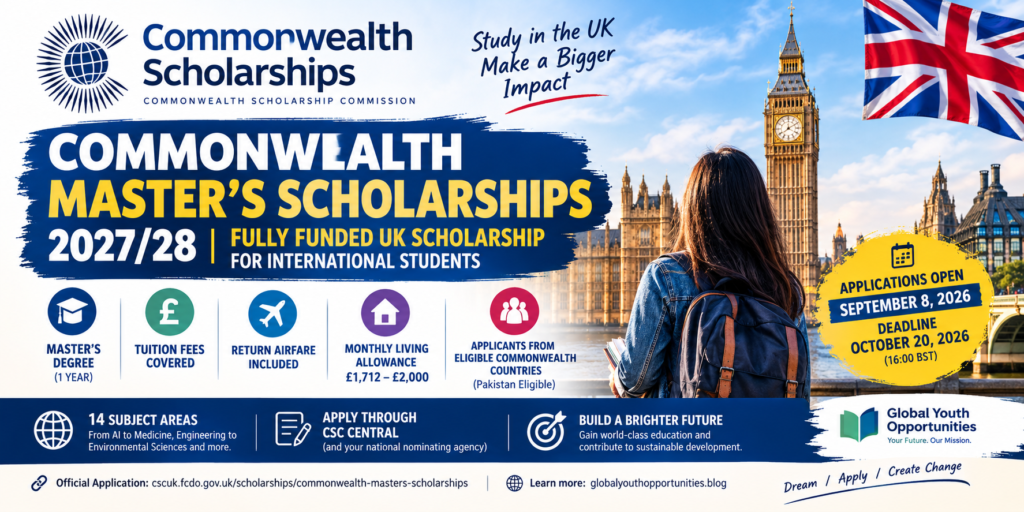
Applications Open: September 8, 2026 | Deadline: October 20, 2026
Are you looking for a fully funded opportunity to pursue a Master’s degree in the UK in 2027?
The Commonwealth Master’s Scholarships 2027/28 are opening applications on September 8, 2026, offering eligible citizens of selected low- and middle-income Commonwealth countries the opportunity to undertake a one-year taught Master’s degree at an approved UK university.
The scholarship is funded by the UK Foreign, Commonwealth & Development Office (FCDO) and is designed for talented candidates who have the potential to contribute to sustainable development in their home countries.
For the 2027/28 academic year, applications must be submitted by 4:00 PM BST on October 20, 2026.
Important: Applicants do not apply directly to the Commonwealth Scholarship Commission alone. They must also apply through an eligible nominating agency or participating nominator, and nominators may have their own earlier deadlines.
Commonwealth Master’s Scholarships 2027/28 at a Glance
| Feature | Details |
|---|---|
| Scholarship | Commonwealth Master’s Scholarships |
| Academic year | 2027/28 |
| Study destination | United Kingdom |
| Degree level | Master’s |
| Study format | Full-time |
| Duration | One-year taught Master’s |
| Applications open | September 8, 2026 |
| CSC deadline | October 20, 2026, 16:00 BST |
| Study begins | September/October 2027 |
| Eligible applicants | Citizens/refugees from eligible Commonwealth countries |
| Pakistan eligible? | Yes |
| Tuition | Covered |
| Airfare | Approved return airfare |
| Living allowance | £1,712/month; £2,000/month in London at current rates |
| IELTS | Not required by the CSC |
| Application fee | None |
What Are Commonwealth Master’s Scholarships?
Commonwealth Master’s Scholarships are UK government-funded scholarships administered by the Commonwealth Scholarship Commission (CSC).
The programme supports talented candidates from eligible Commonwealth countries who could not otherwise afford to study in the UK.
The purpose goes beyond simply funding a degree. The CSC seeks candidates whose education can contribute to development in their home countries, with applications assessed partly on academic merit and potential development impact.
The scholarships support full-time, one-year taught Master’s programmes at approved UK universities.
The programme does not fund MBA degrees under the current Master’s scholarship rules.
When Does the Commonwealth Scholarship 2027 Open?
Applications for the 2027/28 Commonwealth Master’s Scholarships open on Tuesday, September 8, 2026.
The official CSC deadline is:
October 20, 2026 at 16:00 BST
The scholarship is intended for candidates who will begin their studies in the UK in September or October 2027.
However, applicants should not treat October 20 as the only deadline.
The CSC requires applicants to apply through a nominating agency, and individual nominators can establish their own deadlines. These may be earlier than the CSC deadline.
Therefore, applicants should identify their nominator as early as possible.
Who Can Apply for the Commonwealth Master’s Scholarship?
To be considered, applicants generally need to meet the following requirements.
1. Be a citizen of an eligible Commonwealth country
Applicants must be citizens of, or have been granted refugee status by, an eligible Commonwealth country, or be a British Protected Person.
2. Be permanently resident in an eligible Commonwealth country
Applicants must normally be permanently resident in an eligible Commonwealth country.
3. Be available to start study in September 2027
Successful candidates must be available to begin their academic programme in the UK at the start of the 2027 academic year.
4. Hold the required academic qualification
By September 2027, applicants must normally hold:
- A first degree equivalent to at least an upper second-class (2:1) UK honours standard, or
- A lower second-class degree plus a relevant postgraduate qualification, usually a Master’s degree.
The CSC also has provisions for contextual consideration of certain disabled applicants who can demonstrate development potential despite not meeting the normal academic requirement.
5. Demonstrate financial need
Applicants must be unable to afford to study in the UK without the scholarship.
6. Provide the required documentation
All required supporting documents must be submitted in the required format before the application deadline.
Is Pakistan Eligible for the Commonwealth Scholarship?
Yes. Pakistan is currently listed among the countries eligible for the Commonwealth Master’s Scholarships.
Other eligible countries include Bangladesh, India, Ghana, Kenya, Malaysia, Nigeria, Rwanda, South Africa, Sri Lanka, Tanzania, Uganda, Zambia and other participating Commonwealth countries.
However, eligibility for the scholarship does not automatically mean that every applicant from an eligible country will be nominated.
The national nominating agency or other approved nominator conducts its own selection process.
What Does the Commonwealth Master’s Scholarship Cover?
The Commonwealth Master’s Scholarship is considered a fully funded scholarship because the core award covers major costs associated with studying in the UK.
According to the CSC, each scholarship provides:
Full tuition fees
Approved tuition fees are covered through arrangements between the CSC and the UK university.
Successful scholars are not liable for the covered tuition fees.
Return airfare
The scholarship provides approved airfare from the scholar’s home country to the UK and return travel at the end of the award.
The CSC does not normally cover airfare for dependants or journeys undertaken before the award is confirmed.
Monthly living allowance
At the current published rates, scholars receive:
- £1,712 per month, or
- £2,000 per month for scholars studying at universities in the London metropolitan area.
These rates are subject to change.
Study travel grant
A study travel grant may be provided for approved study-related travel within the UK or overseas.
Additional family support
Certain scholars who have children and are widowed, divorced or single parents may qualify for child allowances under the published conditions.
Additional disability-related financial support may also be available following an assessment of needs and eligibility.
Is the Commonwealth Scholarship Really Fully Funded?
Yes, the core Commonwealth Master’s Scholarship is a fully funded award.
The CSC states that the scholarship covers tuition fees, approved fares and personal maintenance.
However, applicants should understand that “fully funded” does not mean that every possible expense for every family situation is automatically covered.
For example, family allowances are described by the CSC as contributions toward family maintenance rather than necessarily covering the full cost of supporting dependants in the UK.
Applicants should therefore carefully review the official conditions before making financial plans.
What Subjects Are Covered?
Commonwealth Master’s Scholarships are linked to the CSC’s development priorities.
The six development themes are:
- Science and technology for development
- Strengthening health systems and capacity
- Promoting global prosperity
- Strengthening global peace, security and governance
- Strengthening resilience and response to crises
- Access, inclusion and opportunity
When choosing a programme, applicants should not only consider whether a degree is academically interesting.
A strong application should demonstrate how the proposed study connects to a genuine development challenge and how the applicant intends to use the knowledge after returning home.
What Master’s Courses Are Eligible?
The Commonwealth Master’s Scholarship supports one-year taught Master’s programmes at approved UK universities.
Applicants should carefully research:
- Course content
- Duration
- Entry requirements
- Tuition fees
- University eligibility
- Development relevance
- Application deadlines
The CSC recommends that applicants identify three preferred university/course choices and explain why those choices are appropriate.
Applicants should also apply separately for admission to their preferred university programmes.
Important
Receiving a Commonwealth Scholarship does not replace the university admission process.
If you are selected but have not taken the necessary steps to obtain admission to a suitable course, your scholarship may not be able to proceed.
How to Apply for Commonwealth Master’s Scholarship 2027
The application process has an important distinction: applicants must deal with both the CSC application system and a nominating agency.
Step 1: Check your eligibility
Confirm that:
- Your country is eligible.
- You meet the academic requirements.
- You can start in September/October 2027.
- You can demonstrate financial need.
- Your proposed degree fits the scholarship requirements.
Step 2: Find your nominating agency
The main route is through national nominating agencies.
There are also selected non-governmental organisations and charitable bodies that can nominate candidates.
Each nominator can have its own:
- Deadline
- Eligibility criteria
- Application process
- Required documents
- Selection procedure
Do not assume that the CSC’s October 20 deadline is your nominator’s deadline.
Step 3: Research UK universities and courses
Identify suitable one-year taught Master’s programmes.
The CSC recommends selecting three preferred university/course combinations.
Consider your choices strategically.
Your preferred programme should connect:
Your academic background → your proposed Master’s → a development problem → your future impact.
Step 4: Prepare your documents
Applicants should prepare:
- Passport or national ID showing relevant identity/citizenship information
- Complete higher-education transcripts
- Certified translations where required
- At least two references
- Academic information
- Employment history
- Publications and prizes, where applicable
- Development Impact statement
- Study plan
- Career plans
- Personal statement
- Voluntary and leadership experience
Step 5: Complete the CSC Central application
Applications to the CSC are submitted through CSC Central.
The CSC does not accept applications or supporting documents submitted outside its official online application system.
The system uses two-factor authentication, so applicants should ensure they have access to the required authentication method.
Step 6: Apply to the nominator
Submitting the CSC application is not enough.
You must also complete the application process required by your relevant nominating agency or participating nominator.
Step 7: Submit early
Do not wait until the final day.
The CSC warns that the application system can become very busy close to the deadline and late applications cannot be accepted.
What Documents Are Required?
The current CSC guidance requires applicants to provide supporting documentation.
Proof of citizenship or status
Applicants need a valid passport or national ID showing relevant information such as:
- Photograph
- Date of birth
- Country of citizenship
Academic transcripts
Applicants must provide full transcripts covering their higher-education qualifications, including current study where applicable.
If documents are not in English, certified translations may be required.
References
At least two references must be uploaded in PDF format.
References must be signed and either:
- On institutional letterhead, or
- From an email clearly showing the referee’s details.
References must be written by the referee in their own words.
What Does the Commonwealth Scholarship Application Ask?
This is one of the most important parts of the application.
The CSC asks applicants to provide much more than basic academic information.
Applicants may need to provide information about:
- Undergraduate and postgraduate qualifications
- Publications and prizes
- Employment history
- Three referees
- Development impact
- Study objectives
- Five-year career plans
- Long-term career plans
- Study plan
- Personal background
- Voluntary activities
- Leadership experience
The Development Impact Statement
The Development Impact statement is particularly important.
Applicants need to explain how their proposed scholarship relates to development issues at:
- Global level
- National level
- Local level
They should also connect their plans to the relevant CSC development theme and wider sector.
Then they must explain:
What will you do after the scholarship?
The application asks candidates to discuss expected outcomes, implementation timeframe, beneficiaries and how impact will be measured.
This means a strong application should not simply say:
“I want to study this Master’s because it will improve my career.”
Instead, the applicant should establish a logical chain:
Problem → Education → Skills → Action → Beneficiaries → Measurable Development Impact
How to Make Your Commonwealth Scholarship Application Stronger
Winning a Commonwealth Scholarship is not simply about having good grades.
The CSC evaluates applications using criteria that include:
Academic and candidate merit
Your academic background should demonstrate that you can successfully undertake the proposed programme.
Quality of the proposed study/research plan
Your proposed study should be coherent, realistic and connected to your goals.
Development impact
This is one of the most important dimensions.
Ask yourself:
- What problem does my country face?
- Why is this problem important?
- Why do I need this particular Master’s degree?
- What skills will I gain?
- How will I apply those skills after returning?
- Who will benefit?
- How will I measure the results?
Leadership and volunteering
The CSC application also asks candidates to describe voluntary activities and opportunities where they demonstrated leadership.
Focus on evidence, not just labels.
Instead of writing:
“I am a great leader.”
Explain:
What did you lead?
Who benefited?
What changed?
What did you learn?
Commonwealth Scholarship for Pakistani Students
Pakistan is one of the countries currently eligible for the Commonwealth Master’s Scholarship.
Pakistani applicants should pay particular attention to the national nominating agency route.
The nominating agency may have its own application process and deadline in addition to the CSC application.
Therefore, Pakistani applicants should:
- Check the official CSC eligibility information.
- Identify the relevant Pakistani nominating agency.
- Check its 2027/28 requirements.
- Prepare documents early.
- Complete the CSC Central application.
- Complete the nominator’s process.
- Keep evidence of submissions and communications.
Do not rely on unofficial Facebook pages or third-party scholarship agents for deadline information.
Does Commonwealth Scholarship Require IELTS?
The CSC states that it does not require candidates to take an IELTS test.
However, this does not necessarily mean that IELTS or another English-language qualification is never required.
Individual UK universities may have their own English-language requirements for admission.
Therefore:
CSC requirement ≠ university admission requirement.
Always check the English-language requirements of your chosen university and course.
Is There an Age Limit?
The current CSC guidance states that there is no age limit for Commonwealth Scholarship applications.
However, applicants should consider any employment-related restrictions, particularly if they need employer approval or leave to undertake study in the UK.
Can You Apply for a Second Master’s Degree?
The CSC states that it has a preference for applicants who have already completed their undergraduate degrees and would not normally fund a second Master’s degree.
Applicants seeking a second Master’s would need to justify why the additional degree is necessary.
Candidates who have already studied at Master’s level at a UK institution or previously received a Commonwealth Master’s Scholarship are not eligible under the published rules.
Do Commonwealth Scholars Have to Return Home?
Yes.
Commonwealth Scholars are expected to return to their home country after completing the scholarship and contribute to development there.
The current conditions require scholars to undertake an obligation to return home before the expiration of their student visa.
This is an important consideration for anyone whose primary goal is permanent migration to the UK.
When Will Commonwealth Scholarship Results Be Announced?
The CSC says that applicants can expect to hear the outcome of their applications by July 2027.
However, applicants should monitor their email carefully, including spam and junk folders.
Remember that nomination by an agency does not guarantee final selection by the CSC.
Commonwealth Master’s Scholarship 2027/28 Timeline
| Date | Event |
|---|---|
| September 8, 2026 | Applications open |
| October 20, 2026 | CSC application deadline — 16:00 BST |
| December 2026 | Nominators submit candidates to CSC |
| September/October 2027 | Scholarship study begins |
| July 2027 | Applicants expected to receive outcome |
Important: Individual nominating agencies may establish earlier deadlines.
Commonwealth Master’s Scholarship vs Other UK Scholarships
| Feature | Commonwealth Master’s | Chevening | GREAT Scholarships |
|---|---|---|---|
| Level | Master’s | Master’s | Usually Master’s |
| Funding | Fully funded | Fully funded | Typically partial tuition support |
| UK study | Yes | Yes | Yes |
| Target countries | Selected Commonwealth countries | Eligible countries worldwide | Selected countries |
| Development focus | Very strong | Leadership-focused | Varies |
| Pakistan | Eligible | Eligible | Selected universities/cycles |
| Main application | CSC + nominator | Chevening | University |
| 2027 timing | Sept–Oct 2026 applications | 2026 cycle | Varies |
Common Mistakes to Avoid
Mistake 1: Applying only through CSC Central
You must also follow the relevant nominator’s process.
Mistake 2: Waiting until October 20
Your nominator may have an earlier deadline.
Mistake 3: Choosing a course without checking eligibility
Not every UK Master’s course is automatically eligible.
Mistake 4: Treating the scholarship as a migration route
The scholarship requires scholars to return home after the award.
Mistake 5: Writing generic development statements
Your development plan needs specific problems, beneficiaries, actions, timelines and measurable outcomes.
Mistake 6: Ignoring university admission deadlines
You should apply to your preferred university courses in advance and check their individual requirements.
Mistake 7: Using unofficial application websites
The CSC specifically advises applicants to use official CSC systems and warns against third parties requesting personal information or supporting documents.
Frequently Asked Questions
When does the Commonwealth Master’s Scholarship 2027 open?
Applications open on September 8, 2026.
What is the deadline?
The CSC deadline is October 20, 2026 at 16:00 BST.
Is Pakistan eligible?
Yes. Pakistan is listed among the eligible countries.
Is the Commonwealth Master’s Scholarship fully funded?
Yes. The scholarship covers approved tuition fees, return airfare and a monthly living allowance, alongside other support specified by the CSC.
Can I apply without IELTS?
The CSC itself does not require IELTS. However, your chosen UK university may have its own English-language requirement.
Can I apply for an MBA?
No. The CSC’s current Commonwealth Master’s Scholarship does not fund MBA degrees.
How long is the scholarship?
The scholarship supports one-year taught Master’s programmes.
Can I apply directly to the CSC?
You apply through CSC Central, but you must also apply to an eligible nominating agency or participating nominator. The CSC does not accept direct applications independently of the nominating process.
When will I know the result?
Applicants can expect to receive the outcome by July 2027, according to the current CSC guidance.
Do I have to return to my country after graduation?
Yes. Commonwealth Scholars are expected to return home after the scholarship.
Final Advice for Applicants
The Commonwealth Master’s Scholarship is highly competitive, so the best approach is to start before submitting the application.
Don’t begin with the application form.
Begin with your development story.
Identify:
1. The problem you want to solve
↓
2. Why it matters in your country
↓
3. The skills you need
↓
4. Why this specific Master’s programme is appropriate
↓
5. What you will do after graduation
↓
6. Who will benefit
↓
7. How you will measure your impact
Then build your application around that logic.
Most importantly, check the official CSC information and your national nominating agency’s instructions before submitting anything.
Official Application Links
Commonwealth Scholarship Commission:
Use the official CSC website for current eligibility, scholarship conditions and programme information.
CSC Central:
Applications are submitted through the official CSC application system.
National Nominating Agencies:
Check the official list to identify the nominating agency for your country.
Study UK:
Use the British Council’s Study UK resources to research UK universities and courses.
Application warning: The Commonwealth Scholarship Commission does not charge an application fee through CSC Central. Be cautious of websites or individuals asking for payment, personal information or documents outside the official application channels.
Official sources to link inside the article
- Commonwealth Master’s Scholarships — Official CSC page
- CSC Central — Official application system
- National Nominating Agencies
- Commonwealth Scholarship Commission — Official website
- Study UK — British Council
Related Scholarship Opportunities
If you are planning to study abroad in 2027, you may also want to explore:
- Chevening Scholarships 2027/28
- Erasmus Mundus Joint Masters 2027
- Open Doors Russian Scholarship 2026/27
- Fully Funded Scholarships in USA 2027
- Fully Funded PhD Programs in USA 2027
- Graduate Assistantships in USA for International Students 2027
Bookmark Global Youth Opportunities and check back regularly for newly opened scholarships, fellowships, internships and international opportunities.