
If you are planning to apply for the Erasmus Mundus Scholarship 2027, one of the first questions you need to answer is:
“Am I eligible?”
Erasmus Mundus Joint Masters (EMJM) are prestigious international master’s programmes delivered by consortia of higher education institutions. Students from around the world can apply, and selected programmes offer competitive scholarships to top-ranked students.
But there is an important point many applicants miss:
There is no single universal GPA, IELTS score, age limit, document checklist or academic profile that applies to every Erasmus Mundus programme.
The basic Erasmus+ eligibility requirement is that applicants must have a bachelor’s degree or be in the final year of their bachelor’s studies and graduate before the master’s begins. Individual master’s programmes then establish their own admission requirements and selection criteria.
This guide explains the Erasmus Mundus Scholarship requirements for 2027, including academic qualifications, GPA, IELTS and English-language requirements, documents, work experience, motivation letters, recommendation letters and scholarship selection.
Quick Erasmus Mundus Scholarship Requirements 2027
| Requirement | General Rule |
|---|---|
| Citizenship | Students worldwide can apply |
| Degree | Bachelor’s degree or equivalent |
| Final-year students | Generally eligible if they graduate before the programme begins |
| Master’s level | Erasmus Mundus Joint Masters |
| GPA | No single universal GPA requirement |
| IELTS | No single universal IELTS requirement |
| Work experience | Programme-specific |
| Age limit | No general universal maximum age stated by Erasmus+ |
| Motivation letter | Frequently required, depending on programme |
| Recommendation letters | Programme-specific |
| CV | Commonly requested |
| Academic transcripts | Commonly required |
| Passport/ID | Often required |
| Scholarship | Competitive; awarded to top-ranked eligible students |
| Application | Directly through the selected master’s programme |
| Deadline | Programme-specific; many applications fall between October and January |
The official Erasmus+ student page confirms that applicants must have a bachelor’s degree, be in their final year of bachelor’s study, or demonstrate an officially recognized equivalent level of learning.
What Is the Erasmus Mundus Scholarship?
The Erasmus Mundus Scholarship is financial support associated with eligible Erasmus Mundus Joint Master programmes.
These programmes are jointly designed and delivered by international university consortia.
An Erasmus Mundus Joint Master normally:
- operates at master’s level;
- involves multiple higher-education institutions;
- includes international mobility;
- lasts 1–2 academic years;
- carries 60, 90 or 120 ECTS credits;
- can lead to a joint or multiple degree.
The official Erasmus+ information says that eligible master’s programmes may offer full scholarships to the best-ranked students worldwide. These scholarships cover participation costs and contribute to travel, visa and living expenses.
Who Is Eligible for Erasmus Mundus Scholarship 2027?
The programme is designed for applicants from around the world.
The basic student requirement is straightforward:
You must either:
1. Already hold a bachelor’s degree, or
2. Be in the final year of your bachelor’s degree and graduate before the master’s programme begins.
Applicants with an equivalent level of learning may also be eligible where that qualification is officially recognized under the applicable national rules and practices.
However, meeting this basic requirement does not automatically mean that you qualify for every Erasmus Mundus programme.
Each master’s programme can have additional academic and professional requirements.
1. Bachelor’s Degree Requirement
A bachelor’s degree is the most important basic academic requirement.
Your bachelor’s degree should satisfy the admission requirements of the specific Erasmus Mundus master’s programme.
For example, a master’s in computer science may require an academic background in:
- Computer Science
- Software Engineering
- Mathematics
- Computer Engineering
- Data Science
while a master’s in public policy may accept degrees in areas such as:
- Political Science
- International Relations
- Economics
- Sociology
- Law
- Public Administration
The key is programme-specific academic fit.
Do not assume that every bachelor’s degree is accepted for every Erasmus Mundus master’s.
2. Can Final-Year Students Apply?
Yes.
The official Erasmus+ requirements specifically allow students who are in the final year of their bachelor’s degree to apply, provided they graduate before the master’s programme begins.
This is particularly useful for students applying during their final undergraduate year.
Example
Suppose applications open in late 2026 and your bachelor’s degree finishes in summer 2027.
If the selected Erasmus Mundus master’s starts later in 2027 and the programme accepts final-year students, you may be eligible.
Always check the specific programme’s admission rules.
3. Is There a Minimum GPA for Erasmus Mundus?
This is one of the most frequently searched questions.
The answer: There is no single universal Erasmus Mundus GPA requirement.
The official Erasmus+ student eligibility page does not establish one universal minimum GPA for every Erasmus Mundus Joint Master. Instead, each master’s website provides its own entry requirements and application process.
Therefore, you should not automatically believe statements such as:
“You need a 3.5 GPA for Erasmus Mundus.”
or:
“You cannot get Erasmus Mundus with a GPA below 3.0.”
Those claims are too general.
What you should do instead
Find your target programme and check:
- Minimum academic grade
- Degree classification
- Required courses
- Academic prerequisites
- Ranking criteria
- Previous academic performance expectations
4. Can Students With a Low GPA Apply?
Potentially, yes.
A lower GPA does not automatically make you ineligible for Erasmus Mundus as a whole.
However, your chances can vary significantly between programmes.
If a particular master’s has a strong academic requirement, applicants with a weaker academic record may face greater competition.
You can strengthen your overall application through:
- Relevant internships
- Research experience
- Publications
- Academic projects
- Professional experience
- Volunteering
- Leadership
- Relevant certifications
- Strong recommendations
- A compelling motivation letter
But don’t use these achievements to ignore an explicit minimum requirement.
If the programme states that applicants must meet a particular academic threshold, you should satisfy it.
5. Is IELTS Required for Erasmus Mundus 2027?
There is no universal IELTS requirement for all Erasmus Mundus programmes.
This is extremely important.
Language requirements are determined by individual master’s programmes.
Depending on the programme, applicants may need to provide evidence of English proficiency or another language.
The official Erasmus+ page directs applicants to the individual master’s websites for detailed admission requirements.
Therefore, don’t publish:
“Erasmus Mundus does not require IELTS.”
Instead, use:
“IELTS and other language requirements vary by Erasmus Mundus programme. Check the official programme website for the accepted forms of language evidence.”
6. Can I Apply Without IELTS?
Possibly, depending on the programme.
Some programmes may accept alternative evidence of language proficiency, while others may require a standardized test.
Possible alternatives, depending on programme rules, can include:
- TOEFL
- Other recognized language tests
- Previous education in an accepted language
- University-issued language evidence
But you should never assume that one alternative is accepted by every programme.
Best strategy
Before paying for an English test:
- Choose your Erasmus Mundus programmes.
- Read their language requirements.
- Determine what evidence they accept.
- Take the required test if necessary.
This can save applicants significant time and money.
7. Is There an Age Limit?
There is no general maximum age requirement stated on the official Erasmus+ student eligibility page.
The core requirement focuses on the applicant’s academic qualification rather than a universal age ceiling.
Nevertheless, individual programmes may establish their own admission rules.
Therefore, applicants should check the programme-specific eligibility criteria rather than relying on generic social-media claims.
8. Is Work Experience Required?
Not for every programme.
Work experience is programme-specific.
Some master’s programmes may value or require professional experience, while others may focus primarily on academic preparation.
Relevant experience can nevertheless strengthen an application.
For example:
Public policy programme
Relevant experience might include:
- Government
- NGOs
- Research
- Policy organizations
- International development
Environmental programme
Relevant experience might include:
- Sustainability
- Climate projects
- Environmental research
- Conservation
- Renewable energy
Technology programme
Relevant experience might include:
- Software development
- Data science
- AI projects
- Research
- Technology internships
The strongest applications generally demonstrate a clear relationship between the applicant’s background and the selected programme.
9. Do I Need Research Experience?
Not necessarily.
Research experience depends on the programme.
For research-oriented master’s programmes, however, research can significantly strengthen your profile.
Relevant evidence could include:
- Bachelor’s thesis
- Research assistantship
- Academic publications
- Conference participation
- Research projects
- Data analysis
- Policy research
- Laboratory work
If you don’t have formal research experience, don’t invent it.
Instead, highlight genuine academic projects and analytical work that demonstrate your potential.
10. Is a Motivation Letter Required?
Many Erasmus Mundus applications require a motivation letter or similar personal statement, although the exact requirements differ by programme.
A strong motivation letter should explain:
Your background
What have you studied or worked on?
Your motivation
Why do you want to pursue this field?
Programme fit
Why this particular Erasmus Mundus programme?
Future goals
How will the degree contribute to your career or impact?
Avoid writing a generic statement that could be sent to any university.
11. Are Recommendation Letters Required?
Recommendation letters are programme-specific.
Some programmes may request academic references, professional references or both.
If recommendations are required, choose referees who can provide meaningful evidence about your:
- Academic ability
- Research potential
- Professional performance
- Leadership
- Communication
- Relevant experience
A generic letter saying that you are “hardworking and sincere” is usually less useful than a detailed recommendation containing specific examples.
12. Is a CV Required?
Many master’s applications request a CV, although the exact format and requirements vary.
Your CV should generally emphasize:
- Education
- Research
- Relevant employment
- Internships
- Publications
- Projects
- Leadership
- Volunteering
- Certifications
- Relevant skills
- International experience
For Erasmus Mundus, relevance matters more than simply making the CV long.
13. What Documents Are Required for Erasmus Mundus?
There is no single universal document checklist for every Erasmus Mundus master’s.
However, applicants may commonly be asked for:
Academic documents
- Bachelor’s degree
- Academic transcripts
- Degree certificates
- Evidence of final-year status, if applicable
Personal documents
- Passport or identity document
- CV
- Photograph, where required
Application documents
- Motivation letter
- Recommendation letters
- Language certificate
- Application form
Additional documents
Depending on the programme:
- Research proposal
- Portfolio
- Writing sample
- Work experience certificates
- Publications
- Proof of specific coursework
- Other supporting documents
Always follow the official checklist for the programme you are applying to.
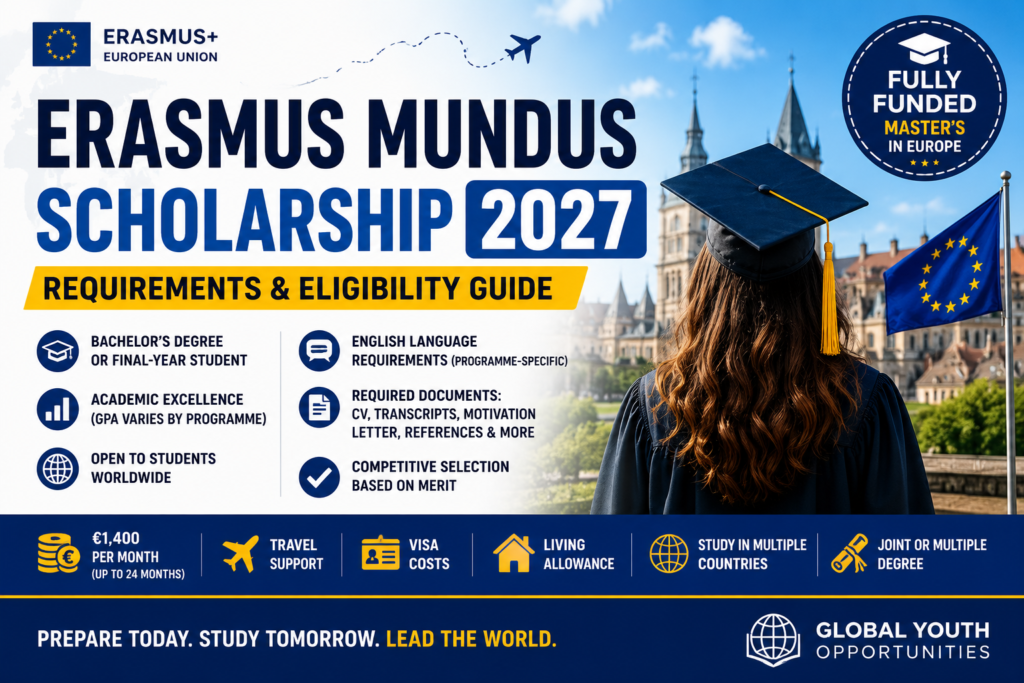
Erasmus Mundus Scholarship 2027 Documents Checklist
Use this checklist when preparing your application:
☐ Bachelor’s degree
☐ Academic transcripts
☐ CV
☐ Motivation letter
☐ Recommendation letters
☐ Passport/ID
☐ Language certificate, if required
☐ Research proposal, if required
☐ Portfolio, if required
☐ Work experience evidence, if required
☐ Additional programme-specific documents
☐ Certified translations, if required
☐ Application confirmation
14. Do Documents Need to Be Translated?
This depends on the programme and institution.
If your academic documents are not in an accepted language, the programme may require official translations.
Possible requirements can include:
- Certified translation
- Official translation
- Original document
- Certified copy
- Legalization or authentication
Don’t translate every document unnecessarily.
First read the programme’s official document requirements.
15. Do I Need a Passport to Apply?
Many international applications request passport information or a copy of an identity document.
However, the exact requirement varies.
If you don’t yet have a passport, check whether the programme allows another identity document during the application stage.
Never upload false or unofficial documents.
16. Does Erasmus Mundus Require an Interview?
Not every programme necessarily uses the same selection process.
Some programmes may include:
- Interviews
- Written assessments
- Additional academic evaluation
- Portfolio reviews
Others may make decisions primarily based on the submitted application.
Check your programme’s selection process carefully.
17. How Competitive Is Erasmus Mundus?
Erasmus Mundus scholarships are competitive.
The official Erasmus+ programme framework describes them as scholarships for the best students worldwide.
This means meeting minimum eligibility requirements is only the first step.
Think of the application in two stages:
Stage 1 — Eligibility
Do you meet the requirements?
Stage 2 — Selection
Are you competitive enough to be selected?
This distinction is crucial.
18. What Makes an Erasmus Mundus Application Strong?
A strong applicant usually demonstrates a coherent combination of:
Academic preparation
Relevant experience
Programme fit
Clear motivation
Future goals
For example:
Bachelor’s degree in environmental science → climate research experience → sustainability project → Erasmus Mundus environmental master’s → career in climate policy.
That story is much stronger than an application that simply says:
“I want to study in Europe because the scholarship is fully funded.”
19. Does Volunteering Help?
Volunteering can strengthen an application when it is relevant and meaningful.
For example, volunteering related to:
- Climate action
- Human rights
- Public health
- Education
- Technology
- Community development
can support your narrative if it relates to the master’s programme.
Don’t add dozens of unrelated volunteer activities simply to fill your CV.
20. Does International Experience Help?
International experience can be useful, especially for programmes built around international collaboration.
Relevant examples may include:
- International conferences
- Exchange programmes
- International research
- Global organizations
- Cross-cultural projects
- International volunteering
But international experience is not automatically required.
A strong domestic academic or professional record can still be valuable.
21. Do I Need Publications?
No universal Erasmus Mundus rule requires publications.
However, publications can strengthen applications for research-oriented programmes.
If you have:
- Journal articles
- Conference papers
- Policy briefs
- Research reports
- Thesis work
include relevant items.
Quality and relevance are more important than quantity.
22. Erasmus Mundus Scholarship Funding
The current Erasmus+ programme information states that the EU scholarship is calculated at €1,400 per month, for the duration of the master’s programme, with master’s programmes lasting 12, 18 or 24 months.
The official student-facing information describes scholarship support as covering participation costs and contributing to:
- Travel
- Visa
- Living allowance.
Scholarship holders also cannot be charged tuition fees or mandatory participation costs by selected projects under the applicable funding rules.
Because programme-specific conditions can apply, applicants should verify the current scholarship terms for their chosen master’s.
23. Is the Erasmus Mundus Scholarship Fully Funded?
Selected Erasmus Mundus Joint Masters can offer full scholarships to the best-ranked students worldwide.
However, applicants should distinguish between:
Admission to an Erasmus Mundus programme
and
Receiving an Erasmus Mundus scholarship.
Being admitted does not necessarily mean that you have been awarded a scholarship.
The scholarship is competitive.
24. Can I Apply to Erasmus Mundus Without a Scholarship?
The official Erasmus+ page indicates that programmes provide application information with and without scholarship.
Therefore, depending on the programme, admission and scholarship selection can be separate considerations.
If you cannot secure the scholarship, you should carefully examine whether you can realistically finance the programme before accepting an offer.
25. How Do I Apply for Erasmus Mundus Scholarship 2027?
There is no single universal application portal for all master’s programmes.
The official Erasmus+ website says students apply directly to the institution running their chosen programme.
General application process
Step 1: Search the Erasmus Mundus catalogue.
Step 2: Choose programmes matching your academic background.
Step 3: Visit each programme’s official website.
Step 4: Read the eligibility criteria.
Step 5: Check scholarship availability.
Step 6: Prepare your documents.
Step 7: Complete the application.
Step 8: Submit before the programme deadline.
Step 9: Monitor your email and application portal.
26. When Is the Erasmus Mundus 2027 Deadline?
There is no single Erasmus Mundus Scholarship 2027 deadline.
The official Erasmus+ student page says that, in most cases, applications are submitted between October and January for courses beginning the following academic year. However, every master’s programme provides its own deadline and application procedure.
Therefore, applicants should not rely on a single website claiming:
“The Erasmus Mundus deadline is January 15.”
That date may apply to one programme but not another.
27. How Early Should You Prepare?
Ideally, start several months before applications open.
Preparation timeline
3–6 months before applications
- Research programmes
- Check eligibility
- Prepare CV
- Identify referees
- Review language requirements
2–4 months before deadline
- Draft motivation letter
- Gather academic documents
- Complete language test if necessary
- Prepare programme-specific materials
1 month before deadline
- Finalize application
- Review every document
- Check formatting
- Verify references
- Confirm deadline and time zone
Final week
- Submit early
- Save confirmation
- Monitor email
Don’t leave an Erasmus Mundus application until the final hours.
28. Erasmus Mundus Requirements for International Students
Erasmus Mundus Joint Masters are open to students from around the world.
This means Global Youth Opportunities should present Erasmus Mundus as a global opportunity, rather than targeting one nationality.
Applicants worldwide should focus on:
- Academic eligibility
- Programme fit
- Language requirements
- Documents
- Scholarship conditions
- Deadline
- Mobility requirements
Country-specific issues such as visa requirements should then be checked separately.
29. Erasmus Mundus Eligibility: The Most Important Rule
Remember this:
There is no single “Erasmus Mundus profile.”
A student may be highly competitive for one programme and not eligible for another.
For example:
Student A
Bachelor’s in Computer Science
→ AI master’s
Strong academic fit
Student B
Bachelor’s in History
→ Engineering master’s
Potential academic mismatch
Even if both students have excellent GPAs.
This is why programme fit is one of the most important concepts applicants should understand.
30. Common Erasmus Mundus Application Mistakes
Avoid these mistakes:
❌ Assuming one GPA applies to every programme
❌ Assuming IELTS is always mandatory
❌ Assuming IELTS is never required
❌ Applying without checking academic prerequisites
❌ Using an outdated programme list
❌ Copying a generic motivation letter
❌ Sending the same application to every programme
❌ Ignoring scholarship-specific instructions
❌ Waiting until the deadline
❌ Uploading incomplete documents
❌ Relying entirely on unofficial scholarship websites
❌ Confusing admission with scholarship selection
Erasmus Mundus Scholarship 2027 Application Checklist
Before clicking Submit, ask yourself:
Eligibility
☐ Do I have a bachelor’s degree or will I graduate before the programme begins?
☐ Does my degree match the programme?
☐ Do I meet any specific academic prerequisites?
Language
☐ Have I checked the programme’s language requirements?
☐ Do I need IELTS, TOEFL or another test?
☐ Does the programme accept an alternative?
Documents
☐ CV
☐ Transcript
☐ Degree certificate
☐ Motivation letter
☐ Recommendation letters
☐ Passport/ID
☐ Language evidence
☐ Additional documents
Scholarship
☐ Is an Erasmus Mundus scholarship available?
☐ Is a separate scholarship application required?
☐ Have I read the funding conditions?
Deadline
☐ Have I checked the exact deadline?
☐ Have I checked the time zone?
☐ Have I submitted before the final day?
Frequently Asked Questions
What are the basic Erasmus Mundus Scholarship requirements?
Applicants generally need a bachelor’s degree or equivalent qualification, or must be in the final year of their bachelor’s degree and graduate before the master’s begins. Individual programmes can impose additional requirements.
What GPA is required for Erasmus Mundus?
There is no single universal GPA requirement for every Erasmus Mundus programme. Check the academic requirements of your chosen master’s.
Is IELTS required for Erasmus Mundus?
There is no universal IELTS requirement. Language requirements vary by programme.
Can final-year students apply?
Yes. Final-year bachelor’s students can generally apply if they graduate before the master’s programme begins.
Is there an age limit?
There is no general maximum age requirement stated in the official Erasmus+ student eligibility criteria. Individual programme rules should still be checked.
Is work experience required?
Not universally. Some programmes may require or prefer relevant professional experience.
Can students from any country apply?
Erasmus Mundus Joint Masters are open to students from around the world, subject to individual programme requirements.
How much is the Erasmus Mundus scholarship?
The current Erasmus+ programme information specifies a scholarship calculation of €1,400 per month for the applicable programme duration, up to 24 months.
How do I apply?
You apply directly to the institution or consortium running your selected Erasmus Mundus master’s.
When should I apply?
Most applications are submitted between October and January for programmes starting the following academic year, but deadlines vary by programme.
Can I apply without IELTS?
Possibly. It depends on the specific programme’s language requirements.
Do I need recommendation letters?
Only if your selected programme requires them. Check its official application checklist.
Do I need research experience?
Not universally. Research experience may strengthen your application, particularly for research-focused programmes.
How to Make Your Erasmus Mundus Application Stronger
Meeting the requirements gets you into the competition.
A compelling application goes further.
Build a clear narrative:
1. Academic foundation
Show that you have the knowledge required for the programme.
2. Relevant experience
Demonstrate how you have applied that knowledge.
3. Programme fit
Explain why this particular Erasmus Mundus master’s makes sense.
4. International perspective
Show that you can contribute to a multicultural academic environment.
5. Future impact
Explain what you plan to do with the degree.
Your application should make the selection committee think:
“This programme is a logical next step for this applicant.”
Final Advice for Erasmus Mundus Scholarship 2027 Applicants
Don’t treat Erasmus Mundus as one giant scholarship with one set of rules.
Think of it as a portfolio of international master’s programmes, each with its own:
- Academic requirements
- Language requirements
- Documents
- Selection process
- Scholarship availability
- Deadline
The official Erasmus+ website specifically advises applicants to use each master’s website for its study structure, participating universities, entry requirements and application process.
Your first job is therefore not to write an application.
Your first job is to find the right programme.
Once you have found the right programme, build an application around your academic background, experience, motivation and future goals.
🔗 Official Erasmus Mundus Resources
Erasmus Mundus Joint Masters — official student information:
Erasmus+ Erasmus Mundus Joint Masters
Erasmus Mundus Programme Guide:
Erasmus+ Programme Guide — Erasmus Mundus
Erasmus Mundus Joint Masters funding information:
Official Erasmus Mundus funding information
Also visit same scholarships: