
The Cambridge ERA:AI Fellowship 2027 is an opportunity for talented researchers, professionals, policy specialists, technical experts and individuals from other disciplines who want to work on some of the most important questions surrounding AI safety, AI governance and the risks associated with increasingly capable artificial intelligence systems.
The fellowship is a 10-week research programme in Cambridge, UK, designed to help talented people develop research projects addressing risks from frontier AI systems. ERA describes the programme as talent-first and says there are no formal eligibility restrictions beyond being 18 or older.
The programme is particularly interesting for applicants who want to build careers at the intersection of:
- Artificial intelligence
- AI safety
- AI governance
- Technology policy
- International security
- Regulation
- Computer science
- Public policy
- Law
- Economics
- Research
- National security
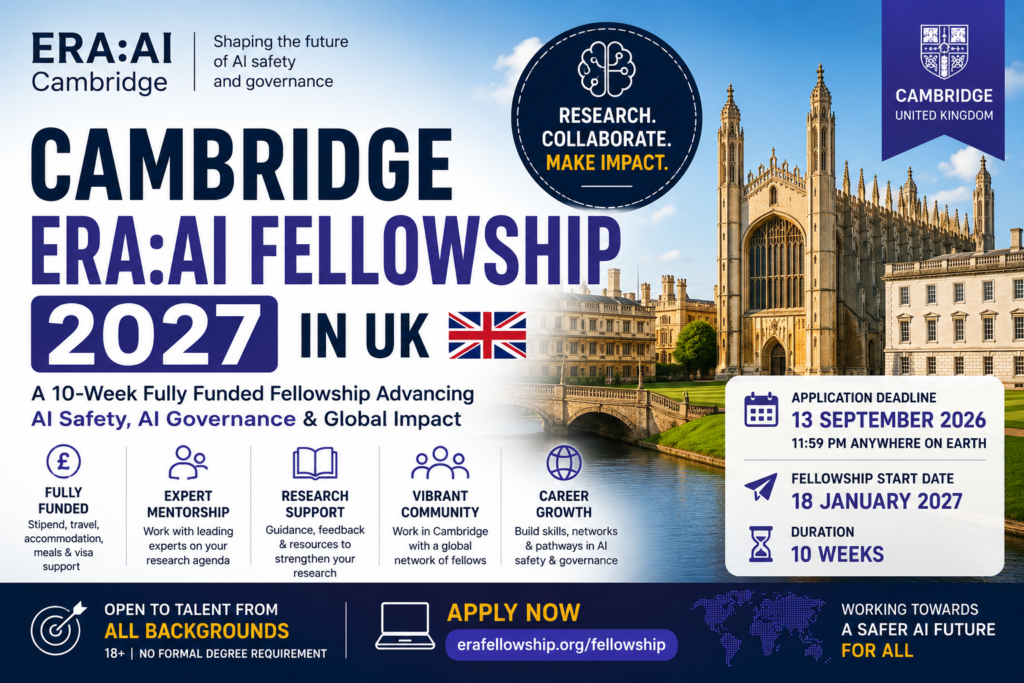
According to the information provided for the Winter 2027 cohort, the fellowship is scheduled to begin on 18 January 2027, with applications closing on 13 September 2026 at 11:59 PM Anywhere on Earth.
Because fellowship dates and funding can change between cohorts, applicants should verify the final details on the official ERA Fellowship application page before submitting.
Official Cambridge ERA:AI Fellowship Website
Cambridge ERA:AI Fellowship 2027 — Quick Overview
| Opportunity | Details |
|---|---|
| Fellowship | Cambridge ERA:AI Fellowship |
| Cohort | Winter 2027 |
| Location | Cambridge, United Kingdom |
| Duration | 10 weeks |
| Start Date | 18 January 2027* |
| Deadline | 13 September 2026, 11:59 PM Anywhere on Earth* |
| Funding | Fully funded* |
| Age Requirement | 18+ |
| Academic Requirement | No formal degree requirement |
| Eligible Backgrounds | Technical, policy, research and interdisciplinary backgrounds |
| Research Areas | AI Safety, AI Governance, Technical AI Governance |
| Application Fee | No application fee |
| Work Format | Primarily in person in Cambridge |
| Application | Online |
| Official Website | ERA Fellowship |
The 2027 dates and funding details should be checked against the live official application page before publication/update.
The official ERA website describes the fellowship as a 10-week, fully funded programme hosted in Cambridge and says applicants can come from a wide range of backgrounds and career stages.
What Is the Cambridge ERA:AI Fellowship?
The Cambridge ERA:AI Fellowship is a research fellowship focused on understanding and mitigating risks associated with advanced or frontier artificial intelligence.
Rather than functioning like a conventional university scholarship, the programme is designed around research, mentorship, community and professional development.
Fellows spend the programme developing a research project related to AI safety or governance.
ERA says fellows receive support from research managers and mentors while working in its Cambridge environment. The organisation has worked with researchers and mentors connected to institutions across AI safety, governance and technology policy.
The programme’s broader mission is to develop talent capable of addressing difficult questions surrounding increasingly powerful AI systems.
Why Is the ERA:AI Fellowship Important?
Artificial intelligence is rapidly becoming a major issue not only for technology companies but also for governments, international organizations, researchers and policymakers.
As AI systems become more capable, questions arise around:
- Safety
- Human oversight
- Accountability
- Regulation
- Security
- International coordination
- Autonomous systems
- AI alignment
- Compute governance
- AI-enabled risks
ERA’s research agenda therefore combines technical and governance approaches.
Its official website describes three major areas:
- Technical AI Safety
- AI Governance
- Technical AI Governance.
This makes the fellowship particularly relevant to applicants who don’t necessarily come from a traditional computer-science background.
Who Can Apply for the Cambridge ERA:AI Fellowship 2027?
One of the most attractive features of the fellowship is its broad eligibility.
ERA states that it is a talent-first programme and has no formal eligibility restrictions beyond being 18 or older.
This means applicants can come from a wide range of educational and professional backgrounds.
Potential applicants may include:
- AI researchers
- Computer scientists
- Machine-learning specialists
- Policy professionals
- Lawyers
- Economists
- Security researchers
- International relations specialists
- Political scientists
- Technology policy researchers
- Entrepreneurs
- Engineers
- Social scientists
- Researchers from other disciplines
The key question isn’t simply:
“Do you have a computer science degree?”
Instead, applicants should ask:
“Can my skills and perspective contribute to important questions about AI safety or governance?”
Is a University Degree Required?
ERA’s official fellowship information says there are no formal eligibility restrictions beyond being 18 or older.
Therefore, the programme should not be presented as requiring a specific bachelor’s, master’s or PhD.
This is especially significant for applicants from non-traditional backgrounds.
For example, someone working in:
- Law
- International security
- Public policy
- Economics
- Governance
- Political science
may have valuable expertise relevant to AI governance even without a computer-science degree.
Is the Fellowship Open to International Applicants?
Yes.
ERA describes its fellowship as welcoming talented individuals from around the world. Its previous fellows have come from multiple countries and backgrounds.
International applicants should, however, pay attention to visa requirements.
ERA says it supports international participants with visa applications and sponsors visas where applicable.
What Does the Cambridge ERA:AI Fellowship Provide?
The fellowship provides a combination of:
💰 Financial Support
ERA describes the programme as fully funded and says fellows receive a paid stipend/salary arrangement.
The current official information describes compensation as equivalent to £34,125 per year, prorated to the fellowship duration.
Because funding arrangements can change by cohort, applicants should confirm the Winter 2027 amount on the live application page.
🏠 Accommodation
ERA says it provides accommodation in Cambridge for fellows during the programme.
✈️ Travel Support
Travel to and from Cambridge is covered according to the official FAQ.
🛂 Visa Support
International fellows can receive visa sponsorship and support with the application process.
🍽️ Meals
Meals are provided during working hours. ERA notes that these meals are vegan and vegetarian in accordance with its organizational policy.
👨🏫 Expert Mentorship
Fellows work with mentors who support their research agenda.
Mentors can come from relevant areas of AI safety, governance and technology policy. ERA notes that mentors are matched with fellows after acceptance.
🧑💻 Research Environment
Fellows work from ERA’s Cambridge workspace alongside other fellows and researchers.
The programme is designed as a collaborative environment rather than a remote online fellowship.
What Will Fellows Work On?
The fellowship focuses on research questions associated with risks from advanced AI systems.
There are three broad research areas.
1. Technical AI Safety
Technical AI safety focuses on understanding AI systems and developing methods to make them safer and more controllable.
Research areas can include:
- AI evaluations
- Interpretability
- Robustness
- Alignment
- Control
- Model monitoring
- Dangerous capability evaluations
- Deceptive behaviour
- Safeguards
- AI-assisted research
ERA’s stated research interests include understanding model internals, designing robust safeguards, monitoring model behaviour and developing methods for controlling increasingly capable AI systems.
2. AI Governance
AI governance examines how governments, institutions and organizations can manage increasingly powerful AI systems.
Potential research areas include:
- International AI cooperation
- AI regulation
- Corporate governance
- Frontier AI safety frameworks
- Regulatory design
- International coordination
- AI policy
- Security
- Governance of autonomous AI agents
This area could be especially relevant to people with backgrounds in:
- International relations
- Public policy
- Law
- Political science
- Economics
- Security studies
3. Technical AI Governance
Technical AI governance sits at the intersection of technology and policy.
The central question is:
How can governance mechanisms actually measure, monitor and verify what advanced AI systems are doing?
ERA identifies research areas including:
- Compute governance
- AI auditing
- Monitoring
- Hardware-enabled verification
- Technical standards
- AI infrastructure
- Privacy-preserving verification
- Risk thresholds
- Frontier AI monitoring
This interdisciplinary area could be particularly valuable for applicants who understand both policy and technology.
Research Topics You Could Explore
Applicants don’t necessarily need to arrive with a fully developed research project.
Potential research directions could include:
AI Governance
- International coordination on frontier AI
- AI regulatory frameworks
- AI governance in developing economies
- AI and national security
- International AI agreements
Technical Governance
- AI auditing
- Compute monitoring
- AI model evaluation
- Technical standards
- Verification mechanisms
AI Safety
- Model interpretability
- AI alignment
- Robustness
- Dangerous capability evaluation
- AI control
Policy
- Frontier AI regulation
- AI governance institutions
- Corporate accountability
- AI safety standards
- Cross-border AI governance
Cambridge ERA:AI Fellowship Selection Process
The application process consists of multiple stages.
Based on the information supplied for the Winter 2027 cohort, the process is expected to include:
Stage 1 — Written Application
Applicants answer short essay questions.
The application reportedly takes approximately two hours to complete.
Stage 2 — First Interview
A subset of applicants is invited to the first interview round.
Stage 3 — Second Interview
Shortlisted candidates may participate in a second interview.
References may also be contacted at this stage.
Stage 4 — Offers
Successful applicants receive offers and then work with ERA to develop their research projects and identify appropriate mentors.
ERA’s official fellowship page describes the same general multi-stage process for its fellowship applications.
Cambridge ERA:AI Fellowship 2027 Application Deadline
According to the Winter 2027 information provided for this article:
📅 Application Deadline
13 September 2026
Time: 11:59 PM Anywhere on Earth
Fellowship Start Date
18 January 2027
Duration
10 weeks
Because the official site currently displays information from an earlier cohort, applicants should confirm these Winter 2027 dates on the official application page before submitting.
How to Apply for Cambridge ERA:AI Fellowship 2027
The application process is online.
Step 1 — Visit the official website
Go to the ERA Fellowship website.
Cambridge ERA:AI Fellowship — Official Website
Step 2 — Review the fellowship
Read the research areas and determine whether your background aligns with the programme.
Step 3 — Prepare your CV
Highlight:
- Research
- Technical skills
- Policy experience
- Publications
- Projects
- Professional experience
- Leadership
- Relevant achievements
Step 4 — Prepare your written responses
The written application is an important part of the selection process.
Step 5 — Provide references
Prepare professional or academic referees who can speak meaningfully about your abilities.
Step 6 — Submit
Complete the online application before the deadline.
What Should Your CV Include?
Your CV should demonstrate evidence of ability, rather than simply listing activities.
A strong CV could include:
Education
Degree and relevant coursework.
Research
Research projects, thesis, publications and working papers.
Professional Experience
Relevant employment and internships.
Technical Skills
Programming, data analysis, AI/ML or other relevant technical abilities.
Policy Experience
Policy research, government, think tanks, NGOs or international organizations.
Leadership
Relevant initiatives and projects.
Publications
Research papers, policy briefs and articles.
How to Write a Strong ERA Fellowship Application
The fellowship is highly focused on research potential and impact.
Instead of writing:
“I am passionate about artificial intelligence.”
demonstrate:
What problem have you worked on?
↓
What have you learned?
↓
What question do you want to investigate?
↓
Why is that question important?
↓
Why is ERA the right environment?
This transforms a generic application into a research-focused application.
How Can a Policy Background Fit an AI Fellowship?
This is one of the most interesting aspects of the ERA:AI Fellowship.
AI governance is not exclusively a computer-science problem.
Advanced AI creates questions involving:
- International relations
- National security
- Public policy
- Law
- Regulation
- Economics
- Human rights
- International cooperation
- Governance
Someone with a strong policy background can therefore contribute valuable perspectives to AI governance research.
What Does a Fellow Produce?
The programme expects fellows to complete meaningful research outputs.
ERA says fellows are expected to:
- Present their research at a Research Symposium
- Produce a written output suited to their project
Possible outputs can include:
- Policy briefs
- Working papers
- Technical reports
- Replication or audit reports
- Code and evaluations
- Research strategy documents
ERA emphasizes rigor, clarity and decision usefulness in these outputs.
Career Benefits of the ERA Fellowship
The fellowship can be valuable for people considering long-term careers in:
AI Safety
Research and technical safety.
AI Governance
Government, policy and regulatory roles.
Technology Policy
Policy research and technology governance.
Research
Academic and independent research.
Think Tanks
AI governance, security and public policy research.
Frontier AI Organizations
Research and policy roles within organizations working on advanced AI.
ERA reports that its alumni have gone on to roles and research involving organizations including the UK AI Security Institute, RAND, Centre for the Governance of AI, Centre for AI Safety and Future of Life Institute.
Why Apply for the Cambridge ERA:AI Fellowship?
There are several compelling reasons.
🌍 International research community
Work alongside people from different backgrounds and countries.
🧠 Interdisciplinary research
Combine technology with policy, governance and other disciplines.
👨🏫 Mentorship
Receive support from experienced researchers.
🏛️ Cambridge environment
Work in Cambridge alongside other fellows and researchers.
💼 Career development
Build skills and connections relevant to AI safety and governance careers.
📚 Research portfolio
Produce a substantial research output during the fellowship.
💰 Financial support
The programme provides funding and covers major participation-related costs according to its current terms.
Is the Cambridge ERA:AI Fellowship Fully Funded?
Yes, ERA describes its fellowship as fully funded.
The official website currently states that support includes compensation, accommodation, meals during working hours, visa support and travel expenses.
However, the exact financial package can vary by cohort, so applicants should check the official Winter 2027 offer before relying on a specific stipend figure.
Is the Fellowship Online?
The fellowship is primarily designed to be in person in Cambridge.
ERA’s FAQ says fellows work in its central Cambridge coworking space and that remote participation is generally not the default, although exceptions may sometimes be considered.
Therefore, applicants should be prepared to spend the fellowship period in Cambridge.
Is AI Experience Required?
Not necessarily.
ERA explicitly welcomes people from a wide range of subject areas and career stages.
What matters is whether you can contribute meaningfully to the fellowship’s research mission.
For example, an applicant could bring expertise in:
- AI
- Law
- Economics
- International security
- Public policy
- Governance
- Political science
- Philosophy
- Computer science
The strongest applicants should be able to demonstrate a credible connection between their expertise and AI safety or governance.
Frequently Asked Questions
What is the Cambridge ERA:AI Fellowship?
It is a 10-week research fellowship in Cambridge focused on technical AI safety, AI governance and technical AI governance.
Who can apply?
ERA says anyone aged 18 or older can apply and that it welcomes talent from diverse academic and professional backgrounds.
Is the fellowship fully funded?
ERA describes the fellowship as fully funded and currently lists compensation, accommodation, meals during working hours, travel and visa support among its provisions.
Do I need a computer science degree?
No universal computer-science degree requirement is stated. ERA uses a talent-first approach and welcomes applicants from different fields.
Is the fellowship open internationally?
Yes. ERA welcomes talented individuals from around the world.
Where is the fellowship held?
The fellowship is held in Cambridge, United Kingdom.
How long is the fellowship?
The ERA:AI Fellowship lasts 10 weeks.
Is the fellowship remote?
Generally no. The programme is designed around in-person participation in Cambridge, although ERA says exceptions may sometimes be possible.
What are the main research areas?
The three major areas are Technical AI Safety, AI Governance and Technical AI Governance.
Do I need previous AI research experience?
Not necessarily. ERA welcomes applicants from diverse backgrounds, although applicants should demonstrate the ability and motivation to contribute to AI safety or governance research.
What documents do I need?
The application may include a CV, written responses and references, with additional supporting materials where relevant.
What is the application deadline?
For the Winter 2027 cohort information supplied for this article, the deadline is 13 September 2026 at 11:59 PM Anywhere on Earth. Verify this on the official application page before applying.
When does the Winter 2027 fellowship start?
The supplied Winter 2027 information gives 18 January 2027 as the start date. Verify the date on the official application page.
Will ERA help with a UK visa?
ERA says it sponsors visas and supports international participants through the visa process.
Final Thoughts
The Cambridge ERA:AI Fellowship 2027 is a particularly interesting opportunity for people who want to work on one of the defining policy and technology challenges of the coming decade.
Importantly, you do not necessarily need to be a computer scientist.
The fellowship’s focus spans technical AI safety, AI governance and technical governance, creating opportunities for people with backgrounds in technology, policy, law, economics, security, international affairs and other disciplines.
For applicants, the biggest question should therefore be:
What can I contribute to solving important problems created by increasingly capable AI systems?
If you can answer that convincingly—and demonstrate the research ability to pursue the question—the ERA:AI Fellowship could be an excellent opportunity to develop your research portfolio, work with experienced mentors and build connections in the AI safety and governance community.
Don’t wait until the deadline to prepare.
Start researching potential topics, updating your CV, identifying referees and thinking seriously about the research questions you would want to explore.
📌 Application Details
Fellowship: Cambridge ERA:AI Fellowship 2027
Location: Cambridge, UK
Duration: 10 weeks
Start: 18 January 2027
Deadline: 13 September 2026
Age: 18+
Funding: Fully funded
Field: AI Safety, AI Governance & Technical AI Governance
Applicants: International applicants welcome
*Verify Winter 2027 dates and funding details on the official ERA application page before submission.
Also visit these links to avail more opportunities: