
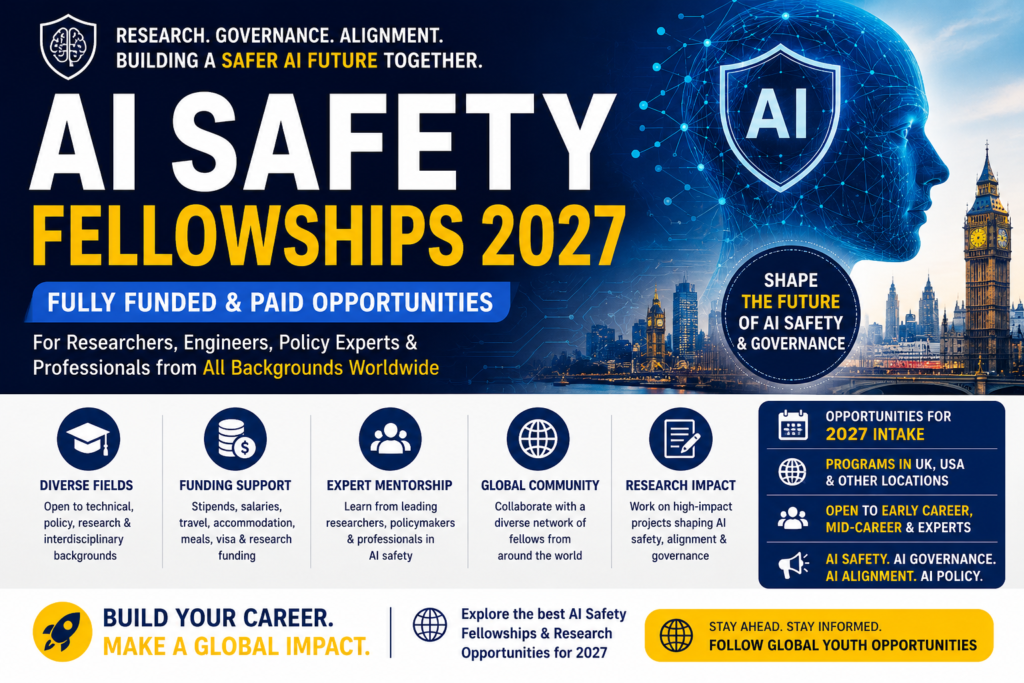
Artificial intelligence is developing rapidly, creating new opportunities for researchers, engineers, policymakers and professionals—but also raising difficult questions about AI safety, alignment, governance, security and responsible development.
For people who want to build a career in this emerging field, an AI safety fellowship can be one of the most effective ways to gain research experience, mentorship, technical skills and professional connections.
In this guide, Global Youth Opportunities brings together some of the most important AI safety and AI governance fellowship programmes to watch for 2027, including opportunities connected with organizations such as ERA, GovAI, MATS, Anthropic and OpenAI.
Some programmes are highly technical, while others welcome applicants from policy, law, economics, international relations, cybersecurity, social science and other backgrounds.
Important: AI fellowship programmes frequently operate in cohorts. Some 2027 opportunities have already closed, while others have not yet opened their next application cycle. We distinguish between confirmed 2027 programmes and programmes you should monitor for the next cohort rather than presenting every programme as currently open.
AI Safety Fellowships 2027 — Quick Overview
| Fellowship / Programme | Main Focus | Location | Funding | 2027 Status |
|---|---|---|---|---|
| GovAI UK Winter Fellowship | AI governance & policy | London, UK | £12,000 + travel support | 2027 cohort announced; applications closed |
| GovAI DC Winter Fellowship | US AI governance | Washington, DC | $21,000 + travel support | 2027 cohort announced; applications closed |
| Cambridge ERA:AI Fellowship | AI safety & governance | Cambridge, UK | Paid + accommodation, meals, travel & visa support | Monitor next cohort |
| MATS Program | AI alignment, safety & governance | Berkeley/London | Stipend, compute, housing & meals | Monitor 2027 cycle |
| Anthropic Fellows Program | Technical AI safety | Varies | Paid + research support | Monitor future cohort |
| OpenAI Safety Fellowship | AI safety & alignment | Berkeley/remote | Monthly stipend + compute | 2026–27 pilot announced |
| SPAR | AI safety & policy research | Remote | Programme-dependent | Monitor next cohort |
| AISI / AI safety programmes | AI safety research & skills | UK | Programme-dependent | Monitor announcements |
The details above are based on currently available official programme information and should be rechecked before publication or application because fellowship dates, funding and eligibility can change. For example, GovAI has already published its 2027 UK and DC fellowship details, while its current opportunities page says applications for those cohorts are closed.
What Is an AI Safety Fellowship?
An AI safety fellowship is a research, training or professional development programme designed to help people understand and address risks associated with increasingly capable artificial intelligence systems.
AI safety can include areas such as:
- AI alignment
- AI evaluations
- Interpretability
- Robustness
- AI control
- Dangerous capability testing
- AI security
- Scalable oversight
- Responsible AI
- AI governance
- Technical AI governance
- Model monitoring
- AI policy
- Frontier AI risk
The field is interdisciplinary.
A person does not necessarily need to be a machine-learning engineer to contribute.
For example, AI governance requires expertise in:
- Public policy
- International relations
- Law
- Economics
- Political science
- Cybersecurity
- National security
- Technology policy
- International cooperation
This makes AI fellowships particularly interesting for people who want to combine technology with policy and governance.
Why Apply for an AI Safety Fellowship in 2027?
AI safety is becoming an increasingly important area of research and public policy.
Governments, technology companies, universities and research organizations are investing in questions surrounding advanced AI systems.
A fellowship can help you:
🧠 Build research skills
Learn how to formulate research questions, conduct experiments and communicate findings.
👨🏫 Work with mentors
Receive guidance from experienced researchers and policy professionals.
💻 Develop technical skills
Depending on the programme, you may work with machine-learning models, evaluations, datasets, computational tools or AI governance frameworks.
🌍 Build an international network
Connect with researchers and professionals working across AI safety and governance.
📚 Produce research
Some fellowships expect fellows to produce papers, reports, benchmarks, policy briefs or other research outputs.
💼 Develop a career pathway
Fellowship experience can help candidates transition into AI safety research, AI governance, policy, academia, think tanks or related roles.
1. GovAI UK Winter Fellowship 2027
The Governance of AI (GovAI) UK Winter Fellowship is one of the most relevant programmes for people interested in AI governance and policy.
The 2027 cohort runs from 18 January to 9 April 2027 in London.
GovAI offers two tracks:
- Research Track
- Applied Track
The Research Track is aimed at people interested in AI governance research and policy analysis.
The Applied Track is broader and can suit people working in areas such as:
- Communications
- Policy engagement
- Events
- Operations
- Programme management
- Research management
- Fundraising
- Advocacy
GovAI says there are no strict degree requirements and welcomes candidates from diverse professional backgrounds.
Funding
The UK Winter Fellowship provides:
- £12,000 salary
- Travel support
- Weekday lunches
- Office space in London
- Three-month programme
- Visa sponsorship for eligible successful applicants
The programme is full-time and in person.
2027 status
Applications for the Winter 2027 UK fellowship are currently closed, according to GovAI’s opportunities page.
What to do: Monitor GovAI for the next fellowship cycle.
2. GovAI DC Winter Fellowship 2027
The GovAI DC Winter Fellowship focuses specifically on American AI governance and policy.
The 2027 programme runs from:
18 January – 9 April 2027
in Washington, DC.
The programme is designed for people interested in:
- US AI policy
- AI regulation
- Public policy
- Technology governance
- National security
- Policy research
- Government affairs
Participants conduct a research project with expert guidance while developing their understanding of the AI policy landscape.
Funding
Fellows receive:
$21,000 stipend
plus travel support.
GovAI also provides:
- Weekday lunches
- Office space
- Research mentorship
- Professional networking
However, this programme has an important restriction:
Applicants must already have the right to work in the United States. GovAI does not sponsor visas for the DC fellowship.
2027 status
The DC Winter Fellowship 2027 application round is currently closed.
3. Cambridge ERA:AI Fellowship
The Cambridge ERA:AI Fellowship is another major opportunity to monitor for future cohorts.
ERA describes its fellowship as a 10-week research programme in Cambridge, UK focused on technical AI safety and governance.
The programme is particularly interesting because it uses a broad, talent-first approach.
ERA states that formal credentials are less important than the ability to:
- Think critically
- Learn quickly
- Solve difficult problems
- Contribute meaningfully to AI safety and governance
Its official FAQ emphasizes that the way applicants approach complex problems can matter more than formal credentials.
Research areas
Potential research areas include:
- AI evaluations
- Interpretability
- Robustness
- Alignment
- AI control
- AI governance
- Compute governance
- AI auditing
- Monitoring
- Technical standards
Funding
ERA currently lists:
- Salary equivalent to £34,125 annually, prorated
- Accommodation
- Meals during working hours
- Visa support
- Travel expense coverage
- Research management support
- Mentorship
Who should consider ERA?
The programme can be particularly interesting for people coming from:
- Computer science
- AI research
- Engineering
- International relations
- Public policy
- Economics
- Law
- Security
- Technology governance
2027 status: Monitor the official website for the next application cycle.
4. MATS Program
The MATS Program—ML Alignment & Theory Scholars—is another major name in AI safety research.
MATS supports emerging researchers and field-builders working on:
- AI alignment
- Interpretability
- AI governance
- AI security
- Technical AI safety
The programme describes itself as a 10–12 week research fellowship connecting fellows with mentors from organizations and research groups in the AI safety ecosystem.
What does MATS provide?
Its current programme information lists:
- $12,500 stipend
- $20,000 compute
- Free housing
- Food
- Travel support
- J-1 visa support where needed
- Research management
- Mentorship
MATS says its mentors include researchers connected with organizations such as Anthropic, OpenAI, Google DeepMind, Redwood Research and others.
Who is MATS for?
MATS is particularly suitable for applicants interested in technical or research-oriented AI safety.
Strong candidates may have experience in:
- Machine learning
- Mathematics
- Computer science
- Physics
- Engineering
- AI research
- Quantitative disciplines
The current Autumn 2026 application cycle is closed, so prospective 2027 applicants should monitor the programme’s official application page.
5. Anthropic Fellows Program
The Anthropic Fellows Program supports researchers and engineers conducting research related to AI safety.
Anthropic’s previous fellowship cohorts have focused on areas including:
- Scalable oversight
- Adversarial robustness
- AI control
- Model organisms
- Mechanistic interpretability
- AI security
- Model welfare
- Dangerous capability evaluations
Anthropic says previous fellows have produced research outputs including papers and that the programme has helped some fellows transition into AI safety roles.
Funding
The most recently published programme information listed:
- Weekly stipend
- Compute funding
- Mentorship
- Four-month research programme
Anthropic’s 2026 programme information listed a $3,850 weekly stipend and approximately $15,000/month in compute.
These figures should not automatically be treated as 2027 funding. Applicants should check the latest cohort announcement.
Important eligibility point
You don’t necessarily need a PhD or previous AI safety publication record.
Anthropic says it has accepted fellows from fields including:
- Physics
- Mathematics
- Computer science
- Cybersecurity
- Other quantitative backgrounds
and emphasizes research ability and execution.
6. OpenAI Safety Fellowship
The OpenAI Safety Fellowship is a newer programme focused on independent research into AI safety and alignment.
OpenAI announced its pilot fellowship in April 2026.
The first programme runs from:
14 September 2026 – 5 February 2027
and is intended for external:
- Researchers
- Engineers
- Practitioners
working on safety and alignment research.
Research areas
OpenAI highlighted areas including:
- Safety evaluation
- AI ethics
- Robustness
- Scalable mitigations
- Privacy-preserving safety methods
- Agentic oversight
- High-severity misuse domains
The programme also supports research outputs such as:
- Papers
- Benchmarks
- Datasets
Fellows receive a monthly stipend, compute support and mentorship.
Important
The announced pilot is a 2026–27 programme, not a confirmed separate 2027 intake.
Therefore, anyone searching for OpenAI Safety Fellowship 2027 should monitor official OpenAI announcements rather than assuming applications are currently open.
OpenAI Safety Fellowship — Official Announcement
7. SPAR Research Program for AI Risks
SPAR is a different type of AI safety research opportunity.
It is a part-time, remote research programme that pairs aspiring AI safety and policy researchers with experienced mentors.
SPAR says participants can commit approximately 5–40 hours per week, depending on their availability.
The programme lasts around three months and culminates in a research presentation or demonstration.
This makes SPAR particularly interesting for people who:
- Cannot relocate internationally
- Are studying
- Have another job
- Want to transition into AI safety
- Want supervised research experience
Who Can Apply for AI Safety Fellowships?
There is no single eligibility standard across all AI fellowships.
Requirements vary significantly.
Technical programmes
May prefer:
- Programming ability
- Machine-learning knowledge
- Mathematics
- Research experience
- Quantitative skills
AI governance programmes
May welcome:
- Public policy professionals
- Political scientists
- Economists
- Lawyers
- International relations specialists
- Government professionals
- Security experts
Applied fellowships
May value:
- Communications
- Project management
- Operations
- Advocacy
- Research management
- Policy engagement
This diversity is one of the most important things prospective applicants should understand.
AI safety is not one career. It is an ecosystem of technical and non-technical fields.
Do I Need a Computer Science Degree?
Not necessarily.
Several major programmes explicitly take a broader approach.
GovAI states that it has no strict degree requirements for its seasonal fellowships.
ERA similarly emphasizes talent and problem-solving ability over formal credentials.
However, technical AI safety programmes may still require substantial technical ability.
For example, an applicant targeting:
Mechanistic interpretability
will likely need a different skill set from someone targeting:
International AI governance
Therefore, choose your fellowship according to your actual strengths.
AI Safety vs AI Governance: What’s the Difference?
This is an important distinction for applicants.
AI Safety
Generally focuses more on making advanced AI systems:
- Robust
- Reliable
- Aligned
- Controllable
- Interpretable
- Resistant to dangerous behavior
AI Governance
Focuses more on:
- Regulation
- Institutions
- Policy
- International cooperation
- Accountability
- Standards
- Corporate governance
- Government decision-making
Technical AI Governance
Combines both.
It may examine:
- Compute governance
- AI auditing
- Technical verification
- Monitoring
- Standards
- Model evaluations
If your background is International Relations, Public Policy, Law or Political Science, AI governance may be a particularly natural entry point.
How to Prepare for an AI Safety Fellowship
Don’t wait until applications open.
Step 1: Learn the fundamentals
Understand:
- Machine learning
- Large language models
- AI alignment
- AI evaluations
- AI governance
- AI risk
- AI regulation
Step 2: Choose a specialization
For example:
Technical
→ Alignment
→ Interpretability
→ Robustness
Policy
→ AI governance
→ International cooperation
→ Regulation
Security
→ AI security
→ Cybersecurity
→ Dangerous capabilities
Step 3: Build a research portfolio
You don’t necessarily need publications.
Start with:
- Research essays
- Policy briefs
- Literature reviews
- Small AI experiments
- Replication studies
- Data analysis
- Governance analysis
Step 4: Publish your work
Create a portfolio containing your strongest work.
Step 5: Network
Attend:
- AI safety seminars
- AI governance events
- Research workshops
- Conferences
- Online communities
Step 6: Apply strategically
Don’t apply to every AI fellowship.
Choose programmes where your background genuinely fits.
What Should You Put in Your CV?
Your CV should emphasize evidence of your ability to solve difficult problems.
Include:
Education
Degrees and relevant coursework.
Research
Research papers, thesis work and independent projects.
Technical skills
Python, statistics, machine learning or data analysis where applicable.
Policy experience
Policy analysis, governance, regulation or international affairs.
Publications
Academic papers, articles and policy briefs.
Projects
AI-related projects and independent research.
Leadership
Relevant initiatives and organizations.
How to Write Your AI Fellowship Motivation Statement
Avoid generic statements such as:
“AI is the future and I want to make a difference.”
Instead, demonstrate:
Problem → Evidence → Research Question → Why It Matters → Your Contribution
For example:
“My research interest lies in how governments can develop credible mechanisms for monitoring increasingly capable AI systems while maintaining international cooperation. My background in public policy has led me to examine the institutional challenges of regulating technologies whose capabilities evolve faster than conventional policymaking cycles.”
That is much more compelling because it communicates a specific research direction.
Frequently Asked Questions
What are the best AI Safety Fellowships for 2027?
Important programmes to monitor include ERA, MATS, Anthropic Fellows, GovAI and OpenAI’s safety fellowship, although their application cycles and eligibility differ.
Are AI safety fellowships fully funded?
Some are fully funded or provide substantial financial support, while others provide stipends or programme-specific funding. Always check the current cohort’s official terms.
Can international students apply?
Many programmes welcome international applicants, but visa and work authorization rules vary.
For example, GovAI’s UK fellowship can sponsor eligible temporary work visas, while its DC Winter Fellowship requires applicants to already have US work authorization.
Do I need a PhD?
No universal PhD requirement exists.
Some programmes explicitly welcome early-career researchers and people from adjacent fields.
Can someone from International Relations work in AI safety?
Yes—particularly in AI governance, international AI cooperation, AI policy, regulation and technology diplomacy.
Are there remote AI safety fellowships?
Yes. SPAR, for example, describes itself as a part-time remote research programme.
What is AI alignment?
AI alignment broadly concerns developing AI systems whose behavior remains consistent with intended goals, values or constraints.
What is AI governance?
AI governance concerns the policies, institutions, regulations and mechanisms used to manage the development and deployment of AI.
When should I start preparing?
Now.
Many competitive fellowships have multiple stages and may require research samples, references, written applications and interviews.
Final Advice for Future AI Safety Researchers
The AI safety field is still developing rapidly.
That means applicants don’t necessarily need to have spent ten years working in AI.
What matters is demonstrating:
Curiosity + analytical ability + technical/policy skills + research potential + strong judgment.
If you’re coming from a non-technical discipline, don’t try to pretend you’re an ML engineer.
Instead, identify the contribution your discipline can make.
A political scientist might study international AI governance.
A lawyer might investigate regulatory frameworks.
An economist might study AI incentives.
A cybersecurity specialist might study AI-enabled threats.
A computer scientist might investigate model robustness.
An international relations researcher might explore global coordination on frontier AI governance.
That interdisciplinary approach is one of the biggest opportunities in the emerging AI governance ecosystem.
📌 AI Safety Fellowships 2027 — Key Takeaway
If you’re searching for:
AI safety fellowships 2027
AI governance fellowships 2027
AI alignment fellowships
AI research fellowships
fully funded AI fellowships
or
AI fellowships for international applicants
start with the programmes discussed above—but always verify the current cohort, deadline, funding and eligibility on the official website before applying.
Best programmes to monitor
- Cambridge ERA:AI Fellowship
- GovAI UK Fellowship
- GovAI DC Fellowship
- MATS Program
- Anthropic Fellows Program
- OpenAI Safety Fellowship
- SPAR Research Program
- Other university, government and independent AI safety programmes
Also visit these opportunities: