
Australia Awards Scholarships 2027 are among the most prestigious international scholarships offered by the Australian Government. The programme provides selected candidates from participating developing countries with the opportunity to undertake full-time undergraduate or postgraduate study at participating Australian institutions.
For the 2027 intake, applications opened on 1 February 2026, with country-specific deadlines. The general round closed on 30 April 2026, although some participating countries have different opening and closing dates.
If you missed the 2027 deadline, this guide is still valuable: it explains the programme, eligibility, benefits, application strategy and how to prepare early for the next round.
Important: Australia Awards is not a scholarship open to every country. Eligibility depends on whether your country is included in Australia’s participating-country list and on the specific requirements for that country. (DFAT)
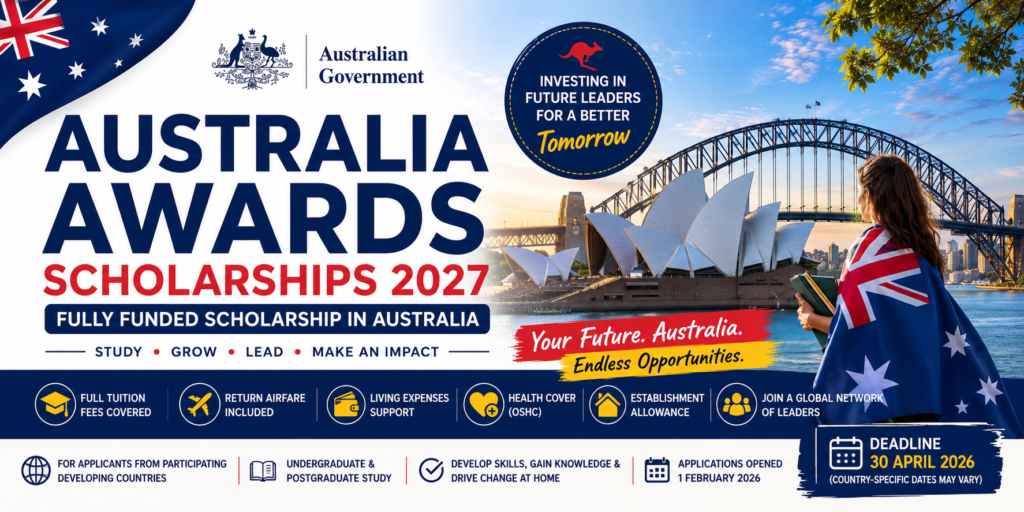
Australia Awards Scholarships 2027 — Quick Overview
| Feature | Details |
|---|---|
| Scholarship | Australia Awards Scholarships (AAS) |
| Host country | Australia 🇦🇺 |
| Provider | Australian Government / Department of Foreign Affairs and Trade (DFAT) |
| Study level | Undergraduate and postgraduate, depending on country/programme |
| Study mode | Full-time |
| Host institutions | Participating Australian institutions |
| Tuition fees | Covered |
| Airfare | Return travel provided |
| Living support | Contribution toward living expenses |
| Health cover | Overseas Student Health Cover (OSHC) |
| Establishment allowance | Provided |
| Application fee | No application fee for the scholarship application |
| 2027 general deadline | 30 April 2026, 14:00 AEST |
| Next step for future applicants | Monitor the official country-specific opening dates |
The scholarship benefits listed above are based on the Australian Government’s information for the 2027 intake. (Study Australia)
What Are Australia Awards Scholarships?
Australia Awards Scholarships are long-term scholarships administered by Australia’s Department of Foreign Affairs and Trade (DFAT).
The programme is designed to contribute to the development needs of Australia’s partner countries and supports people who can use their education, leadership and professional experience to contribute to development after returning home. (DFAT)
Unlike scholarships that focus primarily on academic achievement, Australia Awards places considerable emphasis on leadership, development impact and the candidate’s potential contribution to their country.
This makes the scholarship particularly interesting for applicants who can demonstrate more than good grades.
For example, a strong candidate may have:
- Academic achievements
- Professional experience
- Community involvement
- Leadership experience
- Development-related work
- Policy or research experience
- A clear career plan
- Evidence of positive impact
Why Australia Awards Scholarships Are Highly Competitive
Australia Awards Scholarships are government-funded and provide substantial financial support.
The programme is designed to help talented people from participating developing countries gain knowledge and skills that can contribute to development when they return home. (Study Australia)
That means applicants should avoid approaching the scholarship as simply:
“I want to study in Australia for free.”
A stronger approach is:
“I have a clear development problem I want to work on, I am building the skills to address it, and this scholarship will help me create greater impact.”
That distinction can significantly improve the quality of an application.
What Does the Australia Awards Scholarship Cover?
One of the biggest attractions of Australia Awards is the breadth of financial support.
The official Study Australia information for the 2027 intake lists several major benefits.
1. Full Tuition Fees
Successful scholars receive coverage of their tuition fees at participating Australian institutions.
This removes one of the biggest financial barriers associated with studying internationally.
2. Return Air Travel
The scholarship provides return airfare.
This generally covers travel between the scholar’s home country and Australia according to the programme’s applicable arrangements.
3. Establishment Allowance
An establishment allowance is provided as a contribution toward initial expenses.
The official information describes this as supporting costs such as:
- Accommodation
- Textbooks
- Study materials
4. Overseas Student Health Cover
Australia Awards scholars receive Overseas Student Health Cover (OSHC).
This helps cover eligible healthcare expenses during the scholarship period.
5. Contribution to Living Expenses
The scholarship provides a contribution toward basic living expenses.
The amount is determined by the Australian Government and is paid according to the applicable scholarship arrangements. (Study Australia)
6. Additional Support
Depending on individual circumstances and programme requirements, scholars may receive additional support services.
These can include:
- Academic support
- Language support
- Other programme-related assistance
The exact support available can vary.
What Makes Australia Awards Different?
Australia Awards isn’t simply about paying for a degree.
The programme has a broader development objective.
The Australian Government describes the scholarships as supporting people who can develop skills, knowledge and leadership and then contribute to development in their own countries. (Study Australia)
This means your application should connect:
Your education
↓
Your professional experience
↓
A development challenge
↓
Your proposed solution
↓
Your future impact
That is one of the most important concepts to understand before applying.
Who Can Apply for Australia Awards Scholarships?
Australia Awards is designed for applicants from participating developing countries.
However, there isn’t one universal eligibility checklist that applies identically to every applicant.
Requirements can differ according to:
- Country
- Academic level
- Field of study
- Development priorities
- Professional experience
- English-language requirements
- Previous study
- Employment
- Other country-specific conditions
The Australian Government therefore directs applicants to their country’s specific Australia Awards information. (DFAT)
Is Australia Awards Open to All Countries?
No.
This is an important distinction.
Australia Awards Scholarships are available to applicants from selected participating developing countries rather than every country worldwide. (Study Australia)
So before spending time preparing your application, first ask:
Is my country participating in the Australia Awards Scholarships programme for this intake?
Then check the country-specific eligibility requirements.
What About Pakistan?
Pakistan has been included in the Australia Awards country programme.
For the 2027 intake, the official DFAT schedule listed Pakistan’s application period as:
1 February 2026, 09:00 AEDT → 30 April 2026, 14:00 AEST. (DFAT)
However, Global Youth Opportunities is not a Pakistan-specific platform.
The Australia Awards article should therefore be useful to readers globally, with Pakistan presented only as one example of a participating country.
Applicants from other eligible countries must check their own country page because deadlines, priority areas and requirements can differ.
What Level of Study Does Australia Awards Support?
The programme can support full-time undergraduate or postgraduate study, depending on the relevant country programme and available awards. (Study Australia)
This is important because you should not assume that every country offers the same degree level.
Before applying, check the specific country profile and current scholarship information.
Which Fields of Study Are Eligible?
There is no single universal list of subjects that applies identically to every participating country.
Australia Awards is strongly linked to the development priorities of participating countries.
Potential fields can include areas such as:
- Public policy
- Governance
- Education
- Health
- Agriculture
- Climate change
- Environmental management
- Gender
- Economic development
- Infrastructure
- Digital transformation
- Water and sanitation
- Social development
However, do not assume your preferred field is automatically eligible.
Your country’s programme may prioritize particular sectors.
The Most Important Part: Development Impact
Here’s where many applicants can improve their strategy.
Don’t simply explain:
“I want to study a Master’s degree.”
Explain:
“What problem will this degree help me solve?”
For example:
Weak
I want to study environmental management because I am passionate about the environment.
Stronger
My professional and academic experience has exposed me to challenges surrounding climate resilience and environmental governance. Advanced training in environmental management would strengthen my ability to develop evidence-based policies and programmes that address these challenges in my community.
The second answer establishes a clear relationship between:
Experience → Study → Development → Impact
What Kind of Candidate Should Consider Applying?
Australia Awards may be particularly attractive if you have:
Strong academic preparation
You have demonstrated that you can succeed academically.
Leadership experience
You’ve led:
- Projects
- Teams
- Organizations
- Community initiatives
- Professional activities
Development experience
You’ve worked on issues affecting communities or development outcomes.
A clear career direction
You know where you want to go professionally.
A realistic impact plan
You can explain how your education will contribute to development after your studies.
Why Leadership Matters
The Australian Government specifically highlights leadership qualities and a drive for change as characteristics associated with Australia Awards applicants. (Study Australia)
But leadership doesn’t necessarily mean:
“I was the president of an organization.”
Leadership can also mean:
- Starting a community initiative
- Leading a research project
- Coordinating volunteers
- Creating a youth programme
- Managing a development project
- Advocating for a policy issue
- Mentoring others
- Solving a local problem
The key is to demonstrate what you did and what changed because of your actions.
Don’t Confuse Leadership With Position Titles
Consider these two statements:
Statement A
President of Student Organization.
Statement B
Led a 15-member student team to organize a policy dialogue bringing together students, researchers and civil society representatives to discuss climate governance.
Statement B provides evidence.
When preparing your Australia Awards application, think in terms of:
Action + Scale + Outcome
Your Application Should Tell One Consistent Story
Your academic background, work experience, proposed degree and career goals should connect.
For example:
Bachelor’s in International Relations
↓
Experience in climate policy
↓
Master’s in Public Policy
↓
Work on climate governance
↓
Return home and contribute to policy development
That’s a coherent story.
But if your application says:
“I want to study artificial intelligence.”
and your entire background is unrelated and you cannot explain why AI is relevant to your development goals, the story may be less convincing.
Australia Awards 2027 Application Status
There is an important date issue readers need to understand.
The 2027 Australia Awards application round opened on 1 February 2026. The general deadline was 30 April 2026 at 14:00 AEST, although individual participating countries may have different dates. (Study Australia)
Therefore, as of the current publication/update period, applicants should not assume that the 2027 round is still accepting applications.
Instead:
If you already applied
Monitor your email and the official Australia Awards country programme for updates.
If you missed the deadline
Use the next cycle to prepare early.
If your country has a different deadline
Check the official DFAT country-specific schedule.
What Should You Do If You Missed Australia Awards 2027?
Don’t give up.
A missed deadline doesn’t mean the end of your scholarship journey.
Use the next several months to strengthen:
- Academic profile
- English proficiency
- Professional experience
- Leadership evidence
- Community involvement
- Research experience
- Development impact
- Personal statements
- References
This can make your next application substantially stronger.
Start Preparing Before Applications Open
One of the biggest mistakes applicants make is starting preparation after the application opens.
Instead:
6–12 months before
Identify your target degree.
4–6 months before
Build your CV and leadership portfolio.
3–4 months before
Research development priorities.
2–3 months before
Prepare your essays and supporting evidence.
Before opening
Have your core documents ready.
Then when the application portal opens, you’re refining—not starting from zero.
What We Will Cover in Part 2
In Part 2, we’ll go deeper into the most important part of the Australia Awards application:
Australia Awards Scholarships 2027 Eligibility
We’ll cover:
- Academic requirements
- Country-specific eligibility
- Work experience
- Age requirements
- English-language requirements
- Development experience
- Leadership requirements
- Eligible study levels
- Eligible fields
- Who should apply
- Who may not qualify
- Common eligibility mistakes
- How to evaluate your own profile before applying
We’ll also build a practical Australia Awards eligibility checklist that you can use before preparing yoour application.
Official Australia Awards Resources
For the most reliable and current information, always verify requirements through the Australian Government’s official sources:
Australia Awards Scholarships — Australian Government
Australia Awards Opening & Closing Dates
Study Australia — Scholarships
“Australia Awards Scholarships 2027 in Australia | Fully Funded Government Scholarship”, Australia Awards Scholarships 2027 eligibility, Australia Awards 2027 benefits, Australia Awards application, Australia Awards deadline, and Australian Government Scholarships 2027.
Australia Awards Scholarships 2027 Eligibility: Requirements, Age Limit, Work Experience & Who Can Apply
Part 2 of our complete Australia Awards Scholarships 2027 guide
One of the biggest mistakes applicants make with Australia Awards Scholarships is assuming that there is one universal eligibility checklist.
There isn’t.
The Australian Government states that eligibility requirements vary by country, and applicants must check their country’s specific profile for local requirements, priority fields, eligible courses and required documents. (DFAT)
That means an applicant who qualifies in one participating country may not necessarily qualify under another country’s programme.
In this section, we’ll break down the general eligibility requirements, explain the importance of country-specific conditions, and show you how to assess your own profile before preparing an application.
Australia Awards Scholarships 2027 Eligibility at a Glance
Before getting into the details, here’s a simplified overview.
Generally, applicants need to:
- Be a citizen of an eligible participating country
- Meet the minimum age requirement
- Be applying from and residing in an eligible developing country, subject to the programme rules
- Meet their country’s education requirements
- Meet the relevant English-language requirements
- Meet any country-specific professional experience requirements
- Select an eligible course aligned with their country’s development priorities
- Meet Australian visa requirements
- Satisfy any additional country-specific conditions
The exact requirements must be checked against the Australia Awards Scholarships Policy Handbook and your country’s official profile. (DFAT)
1. You Must Be From a Participating Country
This is the first requirement to check.
Australia Awards Scholarships are not available to applicants from every country.
The Australian Government maintains an official list of participating countries across:
- Africa
- Asia
- the Pacific
The current participating-country list includes countries such as Bangladesh, Bhutan, Cambodia, Indonesia, Malaysia, Maldives, Mongolia, Myanmar, Nepal, Pakistan, Philippines, Sri Lanka and Vietnam, as well as numerous African and Pacific countries. (DFAT)
Why this matters
Don’t start preparing a 20-page application before checking whether you’re eligible to apply.
Your first question should be:
Is my country currently participating in Australia Awards Scholarships?
If it isn’t listed, you cannot apply for this particular programme. (DFAT)
2. You Must Meet the Minimum Age Requirement
The general Australia Awards policy requires applicants to be at least 18 years old on 1 February of the year they commence the scholarship. (DFAT)
For the 2027 intake, this means applicants generally need to have reached the required age by 1 February 2027.
However, age-related conditions can also be affected by country-specific requirements.
Therefore, always check your country’s current profile.
3. Citizenship and Residency Requirements
Being a citizen of a participating country isn’t necessarily the only consideration.
The general policy requires applicants to be citizens of a participating country and to be residing in and applying from an eligible developing country. (DFAT)
This is particularly important for people who:
- Study abroad
- Work abroad
- Hold dual citizenship
- Have recently moved countries
- Are living in Australia
- Have permanent residency elsewhere
Don’t assume that citizenship alone automatically makes you eligible.
4. You Cannot Hold Australian Permanent Residency
Australia Awards Scholarships are designed as development scholarships rather than a pathway to permanent migration.
The official FAQ states that applicants who have Australian permanent residency are not eligible. Applicants intending to migrate to Australia are also not eligible. (DFAT)
Successful scholars are also required to leave Australia for a minimum of two years after completing their scholarship. (DFAT)
This is a major condition and should be understood before applying.
5. Academic Requirements Depend on Your Country
There isn’t one academic requirement for every Australia Awards applicant.
Your country programme determines:
- Required educational level
- Eligible degree programmes
- Previous qualifications
- Course restrictions
- Priority fields
- Supporting documentation
The Australian Government specifically instructs applicants to consult their Country Profile for eligible courses and country-specific requirements. (DFAT)
Therefore, don’t rely on a generic article claiming:
“You need exactly X percentage.”
or:
“Everyone needs a Bachelor’s degree.”
Those requirements can differ between participating programmes.
6. Your Proposed Degree Must Match Development Priorities
This is one of the most important parts of your application.
Australia Awards study programmes must relate to the development priorities of the applicant’s country. (DFAT)
Your country’s profile identifies:
- Priority fields
- Eligible institutions
- Eligible courses
- Country-specific requirements
This means you shouldn’t select a course simply because it sounds interesting.
Instead, ask:
How does this programme address a development priority in my country?
Example: Choosing a Strong Study Programme
Imagine an applicant has experience in environmental policy.
A Master’s programme in:
Climate Change and Sustainability
could potentially make a stronger development case than an unrelated degree—provided it is an eligible field under their country’s current programme.
The applicant could connect:
Previous experience
→ environmental challenges
Proposed degree
→ advanced climate policy knowledge
Career goal
→ climate governance
Development impact
→ stronger climate resilience and policy implementation
That’s the type of logical connection you should aim for.
7. Work Experience Can Be a Major Requirement
This is another area where country-specific rules are extremely important.
Some Australia Awards programmes have substantial professional experience requirements.
For example, the official information for Pakistan’s 2027 intake requires applicants to have:
- Completed 16 years of education
- Five years of relevant work experience in Pakistan
- Be no more than 45 years old at the time of application. (DFAT)
So a candidate who sees a generic article saying “Australia Awards is open to students” should not automatically assume they qualify for Pakistan’s programme.
This illustrates exactly why country-specific information matters.
Australia Awards Eligibility Example: Pakistan
Because Pakistan has its own country-specific requirements, let’s use it as an example.
For the 2027 Pakistan intake, applicants needed to:
Education
Have completed 16 years of education.
Work experience
Have five years of relevant work experience in Pakistan.
Age
Be 45 or younger at the time of application.
Citizenship/residency
Be a Pakistani citizen currently residing in Pakistan and applying from Pakistan.
English
Meet the specified English-language requirement.
The Pakistan-specific requirements are published by the Australian Government and should be checked again for any future intake because requirements can change. (DFAT)
Important: These Pakistan-specific conditions should not be presented as universal Australia Awards requirements.
8. English-Language Requirements
English requirements vary according to the institution and country programme.
The Australian Government states that applicants should check:
- The requirements of their chosen institution; and
- Any additional requirements specified in their country’s profile. (DFAT)
For Pakistan’s 2027 programme, the published requirement was:
IELTS Academic: 6.5 overall, with no individual band below 6.0
or an equivalent accepted TOEFL/PTE score. (DFAT)
The important lesson is:
Don’t assume that one IELTS score applies to every participating country.
Always check your country’s current requirements.
9. English Test Requirements Can Include Validity Rules
It’s not enough to simply have taken an English test.
Your score may need to be valid at a specified date.
For example, the Pakistan 2027 intake information specified that English scores needed to be valid on 1 January 2026. (DFAT)
This demonstrates why applicants should read the current country information carefully rather than relying on an old blog post or previous intake requirements.
10. Disability and English Requirements
Australia Awards can provide specific arrangements for applicants with disabilities.
For Pakistan’s 2027 programme, candidates with a disability who met the other eligibility requirements could apply with an IELTS score of 6.0 overall with no band below 5.0, subject to the additional English testing requirement described by the programme if selected. (DFAT)
This is another reason why applicants should always read the current country-specific documentation.
11. You Must Be Able to Obtain an Australian Visa
Meeting the scholarship criteria doesn’t automatically mean you can travel to Australia.
Successful applicants must also meet relevant Australian visa requirements.
The Australia Awards policy includes visa-related conditions, and applicants should be prepared to satisfy Australia’s immigration and health requirements. (DFAT)
Think of the process as:
Scholarship eligibility
University/course eligibility
Visa eligibility
All three matter.
12. You Need to Be Prepared for Full-Time Study
Australia Awards Scholarships support full-time study.
The programme is designed for scholars to undertake their approved studies in Australia according to their scholarship arrangements. (DFAT)
This means you should consider whether you can realistically commit to:
- Full-time study
- Academic deadlines
- Living abroad
- Australian academic standards
- Programme requirements
- Scholarship conditions
13. You Need to Be Academically Prepared
The Australia Awards Policy Handbook emphasizes that scholarship holders are expected to succeed academically and manage the challenges of studying in Australia. (DFAT)
This means your application shouldn’t only demonstrate ambition.
It should provide evidence that you can succeed.
That evidence can include:
- Academic performance
- Research experience
- Relevant coursework
- Professional achievements
- Publications
- Certifications
- Analytical skills
- Previous postgraduate study
14. Leadership Can Strengthen Your Application
Australia Awards is designed to support future leaders and people capable of contributing to development.
The programme’s official information emphasizes leadership and the potential to drive change. (DFAT)
But leadership doesn’t require an impressive job title.
You could demonstrate leadership through:
- Managing a project
- Leading volunteers
- Creating a community initiative
- Coordinating an event
- Conducting research
- Supporting vulnerable communities
- Advocating for policy change
- Mentoring younger students
- Building an organization
The important thing is to demonstrate impact.
15. Development Experience Matters
Ask yourself:
What have I already done that demonstrates my commitment to development?
It could be:
- NGO work
- Government experience
- Research
- Community service
- Environmental projects
- Education initiatives
- Health programmes
- Human rights advocacy
- Public policy work
- Youth development
Your experience doesn’t have to be directly related to the Australian Government.
It needs to help demonstrate your potential contribution to development.
16. Your Career Goals Should Be Clear
A weak scholarship application might say:
“After completing my Master’s degree, I want to become successful.”
A stronger application explains:
What position/field do you want to enter?
What problem do you want to address?
Who will benefit?
How will your Australian education help?
For example:
“After completing my Master’s degree, I intend to work in climate policy and contribute to strengthening evidence-based climate adaptation planning within public institutions.”
That is much more specific.
17. You Must Intend to Return Home
Australia Awards is fundamentally a development-oriented programme.
Successful scholars are required to leave Australia for a minimum of two years after completing their scholarship. (DFAT)
Therefore, applicants should not frame the scholarship as a route to permanent settlement in Australia.
Your career plan should demonstrate how your Australian education can contribute to your home country or broader regional development.
18. What Can You NOT Study?
Australia Awards has some restrictions.
The official FAQ states that Australia Awards scholarships are not available for training related to:
- Flying aircraft
- Nuclear technology
- Military training
Aviation Management can be an exception to the aviation restriction. (DFAT)
However, individual country programmes may impose additional restrictions or priorities.
19. You Must Select an Eligible Course
Finding a course at an Australian university isn’t enough.
Your chosen course must fit the scholarship programme’s requirements.
Country Profiles provide information about:
- Eligible courses
- Eligible institutions
- Priority fields
- Documentation requirements
- Local eligibility rules (DFAT)
So your process should be:
Country profile
↓
Priority field
↓
Eligible course
↓
Participating university
rather than:
University ranking
↓
Course
↓
Hope it’s eligible
20. You Don’t Normally Need to Contact Universities Before Applying
A common misconception is that applicants need to secure admission from an Australian university before submitting their Australia Awards application.
The Australian Government states that applicants do not need to contact Australian universities when applying for an Australia Awards Scholarship. If selected, country teams work with institutions on placement and admission processes. (DFAT)
You can contact universities if you want general information about:
- Courses
- Entry requirements
- Academic structures
But don’t confuse that with needing a university admission offer before the scholarship application.
Australia Awards 2027 Self-Assessment
Before investing significant time in an application, score yourself against these areas.
| Question | Yes/No |
|---|---|
| Is my country participating? | ☐ |
| Do I meet the minimum age requirement? | ☐ |
| Do I meet my country’s education requirement? | ☐ |
| Do I meet the work-experience requirement, if applicable? | ☐ |
| Do I meet the English requirement? | ☐ |
| Is my proposed field a priority? | ☐ |
| Is my proposed course eligible? | ☐ |
| Do I have relevant professional/development experience? | ☐ |
| Can I demonstrate leadership? | ☐ |
| Do I have a clear career plan? | ☐ |
| Can I explain my future development impact? | ☐ |
| Can I meet Australian visa requirements? | ☐ |
| Am I prepared to return home after the scholarship? | ☐ |
If you answer No to a mandatory requirement, stop and investigate it before applying.
If you answer Yes across the majority of the strategic questions, you may have a profile worth developing further.
Australia Awards Eligibility: The Biggest Mistake to Avoid
Don’t copy eligibility requirements from another country.
This is especially important for SEO content because many websites publish generic scholarship summaries.
For example:
“Australia Awards requires five years of work experience.”
That isn’t a universal rule.
The more accurate statement is:
“Work-experience requirements can vary by country. For example, Pakistan’s 2027 programme required five years of relevant work experience in Pakistan.” (DFAT)
This distinction makes your article more trustworthy and more useful to international readers.
What Makes a Competitive Candidate?
Eligibility only tells you:
Can I apply?
It doesn’t tell you:
Am I competitive?
A competitive applicant can usually demonstrate four things:
1. Academic capability
You can succeed at postgraduate level.
2. Relevant experience
Your professional or community experience connects with your proposed field.
3. Leadership
You’ve demonstrated initiative and responsibility.
4. Development impact
You can explain how your education will create meaningful change.
Think of it as:
Academic Merit + Experience + Leadership + Impact
Your Australia Awards Application Story
Before moving to Part 3, write down your answers to these five questions:
Question 1
What development problem am I trying to address?
Question 2
What have I already done about this problem?
Question 3
What skills am I missing?
Question 4
Why is this particular Australian degree the right way to develop those skills?
Question 5
What will I do after returning home?
If you can answer all five clearly, you’re already moving toward a much stronger scholarship application.
Important Update for Future Applicants
The 2027 Australia Awards Scholarships round opened on 1 February 2026 and the standard closing date for many participating programmes was 30 April 2026. Some programmes have different dates, so applicants should always check the official schedule. (DFAT)
For applicants preparing for a future intake, don’t wait for the next portal to open.
Use the eligibility requirements now to identify what you need to improve.
Part 3: How to Apply for Australia Awards Scholarships
In Part 3, we’ll move from “Can I apply?” to “How do I create a competitive application?”
We’ll cover:
- How the Australia Awards application works
- OASIS application system
- Required documents
- Choosing your course
- CV preparation
- Referee reports
- Development-impact statements
- Leadership examples
- How to structure your application responses
- Common application mistakes
- How candidates are assessed
- Interview preparation
- How to make your application stand out
One very important point for applicants:
The Australian Government currently states that applicants may use AI for basic tasks such as spelling, grammar and organizing ideas, but AI must not be used to write, improve or paraphrase any part of the application. Responses must be the applicant’s own original work, and misuse may result in disqualification. (DFAT)
So we should treat AI as a learning and preparation tool, not as a way to generate actual Australia Awards application answers.
Part 3 will focus on building the application ethically and strategically.
Australia Awards Scholarships 2027: How to Apply, Documents, Application Process & Selection Tips
Part 3 of the complete Australia Awards Scholarships 2027 guide
Knowing that you are eligible is only the beginning.
The next challenge is building an application that demonstrates academic ability, leadership, professional experience and future development impact.
Australia Awards is highly competitive, so submitting a technically complete application isn’t enough. Your application should present a clear and credible story about who you are, what you want to study, why you need that education, and what you intend to contribute after returning home.
Important: Australia Awards application rules can change between intakes and countries. Always follow the current official country profile and application instructions rather than relying solely on a general scholarship guide.
How to Apply for Australia Awards Scholarships
The application process generally follows these stages:
1. Check your country’s eligibility
↓
2. Read your Country Profile
↓
3. Identify an eligible field and course
↓
4. Prepare your supporting documents
↓
5. Create your application
↓
6. Complete the application questions
↓
7. Submit before the country-specific deadline
↓
8. Application assessment
↓
9. Shortlisting/interview
↓
10. Final selection and placement
The exact process can vary by country.
The Australian Government provides country-specific instructions through its Australia Awards website.
Step 1: Start With Your Country Profile
Before writing anything, locate your country’s official Australia Awards profile.
This is one of the most important steps in the entire process.
Your Country Profile can tell you:
- Whether applications are open
- The application deadline
- Eligible study levels
- Priority fields
- Eligible courses
- Professional experience requirements
- English-language requirements
- Required documents
- Selection criteria
- Country-specific restrictions
The Australian Government specifically advises applicants to check the relevant Country Profile before applying.
Don’t skip this step.
A generic article may tell you that a particular degree is eligible, while your country programme may have different priorities.
Step 2: Choose Your Study Area Strategically
Don’t begin with:
“Which Australian university is the most famous?”
Begin with:
“Which development problem do I want to work on?”
Then identify the academic skills you need.
For example:
Problem: Climate vulnerability
→ Skills needed: Climate policy and adaptation
→ Potential degree: Master’s in climate/environmental policy
→ Career: Climate policy professional
→ Development impact: Stronger adaptation planning
This creates a much stronger scholarship narrative.
How to Choose an Australia Awards Course
Your proposed course should ideally satisfy four conditions:
1. It is eligible
Your country’s programme must permit the field/course.
2. It matches your background
Your previous academic or professional experience should make sense.
3. It addresses a development priority
You should be able to explain its relevance to your country.
4. It supports your career plan
The degree should provide skills you can realistically use after graduation.
Think of the selection process as:
Background → Course → Career → Development Impact
Example of a Strong Course Rationale
Instead of:
“I want to study Public Policy because I am interested in politics.”
Try to develop a more specific argument:
“My experience working on community and policy-related initiatives has shown me the challenges involved in translating development priorities into effective public programmes. Advanced training in public policy would strengthen my ability to conduct evidence-based policy analysis and contribute to more effective policy implementation after returning home.”
The second approach demonstrates purpose.
Step 3: Research Australian Universities
Once you know your eligible field, research Australian institutions offering relevant programmes.
Compare:
- Course content
- Specializations
- Research opportunities
- Faculty expertise
- Industry connections
- Practical components
- Location
- Course duration
- Entry requirements
Don’t choose a university simply because it appears high in a global ranking.
The best choice is the institution whose programme most clearly supports your academic and professional objectives.
Do You Need University Admission Before Applying?
For Australia Awards, applicants generally do not need to contact Australian universities before submitting their scholarship application.
The Australian Government explains that if an applicant is selected for an award, the relevant country programme works with institutions regarding placement and admission.
However, you should still research courses carefully.
You want to know:
“If I receive the scholarship, which programme would I realistically want to study?”
Step 4: Prepare Your Documents
The exact document list varies by country.
Depending on your programme, documents may include:
- Passport or national identification
- Academic transcripts
- Degree certificates
- CV/resume
- English-language test results
- Employment certificates
- Evidence of professional experience
- References
- Other country-specific documents
Never assume that the document requirements from another country apply to you.
Your Academic Documents
Make sure your academic documents are:
- Complete
- Legible
- Correct
- Consistent
- Properly certified where required
Check that:
- Your name is consistent
- Dates are accurate
- Degree titles are correct
- Transcripts contain all required pages
If your documents aren’t in English, check whether certified translations are required.
Your CV Is More Important Than You Think
Your CV shouldn’t simply be a list of everything you’ve ever done.
It should help the reviewer quickly understand:
Who are you?
What have you accomplished?
What experience is relevant?
Why are you prepared for this scholarship?
A useful structure is:
Professional Summary
2–4 lines explaining your professional direction.
Education
Relevant degrees and qualifications.
Professional Experience
Focus on achievements rather than only responsibilities.
Leadership
Positions, initiatives and projects.
Community/Development Experience
Activities demonstrating social impact.
Research/Publications
Where relevant.
Skills
Only relevant skills.
Awards & Recognition
Include significant achievements.
Turn Responsibilities Into Achievements
Compare:
Weak CV bullet
Worked on climate awareness activities.
Stronger CV bullet
Coordinated climate-awareness activities involving university students and community stakeholders, supporting outreach and public engagement on climate resilience.
The second communicates action and contribution.
Whenever possible, include measurable results.
For example:
Coordinated a youth workshop involving 80 participants.
is stronger than:
Helped organize youth workshops.
Step 5: Build Your Development Story
This is arguably the most important part of your application.
Australia Awards is development-focused.
Therefore, your application should answer:
What development problem are you trying to help solve?
It could involve:
- Climate change
- Education
- Public health
- Food security
- Gender equality
- Governance
- Digital transformation
- Economic development
- Agriculture
- Infrastructure
- Environmental sustainability
The precise priority areas depend on your country programme.
Use the “Problem → Experience → Education → Impact” Framework
A useful way to organize your thinking is:
Problem
What challenge exists?
Experience
What have you personally seen or worked on?
Education
What knowledge or skills do you need?
Impact
What will you do with those skills after returning?
For example:
Problem: Communities face increasing climate-related risks.
Experience: I have worked on climate-awareness and resilience initiatives and observed gaps between policy and implementation.
Education: I need advanced training in climate policy and governance.
Impact: I intend to apply these skills to strengthen evidence-based climate adaptation planning.
This is much stronger than simply saying:
“Climate change is important to me.”
Step 6: Demonstrate Leadership With Evidence
Don’t write:
“I am a great leader.”
Show it.
Use examples.
Situation
What problem existed?
Action
What did you personally do?
Result
What changed?
Lesson
What did you learn?
For example:
A community initiative lacked coordination → I organized a volunteer team → we delivered a structured awareness programme → I learned how stakeholder coordination affects project outcomes.
That’s evidence of leadership.
Leadership Doesn’t Have to Be Formal
You don’t need to be:
- CEO
- President
- Director
- Founder
to demonstrate leadership.
You may have demonstrated leadership by:
- Coordinating volunteers
- Leading a student project
- Organizing a conference
- Mentoring others
- Conducting research
- Creating a community initiative
- Solving a workplace problem
- Supporting an NGO programme
The question isn’t:
“What title did you have?”
It’s:
“What did you actually accomplish?”
Step 7: Connect Your Experience to Your Proposed Degree
A common application mistake is treating your past and future as separate.
Your application should connect them.
For example:
Bachelor’s in Economics
→ Experience in development research
→ Interest in economic policy
→ Master’s in Development Economics
→ Career in development policy
→ Contribution to national development
That is a coherent career trajectory.
What If Your Proposed Field Is Different From Your Previous Degree?
A change of field isn’t automatically a problem.
But you need a convincing explanation.
For example:
Previous degree: International Relations
Proposed degree: Environmental Policy
You could explain:
“My academic training in international relations introduced me to the role of international cooperation in addressing transboundary environmental challenges. Through subsequent professional and community engagement, I developed a specific interest in climate governance. Advanced study in environmental policy would allow me to build the technical and policy expertise needed to work at this intersection.”
The key is demonstrating progression, not randomness.
Step 8: Prepare Your References
References can help demonstrate your:
- Academic ability
- Professional performance
- Leadership
- Character
- Development commitment
Choose referees who actually know your work.
A famous person who barely knows you may be less useful than a supervisor who can provide specific evidence.
Good referees might include:
- University professors
- Research supervisors
- Professional managers
- Project supervisors
- Senior colleagues
Follow your country programme’s specific instructions regarding who can provide references.
What Should You Tell Your Referee?
Don’t simply send:
“Please write me a recommendation.”
Give them context.
Provide:
- Scholarship name
- Proposed degree
- Your CV
- Key achievements
- Career goals
- Development objectives
- Application deadline
- Any specific referee requirements
This makes it easier for them to write a meaningful reference.
Step 9: Write Your Application Responses Yourself
This deserves special attention.
The Australian Government’s current guidance states that applicants may use AI for limited basic tasks such as spelling, grammar and organizing ideas, but AI must not be used to write, improve or paraphrase application responses. Applications must represent the applicant’s own work.
Therefore, don’t copy an AI-generated essay into your Australia Awards application.
Instead, use legitimate preparation methods:
You can:
- Brainstorm ideas
- Review the scholarship requirements
- Research development priorities
- Practice answering questions
- Improve your understanding of the selection criteria
- Proofread basic errors where permitted
You should not:
- Ask AI to write your final application responses
- Submit AI-generated essays as your own
- Have AI rewrite your answers
- Misrepresent AI-generated content as your personal writing
Your application should sound like you.
Step 10: Make Your Application Specific
Avoid generic statements such as:
“Australia is a beautiful country with world-class universities.”
That’s not enough.
Instead:
“The proposed programme provides training in [specific area], which aligns with my professional objective of [specific goal] and addresses [specific development challenge].”
Specificity demonstrates preparation.
Generic vs Specific Application Writing
Generic
I want to study in Australia because Australia has excellent universities.
Specific
The proposed programme’s focus on evidence-based policy analysis aligns with my professional goal of improving policy design in [field]. The knowledge and analytical skills developed through the programme would support my planned work in [sector] after returning home.
The second answer is more relevant to a development scholarship.
Step 11: Explain Why Australia
Another common mistake is explaining why you want the country without explaining why you need the education.
Your answer should connect:
Australian education
specific academic opportunity
your career objective
development impact
For example:
“Australia’s expertise in [specific field], combined with the proposed programme’s focus on [specific area], would provide me with skills that complement my existing experience and are directly relevant to my intended contribution to [development area].”
Step 12: Don’t Exaggerate Your Impact
Scholarship applications don’t require you to pretend you’ve already changed an entire country.
Be realistic.
Instead of:
“I will completely eliminate climate change in my country.”
Write:
“I aim to contribute to stronger climate adaptation policies by applying the technical and policy skills gained through postgraduate study.”
Credibility is more persuasive than exaggeration.
Step 13: Use Evidence
Whenever possible, support your claims with examples.
Instead of:
“I have strong leadership skills.”
Say:
“I coordinated a team of 12 volunteers to deliver a community outreach initiative.”
Instead of:
“I care about education.”
Say:
“I developed a peer-learning initiative that connected undergraduate students with volunteer mentors.”
Your examples make your claims believable.
Step 14: Prepare for the Interview
If shortlisted, you may be invited to an interview depending on your country’s selection process.
The interview can explore areas such as:
- Your academic background
- Professional experience
- Leadership
- Development challenges
- Proposed study
- Career plans
- Why Australia
- How you intend to use your education
- Your understanding of your country’s priorities
Don’t memorize a speech.
Prepare stories and examples.
Five Interview Questions You Should Practice
1. Why do you want an Australia Awards Scholarship?
2. Why did you choose this particular field of study?
3. What development problem do you want to address?
4. What leadership experience demonstrates your potential?
5. What will you do after completing your studies?
Your answers should connect back to your overall story.
Use the STAR Method for Examples
For experience-based questions, use:
S — Situation
What was happening?
T — Task
What responsibility did you have?
A — Action
What did you personally do?
R — Result
What happened?
For example:
“Our student organization struggled to engage participants in environmental activities. I was responsible for increasing participation. I created a targeted outreach campaign and partnered with student groups. Participation increased significantly, and the experience taught me how stakeholder engagement can determine the success of development initiatives.”
Common Australia Awards Application Mistakes
Mistake 1: Applying Without Checking Your Country Profile
Solution: Start with the official country-specific requirements.
Mistake 2: Choosing a Degree Only Because You Like It
Solution: Connect the programme to development priorities and your career.
Mistake 3: Writing About Australia Instead of Your Development Goals
Solution: Explain what you intend to accomplish with the education.
Mistake 4: Listing Leadership Titles Without Evidence
Solution: Give examples of actions and outcomes.
Mistake 5: Using Generic Essays
Solution: Use your own experiences, challenges and goals.
Mistake 6: Ignoring Work Experience Requirements
Solution: Check your country’s exact requirements before applying.
Mistake 7: Submitting AI-Generated Application Responses
Solution: Follow Australia’s current AI-use rules and write your own responses.
Mistake 8: Waiting Until the Deadline
Solution: Prepare months in advance.
Australia Awards Application Preparation Timeline
If you’re preparing for a future intake, here’s a practical approach.
6–12 Months Before
- Research eligible fields
- Identify development priorities
- Improve your CV
- Build relevant experience
- Research Australian courses
4–6 Months Before
- Identify potential referees
- Take English-language tests if required
- Collect academic documents
- Develop your career plan
2–3 Months Before
- Review the official Country Profile
- Prepare your application information
- Research your proposed course
- Develop examples demonstrating leadership and impact
When Applications Open
- Read the latest instructions
- Complete the application carefully
- Check every eligibility requirement
- Review all documents
- Submit before the deadline
Australia Awards Application Checklist
Before clicking Submit, check:
Eligibility
☐ My country is participating
☐ I meet the age requirement
☐ I meet the academic requirements
☐ I meet work-experience requirements
☐ I meet English requirements
☐ My proposed field is eligible
Course
☐ My course is eligible
☐ It aligns with development priorities
☐ I understand the course content
☐ I can explain why I selected it
Documents
☐ CV
☐ Academic transcripts
☐ Degree certificates
☐ English test results
☐ Employment evidence
☐ References
☐ Other required documents
Application
☐ My responses are my own work
☐ My development story is clear
☐ My leadership examples are specific
☐ My career plan is realistic
☐ My return-home plan is clear
☐ I checked the deadline
☐ I saved a copy of the submitted application
The Golden Rule of an Australia Awards Application
Your application should answer one central question:
Why should Australia invest in your education?
A strong answer isn’t:
“Because I deserve a scholarship.”
It is:
“Because I have demonstrated commitment and potential, I understand an important development challenge, I have a clear reason for pursuing this particular education, and I have a realistic plan to use what I learn to contribute after returning home.”
That is the foundation of a compelling Australia Awards application.
What’s Next? Part 4
In Part 4, we’ll complete this Australia Awards Scholarships 2027 pillar guide with:
- Application timeline
- 2027 deadlines
- Country-specific deadline guidance
- Selection process
- Interview and final selection
- Scholarship conditions
- What happens after selection
- Return-home requirements
- Frequently asked questions
- Australia Awards vs other fully funded scholarships
- Alternatives if you don’t qualify
- Final application checklist
- Official application links
- SEO-focused FAQ section
Australia Awards Scholarships 2027: Deadline, Selection Process, Benefits, FAQs & Final Application Guide
If you have followed Parts 1–3, you now know what Australia Awards Scholarships are, who can apply, how eligibility works, and how to prepare a competitive application.
In this final section, we’ll bring everything together: deadlines, selection, scholarship conditions, what happens after applying, frequently asked questions, alternatives and a final application checklist.
2027 status update: The main Australia Awards Scholarships 2027 application round opened on 1 February 2026 and closed on 30 April 2026 for most participating countries. Some countries have different dates, so applicants should always check the official country schedule. (DFAT)
Australia Awards Scholarships 2027 Deadline
For most participating countries, the 2027 intake followed this timeline:
| Stage | Date |
|---|---|
| Applications opened | 1 February 2026 |
| General closing date | 30 April 2026 |
| Study commencement | 2027 |
| Selection | After application closing |
| Shortlisting | Country-dependent |
| Final outcomes | Country-dependent |
The official DFAT schedule confirms that Pakistan, Bangladesh, Bhutan, Cambodia, Indonesia, Nepal, the Philippines and many other participating programmes used the 1 February–30 April 2026 application period. Palau, for example, had a later 30 June closing date. (DFAT)
Important: Do not assume that every participating country has the same deadline.
Are Australia Awards Applications Currently Open?
For the 2027 intake, applications have closed.
The official OASIS system currently confirms that applications for the 2027 intake have closed. (OASIS)
If you missed the deadline, don’t stop your preparation.
The best strategy is to begin preparing for the next available intake rather than waiting until applications open again.
When Should You Start Preparing?
Ideally, start 6–12 months before the expected application period.
This gives you time to improve areas that may otherwise weaken your application.
12 months before
Research:
- Country eligibility
- Priority fields
- Eligible courses
- Career goals
9 months before
Work on:
- Professional experience
- Leadership
- Development activities
- Research
6 months before
Prepare:
- CV
- Academic documents
- English test
- Referees
3 months before
Develop:
- Study plan
- Career plan
- Development-impact strategy
When applications open
Complete and submit the application carefully.
Are Australia Awards Applications Assessed on a Rolling Basis?
No.
This is useful to know.
Australia Awards applications are reviewed after the application closing date rather than being assessed on a first-come, first-served basis. (DFAT)
Therefore:
Submitting on the first day does not automatically give you an advantage.
However, you should still avoid waiting until the final hours.
Technical problems, missing documents or errors can jeopardize an otherwise strong application.
How Are Australia Awards Applications Selected?
Australia Awards uses a competitive selection process.
The official Policy Handbook says selection considers:
- Professional qualities
- Personal qualities
- Academic competence
- Leadership potential
- Potential to contribute to development challenges in the applicant’s home country
The development impact of the candidate is particularly important. (DFAT)
This means selection isn’t simply:
Highest GPA = Winner
Instead, the programme looks at the overall candidate.
What Does the Selection Committee Look For?
A strong candidate should ideally demonstrate four interconnected qualities:
1. Academic Capability
Can you successfully complete the proposed programme?
2. Professional Experience
Have you developed relevant knowledge and practical experience?
3. Leadership
Have you demonstrated initiative and the ability to influence or lead others?
4. Development Impact
Can you realistically use your education to contribute to development after returning home?
The fourth element is particularly important.
Australia Awards Selection Process
The precise process differs between countries, but a typical pathway can include:
Stage 1 — Application
You submit your application through the relevant system.
Stage 2 — Eligibility Screening
Applications are checked against mandatory eligibility requirements.
Stage 3 — Assessment
Eligible applications are assessed against the relevant selection criteria.
Stage 4 — Shortlisting
The strongest candidates may be shortlisted.
Stage 5 — Interview
Shortlisted candidates are interviewed as part of the selection process. The Policy Handbook requires an interview for shortlisted candidates, although countries can use additional assessment activities. (DFAT)
Stage 6 — Final Selection
Candidates are ranked and final decisions are made.
Stage 7 — Placement and Admission
Successful candidates work with the Australia Awards programme and relevant institutions to arrange placement and admission.
How Important Is the Interview?
Very important.
But remember:
The interview is not an opportunity to invent a new profile.
It should reinforce what you already presented in your application.
If your application says you have experience in climate policy, you should be able to explain:
- What you actually did
- What you learned
- Why climate policy matters
- What skills you need
- Why your proposed course is relevant
- What you intend to do afterwards
Australia Awards Interview Questions to Practice
Prepare for questions such as:
“Why do you want this scholarship?”
“Why did you choose this course?”
“Why do you want to study in Australia?”
“What development problem are you trying to address?”
“What leadership experience are you most proud of?”
“What will you do after returning home?”
“How will your degree contribute to your country?”
“Why should we select you?”
“What are the major challenges in your sector?”
“How will you apply what you learn?”
Don’t memorize artificial answers.
Prepare real examples from your own experience.
How to Answer “Why Should We Select You?”
Avoid saying:
“I am hardworking and passionate.”
Almost every applicant can say that.
Instead, combine:
Experience + achievement + development need + future impact.
For example:
“My academic background, professional experience and community engagement have given me both an understanding of the challenge I want to address and practical experience working around it. The proposed programme would provide skills that I currently lack, and I have a clear plan to apply those skills after returning home.”
Then support the statement with specific evidence.
What Happens After You Are Selected?
Selection doesn’t necessarily mean you immediately board a plane.
There are several steps that may follow.
These can include:
- Final documentation
- University placement
- Admission arrangements
- Visa processing
- Pre-departure preparation
- Scholarship contracting
- Travel arrangements
The Australian Government explains that selected applicants work with country teams on institution placement and admission processes. (DFAT)
Do You Need to Contact Australian Universities Before Applying?
No.
Applicants do not need to contact Australian universities before submitting an Australia Awards application.
If selected, the relevant Australia Awards country team works with institutions regarding placement and admission. (DFAT)
You can still research universities and courses beforehand so that you understand your academic options.
What Happens If Your Application Is Unsuccessful?
Don’t treat rejection as the end of your international scholarship journey.
Use it as feedback.
Ask yourself:
- Did I meet every mandatory requirement?
- Was my proposed course well aligned?
- Was my development story convincing?
- Did I demonstrate leadership?
- Was my professional experience relevant?
- Was my career plan realistic?
- Did I provide strong evidence?
Then strengthen the weakest areas.
You can also explore other scholarships.
Australia Awards Scholarship Conditions
Winning the scholarship comes with responsibilities.
Scholars are expected to:
- Study full-time
- Meet academic requirements
- Follow scholarship rules
- Comply with visa requirements
- Follow institutional regulations
- Maintain satisfactory academic progress
- Return home after completing the scholarship
The exact conditions are set out in the Australia Awards Policy Handbook and scholarship contract. (DFAT)
The Two-Year Return-Home Requirement
This is one of the most important Australia Awards conditions.
Awardees are required to leave Australia for at least two years after completing their scholarship. (DFAT)
This reflects the development purpose of the programme.
Australia Awards is intended to equip scholars with knowledge and skills that can be applied in their home countries.
Therefore, applicants should understand this requirement before accepting an award.
Is Australia Awards a Pathway to Permanent Residency?
No.
Australia Awards is not intended as a migration pathway.
The official FAQ states that applicants intending to migrate to Australia or who already hold Australian permanent residency are not eligible. (DFAT)
Successful awardees must also leave Australia for at least two years after completing their scholarship.
If your primary objective is permanent migration, Australia Awards may not be the right programme for you.
Can You Work During Your Scholarship?
Scholarship holders must follow Australian visa conditions and scholarship rules regarding employment.
Don’t assume that receiving a scholarship automatically gives you unlimited freedom to work.
Check your current scholarship contract and visa requirements before accepting employment.
What If You Change Your Course?
You should not assume you can freely change your degree after receiving an Australia Awards Scholarship.
The scholarship programme and relevant authorities must approve changes according to applicable rules.
Your proposed course should therefore be carefully researched before you apply.
What If You Change Universities?
Similarly, changing institutions isn’t something you should assume is automatically permitted.
Australia Awards placement is part of the scholarship process, and changes may require approval.
Australia Awards vs Other Major Scholarships
Australia Awards is one of many major international scholarship programmes.
| Scholarship | Country/Region | Main Focus |
|---|---|---|
| Australia Awards | Australia | Development & leadership |
| Erasmus Mundus | Europe | Joint Master’s programmes |
| Chevening | UK | Leadership & postgraduate study |
| DAAD | Germany | Study & research |
| Commonwealth Scholarships | UK/Commonwealth | Development & postgraduate study |
| MEXT | Japan | Study & research |
| Fulbright | USA | Graduate study & exchange |
The best programme depends on your:
- Country
- Academic level
- Field
- Career goals
- Professional experience
- Development interests
Don’t apply simply because a scholarship is famous.
Apply because it fits your profile and objectives.
What If You Are Not Eligible for Australia Awards?
You still have many options.
Consider:
Erasmus Mundus Scholarships
Excellent for applicants interested in international Master’s programmes across Europe.
Chevening Scholarships
A major UK scholarship focused strongly on leadership and professional potential.
DAAD Scholarships
A major option for study and research in Germany.
Commonwealth Scholarships
Relevant for eligible citizens of Commonwealth countries.
MEXT Scholarships
Government-funded opportunities for study in Japan.
University Scholarships
Many Australian universities offer their own scholarships for international students.
The Australian Government itself recommends exploring university scholarship opportunities if your country isn’t eligible for Australia Awards. (DFAT)
Frequently Asked Questions About Australia Awards Scholarships 2027
Is Australia Awards Scholarship 2027 fully funded?
Australia Awards provides substantial financial support, including tuition-related support, return travel and living-related assistance, but exact entitlements can vary by country and programme. Always consult the applicable Country Profile and scholarship documentation.
When was the Australia Awards 2027 deadline?
For most participating countries, the 2027 application round closed on 30 April 2026 at 14:00 AEST. Some countries had different deadlines. (DFAT)
Can I still apply for Australia Awards 2027?
The main 2027 application round has closed. The official OASIS system confirms that applications for the 2027 intake are closed. (OASIS)
Can I apply for the next Australia Awards intake?
If your country participates in the relevant future intake, you may be able to apply when applications open, subject to the new eligibility requirements.
Requirements and dates can change, so use the latest official Country Profile.
Is Australia Awards available to international students?
Yes, but only to citizens of participating countries who meet the relevant country-specific requirements. (DFAT)
Can undergraduate students apply?
Australia Awards can support undergraduate or postgraduate study depending on the country programme and its specific rules. Always check your country’s profile.
Can Master’s students apply?
Yes, postgraduate study is a major component of Australia Awards, subject to country-specific eligibility and eligible courses.
Do I need work experience?
This depends on the country.
Some country programmes have professional experience requirements, while others have different criteria.
For example, Pakistan’s 2027 programme required five years of relevant work experience. (DFAT)
Do I need IELTS?
English-language requirements vary by country and institution.
Check both your Country Profile and the requirements of your proposed Australian institution. (DFAT)
Can I apply without contacting a university?
Yes. You generally do not need to contact an Australian university before applying for the scholarship. (DFAT)
Can I apply to more than one course?
You may be able to list preferences in the application system, but country programmes can impose restrictions. Follow your Country Profile instructions. (DFAT)
Is there an application fee?
The Australia Awards application itself does not require an application fee. Be extremely cautious if anyone asks you to pay money to “secure” an Australia Awards scholarship.
Can I use ChatGPT to write my Australia Awards application?
According to current DFAT guidance, no. Applicants may use AI only for limited tasks such as spelling, grammar and organizing ideas. AI must not be used to write, improve or paraphrase application responses. Misuse may result in disqualification. (DFAT)
Do Australia Awards scholars have to return home?
Yes. Awardees are required to leave Australia for a minimum of two years after completing their scholarship. (DFAT)
Australia Awards 2027 Final Application Checklist
Before applying for a future intake, use this checklist.
Eligibility
☐ My country participates
☐ I meet the age requirement
☐ I meet education requirements
☐ I meet work-experience requirements
☐ I meet English requirements
☐ I meet residency/citizenship requirements
☐ I don’t hold Australian permanent residency
☐ I’m not applying as a migration pathway
Course
☐ My field is a priority
☐ My course is eligible
☐ My course supports my career plan
☐ My proposed study addresses a development need
Profile
☐ I have relevant experience
☐ I can demonstrate leadership
☐ I have evidence of impact
☐ I have a realistic career plan
☐ I can explain how I will contribute after returning home
Documents
☐ Academic transcripts
☐ Degree certificates
☐ CV
☐ English-language test
☐ Employment evidence
☐ Referee documents
☐ Identification/passport
☐ Country-specific documents
Application
☐ I read the latest Country Profile
☐ I followed the official application instructions
☐ I answered every required question
☐ My responses are my own work
☐ I checked every attachment
☐ I submitted before the deadline
☐ I saved a copy of my application
The Australia Awards Strategy in One Framework
If you remember only one thing from this entire guide, remember this:
PROBLEM → EXPERIENCE → EDUCATION → LEADERSHIP → IMPACT
Problem
What development challenge matters to you?
↓
Experience
What have you already done about it?
↓
Education
What knowledge and skills do you need?
↓
Leadership
How have you demonstrated your ability to create change?
↓
Impact
How will you use your education after returning home?
If your application can demonstrate this chain clearly and honestly, you have a much stronger foundation.
Final Thoughts
Australia Awards Scholarships are much more than an opportunity to study in Australia.
They are designed around a broader idea:
Education should create development impact.
That’s why the strongest applicants don’t simply present excellent grades.
They present a credible story of experience, leadership, academic potential and future contribution.
If you are preparing for a future intake, don’t wait for applications to open.
Start now.
Build your professional experience.
Develop your leadership.
Understand your country’s development priorities.
Research eligible courses.
Strengthen your English.
Prepare your documents.
And most importantly, develop a clear answer to this question:
“What will I do with this opportunity when I return home?”
That answer could ultimately become the foundation of your Australia Awards application.
Official Australia Awards Resources
For the latest deadlines, eligibility requirements and application instructions, readers should always verify information through the Australian Government.
- Australia Awards Scholarships — Official DFAT Website
- Australia Awards Opening & Closing Dates
- How to Apply for an Australia Awards Scholarship
- Australia Awards Frequently Asked Questions
- Australia Awards Policy Handbook
- OASIS Application System
Explore More International Scholarships
If you’re searching for other fully funded international opportunities, explore our guides on:
- Erasmus Mundus Scholarship 2027
- Chevening Scholarship
- DAAD Scholarships
- UN Internships 2027
- UN Jobs 20271
- World Bank Internships
- Fully Funded Scholarships 2027
- International Fellowships
- Government Scholarships Around the World
Global Youth Opportunities brings together scholarships, fellowships, internships, jobs, conferences and other international opportunities for students and professionals worldwide.
This article covers
- Australia Awards Scholarships 2027
- Australia Awards Scholarship 2027
- Australia Awards 2027
- Australia Awards eligibility
- Australia Awards requirements
- Australia Awards deadline 2027
- Australia Awards application
- Australia Awards fully funded scholarship
- Australian Government Scholarships 2027
- Australia Scholarships for international students
- Australia Awards work experiencec
- Australia Awards IELTS requirement
- Australia Awards age limit
- Australia Awards selection process
- Australia Awards scholarship benefits
- how to apply for Australia Awards
- Australia Awards scholarships for developing countries