
Are you looking for one of the world’s most prestigious international internship opportunities? The World Bank Internship 2026 offers students and recent graduates the chance to work with one of the leading international financial institutions dedicated to reducing poverty, promoting sustainable development, and improving lives across the globe.
Every year, thousands of talented students apply to the World Bank Internship Program to gain practical experience in economics, finance, public policy, climate change, engineering, data science, law, international development, communications, and many other professional fields. The program provides participants with the opportunity to contribute to real-world development projects while working alongside experts from diverse cultural and professional backgrounds.
Whether you are pursuing a bachelor’s, master’s, or doctoral degree, a World Bank internship can significantly strengthen your academic profile, expand your global network, and enhance your future career prospects in international organizations, governments, NGOs, and the private sector.
In this comprehensive guide, you’ll learn everything you need to know about the World Bank Internship 2026, including eligibility requirements, benefits, application procedures, selection tips, required documents, and frequently asked questions.
About the World Bank
The World Bank is an international financial institution that provides loans, grants, technical expertise, and policy advice to developing countries. Its mission is to reduce poverty, promote shared prosperity, and support sustainable economic development around the world.
Established in 1944, the World Bank Group consists of five institutions working together to address global challenges such as climate change, education, healthcare, infrastructure, food security, digital transformation, governance, and economic resilience.
Today, the World Bank operates in more than 170 countries, employing thousands of professionals from diverse academic and professional backgrounds.
For students interested in international development, economics, sustainability, finance, public administration, or global policy, the World Bank is widely regarded as one of the most respected employers in the world.
What is the World Bank Internship Program?
The World Bank Internship Program is a paid professional development opportunity that allows students to gain practical experience while contributing to meaningful development projects.
Interns work with World Bank teams on research, policy analysis, data management, communications, project implementation, digital innovation, and operational support. They receive mentorship from experienced professionals and gain firsthand exposure to international development work.
Internships are generally offered during different recruitment cycles throughout the year, with opportunities available at World Bank headquarters and selected country offices depending on organizational needs.
Why Choose the World Bank Internship?
The World Bank Internship is consistently ranked among the best international internships because it combines professional development with real-world impact.
Unlike many internships that focus on administrative tasks, World Bank interns often contribute to research, policy development, analytical work, and operational projects that support governments and communities worldwide.
Some of the key reasons students choose this internship include:
- Paid internship opportunities
- Exposure to international development projects
- Networking with global experts
- Mentorship from experienced professionals
- Opportunity to work in multicultural teams
- Experience with one of the world’s leading development institutions
- Enhanced employability for future careers in the United Nations, NGOs, government, and international organizations
World Bank Internship 2026 Overview
| Category | Details |
|---|---|
| Organization | World Bank Group |
| Program | Internship Program |
| Location | Washington, D.C. & Selected Country Offices |
| Funding | Paid Internship |
| Eligible Applicants | International Students |
| Degree Levels | Bachelor’s, Master’s & PhD (depending on program requirements) |
| Duration | Varies by internship assignment |
| Application Mode | Online |
| Application Fee | None |
Benefits of the World Bank Internship 2026
One of the biggest reasons students apply for the World Bank Internship is the combination of financial support and professional growth opportunities.
1. Competitive Salary
Selected interns receive compensation based on the internship assignment and organizational policies.
Unlike many unpaid internships, the World Bank recognizes the value interns bring by offering financial support during their placement.
2. International Work Experience
Interns gain valuable experience working on global development projects involving governments, international organizations, and development partners.
This experience is highly valued by employers worldwide.
3. Professional Networking
Participants work alongside economists, policy experts, engineers, climate specialists, researchers, lawyers, and development practitioners.
These connections often lead to future career opportunities and long-term professional relationships.
4. Learning from Global Experts
Interns receive mentorship from experienced professionals and learn about:
- Development economics
- Climate finance
- Infrastructure
- Governance
- Poverty reduction
- Education
- Public health
- Digital transformation
- Sustainable development
5. Career Advancement
A World Bank internship strengthens applications for future opportunities with:
- United Nations agencies
- Regional development banks
- Government ministries
- International NGOs
- Research institutions
- Consulting firms
- Private sector organizations
6. Multicultural Environment
The World Bank brings together professionals from more than 170 nationalities.
Working in such a diverse environment helps interns develop intercultural communication skills and global perspectives.
7. Meaningful Impact
Interns contribute to projects aligned with the Sustainable Development Goals (SDGs), including:
- Ending poverty
- Quality education
- Climate action
- Clean energy
- Gender equality
- Economic growth
- Digital transformation
- Food security
- Water and sanitation
Your work as an intern can directly support initiatives that improve lives in developing countries.
Who Can Apply?
The World Bank Internship Program is open to talented students from around the world who demonstrate academic excellence and a genuine interest in international development.
Applicants are generally expected to:
- Be enrolled in a recognized university program.
- Have strong academic performance.
- Demonstrate proficiency in English.
- Possess analytical, communication, and teamwork skills.
- Show interest in global development and public policy.
Knowledge of additional languages such as French, Spanish, Arabic, Chinese, Portuguese, or Russian may be an advantage for some positions.
Academic Backgrounds Accepted
The World Bank recruits interns from a wide variety of disciplines, including:
- Economics
- Finance
- Accounting
- International Relations
- Political Science
- Public Administration
- Public Policy
- Development Studies
- Environmental Science
- Climate Change
- Computer Science
- Artificial Intelligence
- Data Science
- Statistics
- Mathematics
- Law
- Human Rights
- Communications
- Journalism
- Engineering
- Urban Planning
- Agriculture
- Public Health
- Business Administration
Students from interdisciplinary programs are also encouraged to apply if their skills align with the internship requirements.
Why Competition is So High
The World Bank Internship is one of the most competitive international internships because it offers:
- A globally recognized employer
- Paid professional experience
- Meaningful development work
- Networking with international experts
- Strong career prospects after graduation
As a result, applicants should prepare high-quality application materials and apply well before the deadline.
Detailed Eligibility Criteria
The World Bank Internship Program is designed to attract talented students who are passionate about international development and eager to contribute to solving global challenges. While the specific requirements may vary slightly depending on the internship track and department, applicants are generally expected to meet several core eligibility criteria.
1. Educational Requirements
Applicants should typically be enrolled in a recognized university program at the time of application.
Preferred degree levels include:
- Bachelor’s Degree (where eligible)
- Master’s Degree
- PhD or Doctoral Degree
Students in economics, finance, international relations, environmental science, engineering, public policy, law, computer science, public health, statistics, and other development-related disciplines are particularly encouraged to apply.
2. Academic Excellence
The World Bank seeks candidates with strong academic performance.
Successful applicants often demonstrate:
- High GPA or equivalent academic achievement
- Research experience
- Leadership in academic or extracurricular activities
- Strong analytical and problem-solving abilities
Academic excellence alone is not enough—your application should also show practical experience and a commitment to development.
3. Language Requirements
English is the primary working language for many World Bank roles.
Candidates should possess excellent written and verbal communication skills in English.
Knowledge of additional languages such as:
- French
- Spanish
- Arabic
- Portuguese
- Chinese
- Russian
can strengthen an application, particularly for country-specific assignments.
4. Technical Skills
Depending on the internship, applicants may be expected to demonstrate proficiency in tools such as:
- Microsoft Excel
- Microsoft PowerPoint
- Microsoft Word
- Power BI
- Tableau
- Stata
- SPSS
- R
- Python
- SQL
- GIS software
- Data visualization platforms
Digital literacy is increasingly valuable across all World Bank departments.
Preferred Professional Skills
Although internships are designed for students, candidates with practical experience often have a competitive advantage.
Relevant experience includes:
- Research assistantships
- University projects
- NGO volunteering
- Government internships
- Policy research
- Climate initiatives
- Community development
- Social entrepreneurship
- Consulting projects
Even volunteer experience can significantly strengthen your application if you clearly demonstrate measurable impact.
Required Documents
Preparing your application in advance can improve both quality and submission speed.
Typical documents include:
Updated CV or Resume
Your CV should be concise, achievement-oriented, and tailored to the internship.
Highlight:
- Education
- Professional experience
- Research
- Publications
- Technical skills
- Languages
- Leadership
- Awards
- Volunteer experience
Cover Letter
A compelling cover letter should explain:
- Why you want to work at the World Bank
- Your interest in international development
- Relevant academic background
- Professional achievements
- Long-term career goals
- How you can contribute to the internship team
Avoid generic statements. Tailor your letter to the specific internship.
Academic Transcripts
Official or unofficial transcripts may be requested to verify your academic performance.
Proof of Enrollment
Applicants are generally expected to provide documentation confirming their current enrollment in a university program, if required.
Passport
A valid passport is often required for identity verification and, where applicable, travel arrangements.
Writing Samples (If Requested)
Some departments may ask for:
- Research papers
- Policy briefs
- Reports
- Publications
- Communication portfolios
World Bank Internship Recruitment Process
The recruitment process typically consists of several stages.
Step 1: Online Application
Applicants submit their application through the World Bank careers portal.
Before applying:
- Create an online profile
- Upload documents
- Complete personal information
- Review eligibility carefully
Step 2: Application Screening
Recruiters evaluate applications based on:
- Academic qualifications
- Relevant experience
- Skills
- Motivation
- Overall fit for the role
Only shortlisted candidates proceed to the next stage.
Step 3: Technical Review
Hiring teams review applications relevant to their projects.
They assess:
- Subject-matter knowledge
- Research capabilities
- Technical competencies
- Communication skills
Step 4: Interview
Shortlisted candidates may be invited for interviews conducted virtually or in person.
Interview formats may include:
- Behavioral questions
- Technical questions
- Case studies
- Competency-based assessments
Step 5: Final Selection
Successful applicants receive an internship offer outlining:
- Internship duration
- Work location
- Responsibilities
- Compensation
- Reporting arrangements
Application Timeline
The World Bank generally opens internship recruitment during designated recruitment cycles.
Applicants should:
- Prepare documents early
- Monitor vacancy announcements regularly
- Submit applications before deadlines
- Check emails frequently for updates
Because recruitment schedules may vary between departments, early preparation is essential.
How to Write a Winning CV
A strong CV is one of the most important parts of your application.
Focus on measurable achievements rather than responsibilities.
Instead of writing:
Assisted with climate research.
Write:
Conducted climate vulnerability research covering 25 districts, contributing to a policy report adopted by local stakeholders.
Employers value measurable impact.
How to Write a Strong Cover Letter
Your cover letter should answer three key questions:
Why the World Bank?
Demonstrate your understanding of the organization’s mission.
Why You?
Show how your academic background and experience align with the internship.
Why This Team?
Tailor your application to the specific department whenever possible.
Avoid using the same generic cover letter for multiple positions.
Common Mistakes That Lead to Rejection
Many qualified applicants are rejected because they make avoidable mistakes.
Examples include:
❌ Generic CV
❌ Generic cover letter
❌ Poor grammar
❌ Missing documents
❌ Applying at the last minute
❌ Ignoring job requirements
❌ Listing responsibilities instead of achievements
❌ Weak motivation statement
Tips to Increase Your Chances of Selection
Build Relevant Experience
Participate in:
- Research projects
- International conferences
- Volunteer initiatives
- Community engagement
- Policy competitions
Strengthen Your Technical Skills
Consider learning:
- Data analysis
- Statistical software
- GIS
- AI applications
- Project management
- Monitoring and Evaluation (M&E)
These skills are highly valued in international development.
Develop Leadership Experience
Leadership can be demonstrated through:
- Student organizations
- NGO projects
- Youth networks
- Volunteer coordination
- Entrepreneurship
Leadership does not always require a formal title—it is about creating impact.
Publish Your Research
If you have written:
- Articles
- Policy papers
- Research reports
- Blogs
include them in your application portfolio.
Evidence of analytical thinking can strengthen your profile.
Network Professionally
Attend:
- Development conferences
- UN events
- Academic seminars
- Career fairs
- Online webinars
Networking can help you understand recruitment trends and career pathways.
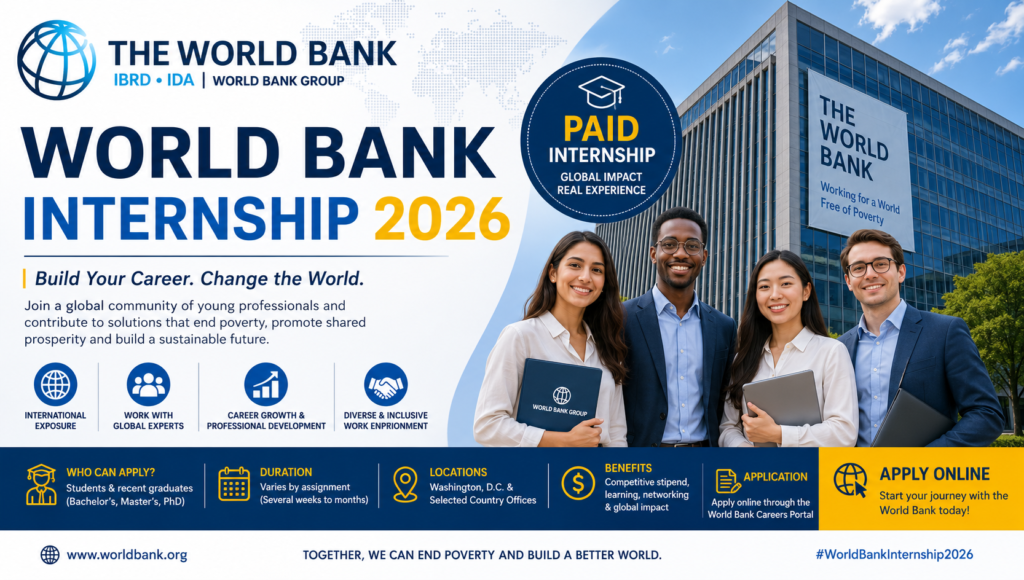
Salary and Benefits
Internship compensation varies depending on the assignment and location.
Depending on the specific internship terms, participants may receive support such as:
- A stipend or salary
- Travel assistance (where applicable)
- Exposure to international projects
- Professional mentoring
- Access to learning resources
- Networking opportunities
- Multicultural work experience
The exact benefits are outlined in each internship announcement.
Why a World Bank Internship Can Transform Your Career
Completing a World Bank internship demonstrates that you can work in a highly professional, multicultural environment on complex global development challenges.
Former interns often go on to careers with:
- International financial institutions
- United Nations agencies
- Regional development banks
- Government ministries
- International NGOs
- Think tanks
- Research institutions
- Consulting firms
- Multinational companies
For many young professionals, the internship serves as a launchpad into international development and public policy careers.
Best Departments to Apply For
The World Bank recruits interns across a wide range of departments. Choosing a department that aligns with your academic background and career goals can improve the relevance of your application.
1. Climate Change and Environment
As climate finance and resilience become global priorities, the World Bank continues to expand its work in:
- Climate adaptation
- Renewable energy
- Disaster risk management
- Carbon markets
- Nature-based solutions
- Environmental policy
Ideal for:
- Environmental Science
- Climate Change
- Geography
- Sustainability
- Engineering
2. Economics and Poverty Reduction
Economics remains one of the World Bank’s core areas of work.
Interns may contribute to:
- Macroeconomic analysis
- Fiscal policy
- Labor markets
- Poverty assessments
- Development finance
- Country diagnostics
Ideal for:
- Economics
- Finance
- Statistics
- Public Policy
3. Digital Development
The World Bank increasingly supports countries in digital transformation.
Projects include:
- Artificial Intelligence
- Digital Governance
- Cybersecurity
- Broadband Expansion
- Digital Public Infrastructure
- GovTech
Ideal for:
- Computer Science
- AI
- Data Science
- Information Systems
4. Education
Education specialists work on improving learning outcomes around the world.
Projects may include:
- Education policy
- Skills development
- Teacher training
- Higher education
- Digital learning
5. Health, Nutrition and Population
The World Bank invests heavily in healthcare systems and public health programs.
Areas include:
- Universal health coverage
- Nutrition
- Disease prevention
- Health financing
6. Infrastructure
Infrastructure remains one of the Bank’s largest investment areas.
Internship projects may focus on:
- Roads
- Transport
- Urban development
- Water supply
- Energy
- Smart cities
7. Agriculture and Food Security
Projects include:
- Sustainable agriculture
- Food systems
- Rural development
- Irrigation
- Climate-smart farming
8. Gender Equality and Social Inclusion
Interns may support initiatives related to:
- Women’s empowerment
- Disability inclusion
- Youth development
- Social protection
- Human capital
Skills That Make You a Competitive Applicant
The World Bank values candidates who combine strong technical knowledge with practical skills.
Highly valued competencies include:
- Policy analysis
- Research
- Quantitative analysis
- Data visualization
- Project management
- Monitoring & Evaluation (M&E)
- GIS mapping
- AI and machine learning
- Climate finance
- Financial modeling
- Communication
- Stakeholder engagement
- Teamwork
- Leadership
- Adaptability
Career Opportunities After the Internship
A World Bank internship can significantly enhance your professional profile.
Many former interns pursue careers with:
- World Bank Group
- International Finance Corporation (IFC)
- Multilateral Investment Guarantee Agency (MIGA)
- United Nations agencies
- Regional development banks
- Government ministries
- International NGOs
- Research institutions
- Universities
- Global consulting firms
The experience also strengthens applications for graduate programs, fellowships, and leadership initiatives.
Tips to Stand Out
Build a Strong LinkedIn Profile
Recruiters often review online professional profiles. Keep yours updated with:
- Education
- Research
- Publications
- Certifications
- Volunteer work
- Leadership experience
Earn Relevant Certifications
Free or affordable courses in the following areas can strengthen your application:
- Project Management
- Data Analysis
- Climate Change
- Sustainable Development
- Monitoring & Evaluation
- Power BI
- Excel
- GIS
- Python
- R Programming
Demonstrate Impact
Rather than listing responsibilities, highlight outcomes.
Example:
❌ Assisted with research.
✅ Conducted policy analysis that informed recommendations adopted in a university climate strategy.
Gain International Experience
Participation in:
- Model United Nations
- International conferences
- Exchange programs
- Research collaborations
- Youth organizations
can demonstrate intercultural competence and global engagement.
Common Myths About the World Bank Internship
Myth 1: Only economists are selected.
Reality: The World Bank recruits students from diverse fields including law, engineering, communications, computer science, environmental science, public health, and social sciences.
Myth 2: Only students from top universities can apply.
Reality: Academic excellence matters, but relevant skills, experience, and motivation are also important.
Myth 3: You need years of work experience.
Reality: The internship is designed for students. Practical experience through research, volunteering, or campus leadership can strengthen your application.
Myth 4: International students cannot apply.
Reality: The program welcomes applicants from many countries, subject to the eligibility requirements of individual opportunities.
Frequently Asked Questions (FAQ)
Is the World Bank Internship paid?
Many World Bank internship opportunities provide financial support. The exact benefits depend on the internship announcement and location.
Can international students apply?
Yes. The internship attracts applicants from around the world.
Is IELTS required?
There is no universal IELTS requirement for the internship itself. However, applicants should have strong English communication skills, and language requirements may vary depending on the role.
How long does the internship last?
The duration varies by assignment and department.
Can undergraduate students apply?
Eligibility depends on the specific internship opportunity. Applicants should carefully review the requirements for each posting.
Does the World Bank sponsor visas?
Visa arrangements depend on the internship location and the applicable policies for the specific opportunity.
Is previous work experience mandatory?
Not necessarily. Relevant academic projects, research, internships, volunteering, and leadership activities can strengthen an application.
How competitive is the World Bank Internship?
It is highly competitive, with applications from talented students worldwide. A tailored application and strong evidence of impact can improve your chances.
Related Opportunities You Should Explore
To help readers discover more opportunities, add internal links to related articles on Global Youth Opportunities, such as:
- UNICEF Internship 2026
- UNDP Jobs 2026
- Canada Scholarships 2026
- Latest Jobs for Students 2026
- Fully Funded Scholarships 2026
- International Internships 2026
- United Nations Careers Guide
This strengthens your site’s topical authority and encourages visitors to explore multiple pages.
Conclusion
The World Bank Internship 2026 is an outstanding opportunity for students who want to gain practical experience in international development while contributing to projects that address global challenges. Whether your interests lie in economics, climate action, public policy, technology, health, or infrastructure, the internship offers a chance to learn from leading experts, develop professional skills, and build a global network.
Competition is intense, but a well-prepared application can make a meaningful difference. Focus on showcasing your academic achievements, leadership, analytical skills, and commitment to sustainable development. Start preparing your documents early, tailor each application to the role, and monitor new opportunities regularly.
Your internship could be the first step toward a rewarding career dedicated to creating positive change around the world.