
COP31 Antalya 2026
COP31 Türkiye, COP31 dates, COP31 climate conference, COP31 registration, COP31 youth participation, COP31 climate finance, COP31 agenda, UN Climate Change Conference 2026, COP31 Antalya venue, COP31 accreditation.
COP31 Antalya, Türkiye 2026: The World’s Next Major Climate Summit
The decisions made at international climate negotiations can influence how countries finance climate adaptation, transition towards cleaner energy, protect vulnerable communities and respond to increasingly severe climate impacts. In November 2026, global attention will turn to Antalya, Türkiye, for the 31st Conference of the Parties to the United Nations Framework Convention on Climate Change.
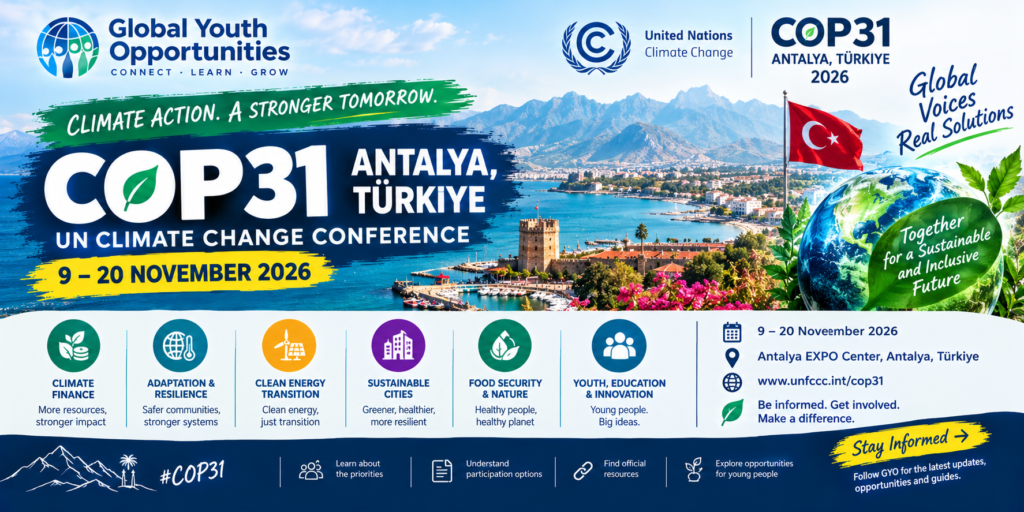
COP31 will take place from 9 to 20 November 2026 at the Antalya EXPO Center in Antalya, Türkiye. The conference will bring together government delegations, climate negotiators, scientists, businesses, international organisations, Indigenous Peoples, young people and civil society representatives to advance international climate cooperation.
The central challenge is to turn existing climate commitments into implementation: practical policies, accessible finance, stronger resilience and measurable progress towards the goals of the Paris Agreement.
For young climate advocates, researchers, students, NGOs and sustainability professionals, COP31 is also an opportunity to understand how international climate policy is negotiated, how climate solutions are developed and where meaningful contributions can be made.
Conference dates: 9–20 November 2026
Venue: Antalya EXPO Center, Antalya, Türkiye
Host country: Türkiye
Official conference website: https://unfccc.int/cop31
Host-country website: https://cop31.tr/
What Is COP31?
COP stands for the Conference of the Parties. It is the annual decision-making conference under the United Nations Framework Convention on Climate Change (UNFCCC), the international climate treaty adopted in 1992.
COP31 is the 31st session of this conference. It will also include the 21st meeting of the Parties to the Kyoto Protocol (CMP21) and the eighth meeting of the Parties to the Paris Agreement (CMA8).
The Paris Agreement, adopted in 2015, established a framework for countries to strengthen climate action and pursue efforts to limit global warming to 1.5°C above pre-industrial levels.
At COP meetings, governments negotiate decisions on issues such as reducing greenhouse gas emissions, adaptation, climate finance, transparency and international cooperation. Businesses, research institutions, civil society and youth organisations also contribute through approved participation channels, events, research and engagement with national delegations.
COP31 is not simply a conference where climate organisations display projects. It is part of a formal multilateral process in which participating governments negotiate and adopt decisions that can shape international climate policy.
When and Where Is COP31 Taking Place?
| Detail | Information |
|---|---|
| Event | UN Climate Change Conference — COP31 |
| Dates | 9–20 November 2026 |
| City | Antalya |
| Country | Türkiye |
| Main venue | Antalya EXPO Center |
| Host-country website | https://cop31.tr/ |
| UNFCCC conference page | https://unfccc.int/cop31 |
The official venue will host negotiations, country pavilions, presidency events, roundtables, panels and side events.
Participants planning to attend should check the official information for venue access, transport, accommodation, visa arrangements and security updates. Conference arrangements may change as the event approaches.
Who Will Lead COP31?
Türkiye will host COP31, with Murat Kurum nominated as President of COP31. Australia’s Chris Bowen will serve as President of Negotiations.
The arrangement places Türkiye in the host and presidency role while Australia leads the negotiations. The two countries have been working through the preparation process to build momentum towards Antalya.
The COP31 process also includes preparatory engagement with governments and other stakeholders before the main conference. The official UNFCCC website publishes presidency communications, provisional agendas, meeting schedules and documents as they become available.
Official updates: https://unfccc.int/cop31/the-road-to-antalya
What Are the Main Priorities for COP31?
COP31 will address the continuing challenge of implementing the Paris Agreement. Negotiations and related activities are expected to cover climate finance, adaptation, mitigation, energy transition and a just transition, alongside the wider implementation agenda.
The host-country Action Agenda highlights a range of practical areas where governments, cities, companies, researchers and civil society can contribute.
1. Climate Finance for Developing Countries
Climate finance remains a major issue for developing countries facing rising adaptation costs, disaster losses and the expense of transitioning to lower-emission development pathways.
Discussions around finance can include how resources are mobilised, how funding reaches vulnerable communities, the roles of public and private investment, and how climate finance commitments are implemented.
For developing countries, access to predictable, affordable and effective climate finance is essential. Funding needs to support real-world implementation rather than remain only a headline commitment.
2. Climate Adaptation and Resilience
Communities around the world are experiencing the effects of heatwaves, floods, droughts, wildfires, coastal erosion and other climate-related hazards.
Adaptation is about preparing for these impacts and reducing harm. This can include climate-resilient infrastructure, early-warning systems, disaster preparedness, resilient agriculture, water security, urban planning and stronger public services.
COP31 will provide a forum for advancing adaptation discussions and highlighting practical approaches that help communities withstand climate shocks.
3. Clean Energy Transition and Electrification
Transitioning towards cleaner energy systems is central to reducing greenhouse gas emissions. The COP31 Action Agenda highlights electrification and the clean energy transition, including efforts to expand access to affordable and reliable electricity.
Relevant solutions include renewable energy, grid improvements, energy efficiency, electric transport and the electrification of buildings and industrial processes.
The transition must also consider affordability, energy access, employment and the needs of communities that currently depend on fossil-fuel industries.
4. Green Industrialisation and a Just Transition
Low-emission industrial development can help countries pursue economic growth while reducing environmental impacts.
Green industrialisation may involve cleaner manufacturing, resource efficiency, low-carbon technologies, sustainable supply chains and new green jobs.
A just transition is equally important. Workers and communities need opportunities to participate in and benefit from economic change, with attention to skills development, decent work and social protection.
5. Climate-Resilient Cities and Buildings
Cities face growing risks from extreme heat, flooding, water stress and pressure on infrastructure.
The COP31 Action Agenda identifies climate-resilient cities as a priority. Possible areas for action include energy-efficient buildings, sustainable transport, urban green spaces, better drainage, heat planning and climate-informed infrastructure investment.
These issues are especially relevant to urban planners, architects, real-estate professionals, engineers, local governments and sustainable-building specialists.
6. Food Security and Resilient Food Systems
Climate change affects agricultural productivity, food prices, water availability and the livelihoods of farming communities.
Climate-resilient food systems can include improved agricultural practices, efficient irrigation, climate information services, soil restoration, crop diversification and reduced food loss and waste.
COP31 offers an opportunity to connect climate policy with food security, rural development and the needs of communities most exposed to climate risks.
7. Oceans, Seas and Zero Waste
The host-country agenda also highlights oceans and seas, alongside zero-waste approaches and methane reduction.
Ocean protection is connected to biodiversity, coastal livelihoods and climate resilience. Waste management and methane reduction can contribute to climate mitigation while improving public health and resource efficiency.
Circular-economy approaches, recycling, waste prevention and better management of organic waste can help reduce emissions and pressure on natural resources.
8. Youth, Education and Climate Awareness
Young people are important participants in climate action as researchers, organisers, innovators, policy advocates and representatives of affected communities.
The COP31 Action Agenda identifies youth and education as a priority. Meaningful youth participation involves more than attending events: it includes access to information, opportunities to contribute to policy discussions, and pathways for youth-led ideas to influence implementation.
Youth engagement is most effective when it connects lived experience and evidence-based proposals with decision-making processes.
9. Health and Climate Resilience
Climate change affects human health through extreme heat, air pollution, changing disease risks, food insecurity and disasters.
Resilient health systems need to prepare for climate-related emergencies while reducing the environmental footprint of healthcare where feasible.
Connecting climate action with health can help make the benefits of adaptation and emissions reduction more visible to communities.
10. Linking Climate, Biodiversity and Land Restoration
Climate change, biodiversity loss and land degradation are interconnected challenges.
Integrated approaches can support ecosystem restoration, sustainable land management, biodiversity protection and more resilient communities. Coordination across climate, biodiversity and desertification initiatives can also help avoid fragmented policies and make better use of limited resources.
Official Action Agenda information: https://cop31.tr/
These themes describe the host-country Action Agenda and wider climate priorities. They should not be interpreted as a guarantee that every topic will result in a separate negotiated decision.
Why Is COP31 Important?
COP31 takes place at a time when countries need to strengthen implementation of their existing climate commitments and respond to the gap between ambition and action.
Its importance can be understood through five connected challenges.
First, implementation: Climate commitments must translate into policies, projects, investment and measurable results.
Second, climate finance: Vulnerable countries need effective pathways to mobilise resources and implement adaptation and mitigation plans.
Third, resilience: Communities require better preparedness for climate impacts that are already affecting lives, infrastructure and livelihoods.
Fourth, energy and economic transformation: Governments need to expand clean energy and lower-emission development while addressing affordability, jobs and equity.
Fifth, accountability and cooperation: International climate action depends on transparency, trust, evidence and continued collaboration among countries and non-state actors.
No single COP can resolve the climate crisis. However, each conference can advance collective decisions, create partnerships and strengthen the international process.
COP31 Blue Zone and Green Zone: What Is the Difference?
Understanding the conference zones is important for anyone planning to participate.
Blue Zone
The Blue Zone is the official UNFCCC area. It hosts formal negotiations, official meetings, accredited country delegations, observer organisations and other authorised participants.
Access is restricted to properly registered and accredited participants. Being a climate activist, student, NGO member or researcher does not automatically provide access.
Green Zone
The Green Zone is organised by the host country and provides a platform for public engagement, exhibitions, innovation, civil society activities and climate solutions.
The host-country website identifies the Green Zone as an area designed to enable broader participation. Visitor arrangements, registration requirements and opening dates should be checked through the official website.
The Green Zone is generally the more accessible route for members of the public, but visitors should verify current arrangements before making travel plans.
Official information: https://unfccc.int/cop31/about
Host-country information: https://cop31.tr/
How Can Young People Participate in COP31?
Young people can contribute to climate action in different ways, depending on their role, organisation and access to the conference.
1. Through YOUNGO
YOUNGO is the official children and youth constituency of the UNFCCC. It connects youth-led organisations and young climate advocates involved in international climate processes.
YOUNGO participants may engage in policy discussions, coordinate advocacy, develop youth positions, participate in approved events and communicate youth priorities to negotiators.
Participation in YOUNGO does not itself guarantee a COP31 badge. Applicants should follow the relevant constituency procedures and any specific registration requirements.
Official website: https://youngoclimate.org/
2. Through an Admitted Observer Organisation
Some non-governmental organisations participate in the UNFCCC process through observer status. An admitted organisation may nominate eligible representatives during the relevant registration period.
For COP31, the published NGO observer nomination period ran from 7 July to 10 August 2026, with confirmation running from 24 August to 8 November 2026. These are official process dates, not an open registration invitation for anyone to apply directly as an individual.
If you are affiliated with an admitted organisation, contact its authorised focal point to understand whether any nomination or confirmation steps remain available.
Official registration guidance: https://unfccc.int/cop31/ifp
3. Through a National Delegation
Governments may include youth representatives, technical experts and other stakeholders in their national delegations.
Those interested in this route can contact the relevant national ministry or climate-change focal point, explain their expertise and ask about the delegation’s established selection process. Selection is not guaranteed.
4. Through Research, Advocacy and Public Engagement
You can contribute even if you do not have access to the official negotiation area.
Useful activities include:
- Publishing evidence-based policy briefs and explainers.
- Organising climate education sessions or youth dialogues.
- Sharing research on adaptation, finance, resilience and just transition.
- Supporting locally led climate initiatives.
- Participating in public events when registration is available.
- Following official proceedings and communicating verified developments.
- Building partnerships with universities, NGOs and climate networks.
The key is to connect participation to a clear purpose and a realistic contribution.
How to Follow COP31 Without an Onsite Badge
An onsite badge is not the only way to engage with COP31.
If you cannot attend in person, you can still follow public updates, monitor documents and share evidence-based analysis.
- Bookmark the official COP31 page: https://unfccc.int/cop31/
- Check provisional agendas and meeting schedules: use the official conference page for updated documents.
- Follow the COP31 Presidency: https://cop31.tr/
- Monitor youth climate engagement: https://youngoclimate.org/
- Review official announcements and press briefings: rely on UNFCCC and host-country sources for confirmed decisions.
- Share useful analysis: explain what announcements mean for communities, organisations and climate policy without overstating what has been agreed.
Meeting schedules and public-access arrangements may change. Verify whether a session is open to your registration category before relying on remote access or planning an event around it.
COP31 Registration and Accreditation: What Applicants Need to Know
COP31 registration is governed by UNFCCC procedures. The process depends on the category under which someone is participating.
Eligible categories include government parties and observer states, UN organisations and specialised agencies, admitted intergovernmental organisations, admitted non-governmental organisations and accredited media.
For many participants, registration is handled by an authorised organisation or focal point rather than through an unrestricted individual application.
Is COP31 registration free?
The UNFCCC states that the formal registration process for duly nominated participants is free of charge. This does not mean travel, accommodation, insurance, meals and other attendance costs are covered.
Be cautious of third parties claiming they can sell an official UNFCCC badge. Verify any registration communication through the relevant organisation and official UNFCCC channels.
Can anyone obtain a COP31 Blue Zone badge?
No. Access to the official negotiation area requires the appropriate registration and accreditation. Applying or expressing interest does not guarantee approval.
Can I still apply through an NGO?
The published NGO nomination period ended on 10 August 2026. The confirmation period is listed through 8 November 2026. If your organisation has already nominated you, contact its authorised focal point immediately about your status. Do not assume that a new individual application is possible.
Is virtual participation available?
The UNFCCC participant information describes a virtual-only registration option for eligible delegates from Parties and observer organisations, subject to applicable rules and session access. This is not necessarily an open public livestream or unrestricted virtual badge.
Check the official participant guidance for the current conditions.
Official registration source: https://unfccc.int/cop31/ifp
Travel, Visa and Practical Planning
If you are already registered or have a confirmed route to participation, begin practical planning early.
Visa: Check the requirements for your nationality and the official visa instructions for conference participants. A registration confirmation does not guarantee a visa.
Accommodation: Compare location, cancellation terms and transport options before booking. Check whether your accommodation is connected to the official shuttle arrangements.
Transport: Review the official conference transportation information for shuttle stops, airport transfers and other arrangements.
Insurance: The UNFCCC advises participants to obtain comprehensive international medical insurance. Do not assume conference accreditation provides travel or medical coverage.
Documents: Keep your passport, registration confirmation, travel details, insurance information and any required visa documents accessible.
Weather: November in Antalya can bring mild daytime conditions and cooler evenings, with possible rain. Check the forecast shortly before departure and pack accordingly.
Official participant information: https://unfccc.int/cop31/ifp
How NGOs and Climate Organisations Can Prepare
For organisations planning climate engagement around COP31, the remaining preparation period is short. Focus on activities that can be delivered responsibly and that connect with the conference’s substantive priorities.
Define a clear objective
Choose one or two priority areas rather than trying to cover every climate issue. Examples include climate adaptation, youth participation, climate finance, disaster resilience, climate-smart agriculture or sustainable cities.
Prepare evidence-based material
Develop a concise policy brief, research summary, case study or project presentation. State the problem, provide credible evidence, explain the proposed solution and identify the stakeholders who could act on it.
Identify realistic partners
Contact universities, civil society organisations, research groups, local authorities or businesses with a relevant mandate. Explain the specific collaboration you are proposing and what each partner could contribute.
Communicate responsibly
Distinguish between a proposal, a public pledge, an announced initiative and a formally adopted negotiated decision. Do not claim that an organisation is an official COP partner or has a confirmed speaking role unless that status is documented.
Plan beyond the conference
COP participation should not be treated as a one-off publicity opportunity. Identify how relationships, research, commitments and discussions could lead to work after November 2026.
How Businesses and Researchers Can Engage
COP31 is also relevant to organisations working on clean technology, energy, infrastructure, climate finance, resilient agriculture, environmental data and sustainable buildings.
Businesses can use the wider climate-action platform to explore partnerships and present solutions where appropriate. Researchers can contribute through credible evidence, technical briefings, public discussions and collaboration with relevant institutions.
Organisations should avoid treating conference attendance as proof of endorsement. Being present at a COP does not automatically mean a product, service or project is approved by the UNFCCC or the host country.
What Should We Expect COP31 to Deliver?
COP31 should be assessed against concrete outcomes rather than the number of announcements, events or attendees.
Important questions include:
- Does the conference advance implementation of existing climate commitments?
- Are discussions on climate finance connected to practical access and delivery?
- Does the process strengthen adaptation and resilience?
- Are clean-energy transition efforts attentive to affordability and equity?
- Are youth and affected communities given meaningful opportunities to contribute?
- Do announced partnerships and initiatives have credible implementation plans?
- Are progress and remaining gaps communicated transparently?
The final assessment should be based on the decisions, declarations and initiatives actually published during and after the conference. Before those outcomes are available, it is more accurate to describe priorities and expectations than to promise results.
Frequently Asked Questions About COP31
When is COP31?
COP31 takes place from 9 to 20 November 2026.
Where is COP31 being held?
The conference is being held at the Antalya EXPO Center in Antalya, Türkiye.
What does COP31 stand for?
It stands for the 31st Conference of the Parties to the United Nations Framework Convention on Climate Change.
Who is hosting COP31?
Türkiye is hosting the conference. Murat Kurum has been nominated as COP31 President, while Australia’s Chris Bowen will serve as President of Negotiations.
What will be discussed at COP31?
Key issues include climate finance, adaptation, emissions reduction, the clean-energy transition, a just transition and implementation of the Paris Agreement. The host-country Action Agenda also highlights electrification, resilient cities, food security, oceans, zero waste, green industrialisation, youth and education, and climate-resilient health systems.
Can students attend COP31?
Students may be able to participate through eligible organisations, national delegations or other authorised routes. A student identity alone does not provide a badge. Public Green Zone access is subject to host-country arrangements.
Can I attend COP31 without an official badge?
You cannot enter the restricted Blue Zone without the required accreditation. Public access opportunities may be available through the Green Zone, subject to the host country’s visitor arrangements.
Is COP31 registration free?
Formal UNFCCC registration for duly nominated participants is free. Travel, accommodation, insurance and other personal expenses may still apply.
Can I still obtain a COP31 badge?
Possibilities depend on the participant category and the status of the relevant nomination and confirmation process. The published NGO nomination window has closed. Check the official UNFCCC guidance rather than relying on unverified badge offers.
Where can I follow COP31 online?
Start with the official UNFCCC COP31 page at https://unfccc.int/cop31 and the host-country website at https://cop31.tr/. Check those sources for current documents, announcements and any available remote participation information.
Official COP31 Resources
Use these links for verified conference information and updates.
- UNFCCC COP31 conference page: https://unfccc.int/cop31/
- About COP31: https://unfccc.int/cop31/about
- Information for participants: https://unfccc.int/cop31/ifp
- The Road to Antalya: https://unfccc.int/cop31/the-road-to-antalya
- COP31 Türkiye Presidency website: https://cop31.tr/
- YOUNGO — official children and youth constituency: https://youngoclimate.org/
- UNFCCC official website: https://unfccc.int/
Final Thoughts
COP31 in Antalya is an important moment for international climate cooperation, but its significance will depend on the quality of its decisions and the work that follows.
For young people, NGOs, researchers and climate professionals, meaningful engagement starts with understanding the process, identifying a clear contribution and using reliable information. Whether you participate onsite, through an authorised organisation or by following public updates, focus on the substance of climate action: finance, resilience, implementation and fair opportunities for communities to shape their future.
For ongoing coverage, follow Global Youth Opportunities for climate-related opportunities, youth engagement updates and international programmes.