
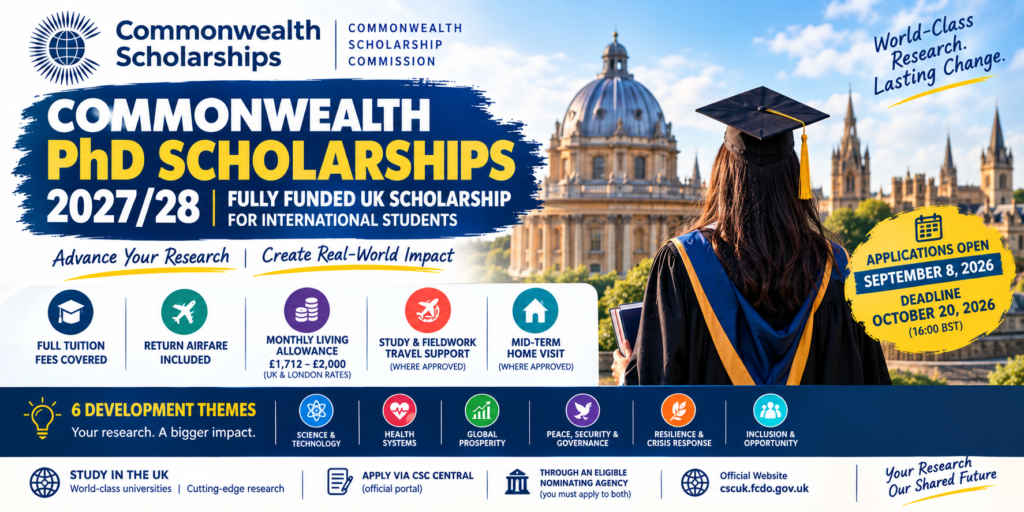
Applications Open: September 8, 2026 | Deadline: October 20, 2026
Are you looking for a fully funded PhD scholarship in the UK for 2027?
The Commonwealth PhD Scholarships 2027/28 offer talented graduates from eligible Commonwealth countries the opportunity to undertake full-time doctoral study at a UK university.
The programme is funded by the UK Foreign, Commonwealth & Development Office (FCDO) and is designed for candidates whose proposed research has the potential to contribute to development in their home countries.
For the 2027/28 academic year, applications opened on September 8, 2026, and the official Commonwealth Scholarship Commission deadline is October 20, 2026 at 16:00 BST.
Successful scholars are expected to begin their studies in the UK in September or October 2027.
Important: Applicants must apply through both the official CSC application system and an eligible nominating agency or organisation. Nominators may impose their own earlier deadlines.
Commonwealth PhD Scholarships 2027/28 at a Glance
| Feature | Details |
|---|---|
| Scholarship | Commonwealth PhD Scholarships |
| Academic year | 2027/28 |
| Study destination | United Kingdom |
| Degree level | PhD |
| Study mode | Full-time |
| Applications open | September 8, 2026 |
| CSC deadline | October 20, 2026, 16:00 BST |
| Study begins | September/October 2027 |
| Eligible countries | Selected Commonwealth countries |
| Pakistan eligible? | Yes |
| Tuition fees | Fully covered |
| Airfare | Approved return airfare |
| Monthly stipend | £1,712; £2,000 in London at current rates |
| Study travel | Included where approved |
| Fieldwork support | Available where approved |
| Application fee | No CSC application fee |
What Are Commonwealth PhD Scholarships?
Commonwealth PhD Scholarships are UK government-funded awards administered by the Commonwealth Scholarship Commission (CSC).
The programme supports high-quality graduates who have the potential to undertake world-class research with developmental impact and eventually contribute as researchers, teachers, professionals or leaders in their home countries.
The scholarships are intended primarily for candidates who could not otherwise afford to study in the UK.
The programme is offered under six CSC development themes:
- Science and technology for development
- Strengthening health systems and capacity
- Promoting global prosperity
- Strengthening global peace, security and governance
- Strengthening resilience and response to crises
- Access, inclusion and opportunity
When Does the Commonwealth PhD Scholarship 2027 Open?
Applications for the 2027/28 Commonwealth PhD Scholarships opened on September 8, 2026.
The official CSC closing date is:
October 20, 2026 at 16:00 BST
The scholarship is intended for doctoral study beginning in September or October 2027.
However, applicants should not wait until the CSC deadline.
You must also apply through an eligible nominating agency, and individual nominators can establish their own deadlines and additional requirements.
Who Can Apply for Commonwealth PhD Scholarships?
Applicants must satisfy the CSC’s eligibility requirements.
1. Be a citizen of an eligible Commonwealth country
Applicants must be citizens of, or have been granted refugee status by, an eligible Commonwealth country, or be a British Protected Person.
2. Be permanently resident in an eligible Commonwealth country
Applicants must normally be permanently resident in an eligible Commonwealth country.
3. Be available to begin study in September 2027
Successful candidates must be available to start their academic programme in the UK at the beginning of the 2027/28 academic year.
4. Meet the academic qualification requirement
By September 2027, applicants must normally hold:
- A first degree equivalent to at least an upper second-class UK honours standard (2:1), or
- A lower second-class degree together with a relevant postgraduate qualification, usually a Master’s degree.
5. Not already be registered for a PhD
Applicants must not already be registered for a PhD, or an MPhil leading to a PhD, at a UK university or in their home country before September/October 2026.
Which Countries Are Eligible?
The current CSC list for the 2027/28 Commonwealth PhD Scholarships includes:
- Bangladesh
- The Gambia
- Kiribati
- Lesotho
- Malawi
- Mozambique
- Nigeria
- Pakistan
- Rwanda
- Sierra Leone
- Solomon Islands
- Sri Lanka
- Tanzania
- Togo
- Tuvalu
- Uganda
- Zambia
Commonwealth PhD Scholarship for Pakistani Students
Pakistan is eligible for the 2027/28 Commonwealth PhD Scholarship.
For Pakistani applicants, the main national route includes the Higher Education Commission (HEC).
The CSC also lists several Pakistani universities/university bodies among the organisations invited to nominate academic staff, including:
- Higher Education Commission
- Fatima Jinnah Women University
- Jinnah University for Women
- Lahore College for Women University
- Peoples Medical College of Medical and Health Sciences for Women
- Sardar Bahadur Khan Women University
- Shaheed Benazir Bhutto Women University
- Kinnaird College for Women
Applicants should check the current requirements and process of their relevant nominator rather than relying on previous scholarship cycles.
What Does the Commonwealth PhD Scholarship Cover?
The Commonwealth PhD Scholarship is a fully funded award covering the major costs of doctoral study in the UK.
Full tuition fees
Approved tuition fees are covered through an agreement between the CSC and the UK university.
Scholars are not liable to pay the covered tuition fees.
Return airfare
The scholarship provides approved airfare from the scholar’s home country to the UK and return travel at the end of the award.
The CSC does not normally reimburse fares for dependants or journeys made before the award is confirmed.
Monthly living allowance
The current published stipend is:
- £1,712 per month, or
- £2,000 per month for scholars studying at universities in the London metropolitan area.
Rates may change.
Study travel grant
A study travel grant is available toward approved study-related travel within the UK or overseas.
Fieldwork support
Where approved, scholars can receive support for fieldwork undertaken overseas, including the cost of one economy-class return airfare to the fieldwork location.
Mid-term home visit
The scholarship can also provide a paid mid-term visit to the scholar’s home country, subject to the CSC’s conditions.
Is the Commonwealth PhD Scholarship Fully Funded?
Yes.
The core scholarship covers approved tuition fees, return airfare and a monthly living allowance, along with additional support specified in the scholarship conditions.
However, applicants should always read the current CSC terms carefully.
“Fully funded” does not mean that every possible personal or family expense is automatically covered.
What Research Areas Are Eligible?
The Commonwealth PhD programme is organised around six development themes:
1. Science and technology for development
Research involving science, technology, innovation, digital transformation and related development challenges.
2. Strengthening health systems and capacity
Research addressing health systems, public health, medical capacity and related challenges.
3. Promoting global prosperity
Research contributing to economic development, employment, trade, innovation, sustainable growth and related priorities.
4. Strengthening global peace, security and governance
This theme can cover areas such as:
- Governance
- Public policy
- International relations
- Peace and security
- Institutions
- Human rights
- Rule of law
5. Strengthening resilience and response to crises
Research relating to:
- Climate change
- Disaster risk reduction
- Environmental resilience
- Humanitarian crises
- Adaptation
- Emergency response
6. Access, inclusion and opportunity
Research addressing inequality, inclusion, education, social protection, disability, gender and access to opportunities.
How to Choose a Strong Commonwealth PhD Research Topic
Your proposed PhD should not simply be a topic that you personally find interesting.
A competitive research proposal should establish a clear connection between:
Development problem → Research gap → Research question → Methodology → Expected findings → Practical impact
For example:
Climate change is increasing vulnerability in developing countries.
This is a broad problem.
A stronger proposal would identify:
- A specific country or region
- A specific population
- A defined policy problem
- A research gap
- A clear methodology
- Expected policy contribution
- How the research could improve outcomes
The CSC is looking for candidates whose research can contribute to development after the scholarship.
How to Apply for Commonwealth PhD Scholarships 2027
The application process has several important stages.
Step 1: Check your country eligibility
Confirm that your country appears on the official Commonwealth PhD Scholarship list.
Step 2: Identify your nominating agency
The main route is through national nominating agencies.
There are also selected NGOs and charitable organisations that can nominate candidates.
Your nominator may have:
- Its own application form
- Its own deadline
- Additional eligibility requirements
- Additional documents
- Its own selection process
Step 3: Identify a suitable UK university
Research universities that offer a PhD aligned with your research interests.
Look at:
- Research groups
- Supervisors
- Research centres
- Funding environment
- Department expertise
- Facilities
- Programme requirements
Step 4: Contact potential supervisors
For a PhD application, contacting potential supervisors can be extremely valuable.
A strong initial email should briefly explain:
- Who you are
- Your academic background
- Your proposed research
- Why you are interested in their research
- Why you believe there is a potential fit
- Your intended scholarship
- Whether they would consider supervising your research
Avoid sending the same generic email to dozens of professors.
Step 5: Prepare your research proposal
Your research proposal should demonstrate:
- A clear research problem
- Literature/context
- Research gap
- Research questions
- Objectives
- Methodology
- Expected contribution
- Development impact
- Feasibility
- Relevant references
Step 6: Prepare supporting documents
Prepare your:
- Passport or national ID
- Academic transcripts
- Degree certificates
- CV
- References
- Research proposal
- Publications and awards
- Employment information
- University information
- Development impact statement
Step 7: Complete the CSC Central application
The official CSC application must be submitted through CSC Central.
The CSC does not accept applications or documents submitted outside its official application system.
Applicants should prepare their answers separately before entering them into the online application.
Step 8: Apply to your nominator
Submitting the CSC application alone is not sufficient.
You must also complete the process required by your nominating agency.
Step 9: Apply to the university
You should also follow the university’s own PhD admission process.
Scholarship application and university admission are related but separate processes.
What Information Is Required in the Application?
The CSC application asks candidates to provide detailed academic and professional information.
This includes:
Academic qualifications
Applicants must list their undergraduate and postgraduate qualifications.
Publications and prizes
The application allows candidates to list up to 10 publications and prizes.
Choose evidence that demonstrates your research ability, academic achievement or contribution to your field.
Employment history
Candidates must provide employment information and explain how their experience relates to the proposed programme.
Referees
Applicants must provide the details of three referees who can comment on:
- Their ability to benefit from the scholarship
- Their research potential
- Their development impact potential
At least two references must be included with the application.
One referee should be a current employer where applicable.
The Development Impact Statement
This is one of the most important parts of the application.
Applicants are asked to explain their expected development impact in four parts.
Your statement should demonstrate:
What problem are you addressing?
Clearly define the development challenge.
Why does the problem matter?
Explain its significance at:
- Local level
- National level
- Regional level
- Global level, where relevant
How will your PhD help?
Explain exactly how the research and skills acquired in the UK will help address the problem.
What will happen after your PhD?
Describe:
- Expected outcomes
- Beneficiaries
- Implementation timeframe
- Institutions you may work with
- How impact will be measured
Avoid vague statements such as:
“I will contribute to my country’s development.”
Instead, explain exactly how.
How to Find a Commonwealth PhD Supervisor
Finding the right supervisor can strengthen your overall PhD strategy.
Start with universities rather than randomly emailing professors.
Research the department
Find researchers working on your specific topic.
Read recent publications
Look for professors whose recent research overlaps with your proposed project.
Identify the research gap
Explain why your proposed research could complement their existing work.
Write a focused email
A good supervisor email should usually include:
Subject: Prospective PhD Applicant – [Research Topic] – Commonwealth Scholarship 2027
Then briefly explain your academic background, research idea, relevant experience and why their research is a strong fit.
Attach a concise CV and, if appropriate, a short research concept note.
How to Make Your Application Competitive
1. Build a clear research story
Your academic background, research proposal and career plans should make sense together.
2. Demonstrate research readiness
Use evidence such as:
- Thesis work
- Research projects
- Publications
- Conference presentations
- Research internships
- Policy research
- Relevant professional experience
3. Connect research to development
Don’t make development impact an afterthought.
Build it into your research design from the beginning.
4. Be specific
Weak:
“My research will help policymakers.”
Stronger:
“The research will produce evidence that can inform national adaptation planning by identifying…”
5. Show realistic impact
Avoid promising to transform an entire country immediately after completing your PhD.
Explain what you can realistically accomplish in the first:
- 1 year
- 3 years
- 5 years
6. Choose your university strategically
A famous university is not automatically the best choice.
The best university is one where:
- Relevant expertise exists
- Supervisors fit your topic
- Research facilities are appropriate
- The programme supports your methodology
- Your research can realistically be completed
Commonwealth PhD Scholarship Timeline 2027/28
| Date | Stage |
|---|---|
| September 8, 2026 | Applications open |
| October 20, 2026 | CSC application deadline — 16:00 BST |
| December 2026 | Nominators submit candidates |
| 2027 | CSC selection process |
| By July 2027 | Applicants expected to receive outcome |
| September/October 2027 | PhD study begins |
Important: Your nominator may set an earlier deadline than the CSC.
Commonwealth PhD Scholarship vs Commonwealth Master’s Scholarship
| Feature | Commonwealth PhD | Commonwealth Master’s |
|---|---|---|
| Degree | PhD | Master’s |
| Duration | Doctoral programme | One-year taught Master’s |
| UK study | Yes | Yes |
| Tuition | Covered | Covered |
| Airfare | Included | Included |
| Living allowance | Included | Included |
| Research proposal | Central | Study plan/development focus |
| Supervisor | Highly relevant | Course dependent |
| Pakistan | Eligible | Eligible |
| 2027 deadline | Oct. 20, 2026 | Oct. 20, 2026 |
Common Mistakes to Avoid
Mistake 1: Applying only to CSC Central
You must also follow your nominator’s process.
Mistake 2: Ignoring your nominator’s deadline
The national agency may close applications earlier than the CSC.
Mistake 3: Using a generic research proposal
Your proposal should be specific to your research problem and development context.
Mistake 4: Choosing a supervisor randomly
Research the professor’s recent work before contacting them.
Mistake 5: Focusing only on university rankings
Research fit is more important than simply choosing the highest-ranked university.
Mistake 6: Writing a vague development-impact statement
Explain the problem, beneficiaries, actions, timeline and measurable outcomes.
Mistake 7: Claiming unrealistic impact
Your five-year plan should be ambitious but credible.
Mistake 8: Waiting until the deadline
The application requires substantial preparation.
Start preparing your research proposal, references, transcripts and university applications immediately.
Frequently Asked Questions
When does the Commonwealth PhD Scholarship 2027 open?
Applications opened on September 8, 2026.
What is the application deadline?
The CSC deadline is October 20, 2026 at 16:00 BST.
Is Pakistan eligible?
Yes. Pakistan is included in the current eligible-country list for the Commonwealth PhD Scholarships.
Is the Commonwealth PhD Scholarship fully funded?
Yes. The award covers approved tuition fees, return airfare and a monthly living allowance, with additional support available under the scholarship conditions.
How much is the Commonwealth PhD stipend?
The current published rate is £1,712 per month, or £2,000 per month for scholars at universities in the London metropolitan area.
Do I need a Master’s degree?
The CSC requires a first degree at least equivalent to a UK upper-second-class standard, or a lower-second-class degree plus a relevant postgraduate qualification, usually a Master’s.
Can I apply if I am already doing a PhD?
Applicants cannot already be registered for a PhD, or an MPhil leading to a PhD, at a UK university or in their home country before September/October 2026.
Do I need a PhD supervisor?
For a doctoral scholarship, identifying an appropriate supervisor and research environment is an important part of preparing a strong application. Applicants should also follow the admission requirements of their chosen university.
Do I apply directly to the Commonwealth Scholarship Commission?
You apply through CSC Central, but you must also apply to an eligible nominating agency or participating nominator. The CSC does not accept independent direct applications outside this process.
When will the results be announced?
Applicants can expect to hear the outcome by July 2027.
Is there an application fee?
The CSC does not charge applicants an application fee through its official application system.
Final Advice
The Commonwealth PhD Scholarship is not simply a funding competition.
It is looking for candidates who can connect academic excellence with development impact.
Before submitting your application, make sure your story is clear:
Your academic background
↓
Your research problem
↓
Your proposed PhD
↓
Why the UK and this research environment
↓
The development problem you want to address
↓
What you will do after graduation
↓
Who will benefit
↓
How you will measure your impact
If these elements reinforce each other, your application becomes much more convincing.
Most importantly, always verify the latest eligibility rules, nominator requirements and deadlines on the official Commonwealth Scholarship Commission website before submitting your application.
Official Links
Commonwealth Scholarship Commission:
https://cscuk.fcdo.gov.uk/
Commonwealth PhD Scholarships:
https://cscuk.fcdo.gov.uk/scholarships/commonwealth-phd-scholarships-for-least-developed-countries-and-vulnerable-states/
CSC Central:
https://portal.csccentralonline.org.uk/
Commonwealth PhD Nominating Universities:
https://cscuk.fcdo.gov.uk/apply/nominating-universities/
CSC Scholarships and Fellowships:
https://cscuk.fcdo.gov.uk/about-us/scholarships-and-fellowships/
Important: Apply only through official CSC systems and your legitimate nominating agency. The CSC warns applicants to be cautious of third-party websites requesting personal information or supporting documents.
Also visit these opportunities: