
Want to study for a Master’s degree in Germany with financial support from DAAD? The DAAD EPOS Scholarship 2027/28 offers qualified professionals from eligible developing and emerging countries the opportunity to study selected development-related postgraduate programmes at German universities.
Unlike many general scholarship programmes, EPOS is specifically designed for applicants who already have professional experience and want to develop expertise that can contribute to development in their home countries or regions.
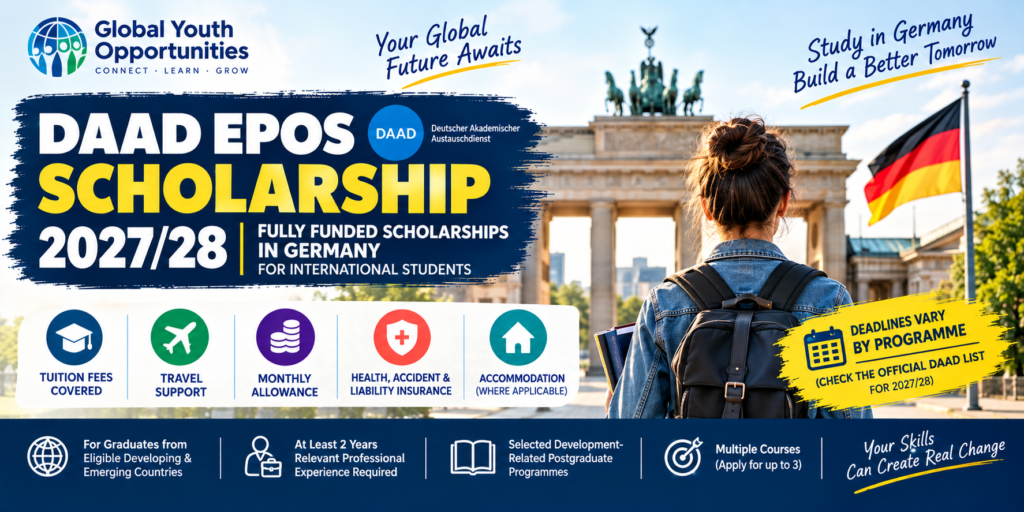
The scholarship can include a monthly allowance, insurance coverage and travel support, while the exact funding and programme conditions depend on the individual EPOS course.
Important: There is no single DAAD EPOS deadline. Each participating postgraduate programme has its own application deadline, and applications are normally submitted directly to the university or programme rather than directly to DAAD.
DAAD EPOS Scholarship 2027/28 at a Glance
| Feature | Details |
|---|---|
| Scholarship | DAAD Development-Related Postgraduate Courses (EPOS) |
| Country | Germany |
| Study level | Mainly Master’s; exceptional doctoral opportunities |
| Target applicants | Graduates from eligible developing and emerging countries |
| Work experience | At least 2 years of relevant professional experience |
| Study areas | Development-related fields across multiple disciplines |
| Funding duration | 12–42 months, depending on programme |
| Monthly scholarship | €992 for graduates; doctoral rate is higher |
| Insurance | Health, accident and personal liability insurance support |
| Travel | Travel allowance under the scholarship conditions |
| Application | Directly to the selected postgraduate programme |
| Number of courses | Applicants can apply for up to 3 courses |
| 2027/28 deadlines | Vary by programme |
What Is the DAAD EPOS Scholarship?
The Development-Related Postgraduate Courses (EPOS) programme is a DAAD scholarship scheme that supports qualified professionals from developing and emerging countries who want to pursue selected postgraduate programmes in Germany.
The programme is designed around development-related education. It aims to prepare specialists and future decision-makers who can use advanced knowledge and professional skills to contribute to economic, social, technological and other development challenges.
EPOS is therefore different from a general “study in Germany” scholarship.
The programme is particularly suitable for applicants whose:
- academic background fits a selected EPOS course;
- professional experience is relevant to the programme;
- career goals have a clear development connection;
- proposed study can contribute to their professional and social impact after graduation.
Is DAAD EPOS a Fully Funded Scholarship?
DAAD EPOS is commonly described as a fully funded scholarship, but applicants should understand exactly what the official funding package covers.
According to the current DAAD scholarship information, EPOS funding can include:
- €992 per month for graduates
- Higher monthly funding for doctoral candidates
- Health insurance
- Accident insurance
- Personal liability insurance
- Travel allowance, unless covered by another source
- Possible monthly rent subsidy under certain conditions
- Possible allowance for accompanying family members under certain conditions
Funding duration ranges from 12 to 42 months, depending on the selected study programme.
The exact financial package should always be checked against the current DAAD call and programme information.
Who Can Apply for DAAD EPOS 2027/28?
The programme is aimed at graduates from eligible developing and emerging countries.
A typical EPOS applicant should have:
- a relevant Bachelor’s degree;
- strong academic performance;
- at least two years of relevant professional experience after the Bachelor’s degree;
- professional experience related to development or the selected field;
- a clear motivation for studying the chosen programme;
- appropriate language proficiency;
- a realistic plan for applying the acquired knowledge after graduation.
Applicants should also check the official DAAD country eligibility list because EPOS is not open to citizens of every country.
DAAD EPOS Academic Requirements
Applicants normally need a Bachelor’s degree in a relevant subject.
DAAD states that applicants should generally have achieved above-average academic results, typically within the upper third of their graduating class.
However, academic excellence is only one part of the selection process.
EPOS also evaluates:
- professional experience;
- motivation;
- development relevance;
- language skills;
- suitability for the chosen programme;
- potential future impact.
This means an applicant should not treat EPOS as simply a GPA-based scholarship.
The 2-Year Work Experience Requirement
One of the most important EPOS requirements is professional experience.
Applicants generally need at least two years of relevant professional experience after completing their first degree.
This is one of the biggest differences between EPOS and many scholarships aimed at recent graduates.
Relevant experience may come from:
- government institutions;
- NGOs;
- international organisations;
- private-sector organisations;
- development projects;
- research and policy work;
- social-impact organisations;
- other professional roles related to the chosen field.
Applicants should carefully read the individual course requirements because relevance and documentation requirements can vary.
Why does EPOS require professional experience?
The programme is designed for professionals who can use advanced postgraduate education to contribute to development after their studies.
Therefore, your application should demonstrate a connection between:
Education → Professional experience → EPOS programme → Development impact → Future career
Eligible Countries for DAAD EPOS
EPOS is restricted to applicants from countries included in the programme’s official eligibility list.
The list covers developing and emerging countries across different regions.
Because the official country list can change, applicants should check the current DAAD eligibility list before applying rather than relying on an old blog post or social media list.
This is particularly important because eligibility can also depend on the applicant’s country of residence and other programme conditions.
What Can You Study Through DAAD EPOS?
EPOS supports selected postgraduate programmes rather than every Master’s programme offered by German universities.
The courses cover a broad range of development-related disciplines.
Possible subject areas include:
- Development studies
- Economics
- Public policy
- Environmental sciences
- Climate and sustainability
- Agriculture
- Natural resource management
- Engineering
- Public health
- Social sciences
- Education
- Urban development
- Water management
- Regional planning
- Governance
- International development
- Other development-related disciplines
The exact list of eligible courses for 2027/28 should be checked in the official DAAD EPOS course and deadline list.
DAAD EPOS 2027/28 Master’s Programmes
One of the strongest features of EPOS is the range of specialised postgraduate courses available through participating German universities.
Instead of applying to “DAAD” for a generic scholarship, you first identify a suitable EPOS-listed postgraduate programme.
The right course should match:
- Your Bachelor’s degree
- Your professional experience
- Your career goals
- Your development interests
- Your language qualifications
- Your future impact plans
Do not select a programme simply because it has a famous university name.
Programme fit is extremely important.
DAAD EPOS 2027/28 Deadlines
There is no single EPOS deadline.
This is one of the most important things applicants need to understand.
The official DAAD 2027/28 deadline list provides individual deadlines for participating courses.
Some programmes have deadlines in 2026, even though the scholarship-supported study begins in the 2027/28 academic year.
Therefore, applicants should begin preparing well before the end of 2026.
How to use the deadline list
For every programme you are considering, record:
| Information | What to check |
|---|---|
| University | Name of German university |
| Programme | Exact EPOS course |
| Degree | Master’s/other |
| Language | English/German |
| Deadline | Programme-specific date |
| Work experience | Required years |
| Academic background | Required Bachelor’s field |
| IELTS/TOEFL | Required score |
| Application method | University/course portal |
| Additional documents | Programme-specific requirements |
Never rely on one general “DAAD deadline.”
When Should You Apply for DAAD EPOS 2027/28?
Applicants should begin preparing several months before their chosen programme’s deadline.
A sensible preparation schedule is:
Now – September 2026
- Check EPOS eligibility
- Review your academic background
- Identify eligible countries
- Shortlist programmes
- Check work-experience requirements
- Start preparing your CV
September–October 2026
- Prepare motivation letter
- Request recommendation letters
- Collect employment certificates
- Check language requirements
- Prepare degree and transcript documents
October–December 2026
Many EPOS programme deadlines fall during this broader period, although exact dates vary.
Submit each application according to the official deadline of the selected course.
2027
Selected applicants progress through university and DAAD selection procedures according to the relevant programme’s process.
How to Apply for DAAD EPOS 2027/28
The application process is different from many centralized scholarship programmes.
Step 1: Check your eligibility
Confirm:
- country eligibility;
- Bachelor’s degree;
- academic performance;
- professional experience;
- language requirements;
- programme-specific requirements.
Step 2: Find an EPOS programme
Use the official DAAD EPOS programme list and identify courses that match your profile.
Step 3: Research the university
Read the programme’s official website carefully.
Check:
- curriculum;
- admission requirements;
- deadline;
- language;
- tuition fees;
- required documents;
- application portal;
- additional university requirements.
Step 4: Prepare your documents
Typical documents include:
- DAAD EPOS application form;
- CV;
- motivation letter;
- recommendation letter;
- employment certificates;
- degree certificate;
- academic transcripts;
- language certificate;
- other programme-specific documents.
Step 5: Apply directly to the programme
This is crucial.
EPOS applications are submitted directly to the selected postgraduate course/university.
Applications sent directly to DAAD are not simply forwarded to the university.
Step 6: University selection
The relevant programme or university reviews applications and may nominate suitable candidates for a DAAD scholarship.
Step 7: DAAD selection
Candidates recommended for the scholarship may then be contacted by DAAD and asked to submit documents through the DAAD Portal.
Can You Apply for More Than One EPOS Programme?
Yes.
According to the current DAAD EPOS instructions, applicants can apply for up to three courses.
If applying to more than one course, applicants must:
- rank their programmes by priority;
- explain the reasons for their choices;
- provide a coherent motivation;
- follow the relevant programme instructions.
Do not submit three completely unrelated applications.
A strong application should demonstrate why each selected programme fits your academic and professional trajectory.
Documents Required for DAAD EPOS
Although individual programmes may request additional materials, applicants should generally prepare:
Academic documents
- Bachelor’s degree certificate
- Academic transcripts
- Grading-system explanation where required
- Certified translations where applicable
Professional documents
- Employment certificates
- Proof of at least two years of relevant experience
- Current employer recommendation
- Other professional evidence where relevant
Application documents
- CV
- Motivation letter
- DAAD EPOS application form
- Language certificate
- Programme-specific forms
Additional documents
Depending on the programme, you may need:
- Research proposal
- Portfolio
- Additional recommendation
- Work samples
- Other academic or professional evidence
DAAD EPOS Motivation Letter
The motivation letter is one of the most important parts of the application.
Do not write a generic essay about how much you want to study in Germany.
Your motivation letter should answer:
1. Why this field?
Explain the academic and professional problem you want to address.
2. Why this programme?
Show that you understand the curriculum and explain how specific components fit your goals.
3. Why Germany?
Explain the academic or professional value of studying in the selected environment.
4. Why now?
Connect your professional experience with your need for advanced training.
5. What happens after graduation?
Explain how you intend to use your knowledge in your professional environment and contribute to development.
A strong structure is:
Past experience → Current challenge → Proposed study → Skills gained → Future impact
How to Make Your DAAD EPOS Application Stronger
1. Build a clear professional story
Your application should not look like a collection of unrelated achievements.
The selection committee should understand:
What you have done → What problem you understand → What you want to learn → What you will do with that knowledge.
2. Connect your experience to development
EPOS is development-oriented.
Explain the real-world problem your professional experience has exposed you to.
3. Choose programmes carefully
Don’t apply simply because a programme offers a scholarship.
Choose a course where your academic background and professional experience make sense.
4. Quantify your experience
Instead of:
“I worked on environmental projects.”
Write about:
- projects managed;
- people reached;
- research conducted;
- policies developed;
- partnerships created;
- measurable outcomes.
5. Make your future plan realistic
Avoid vague statements such as:
“I want to change the world.”
Instead explain:
what problem you will work on, where, with whom and how your new skills will help.
DAAD EPOS and IELTS
English-language EPOS programmes normally require proof of adequate English proficiency according to the relevant course requirements.
Depending on the programme, accepted evidence may include IELTS or TOEFL.
German-language courses have different requirements.
For German-taught programmes, applicants may need German-language proficiency and may receive preparatory language training under the scholarship conditions.
Do not assume that every DAAD EPOS programme has the same IELTS requirement.
Always check the individual course page.
Is DAAD EPOS Available for PhD Students?
EPOS is primarily associated with postgraduate and Master’s-level study, but the current DAAD description notes that in exceptional cases a doctoral degree may also be supported.
Therefore, applicants looking specifically for a fully funded PhD should not assume that every EPOS course offers doctoral funding.
Check the current programme list and individual course description.
Does DAAD EPOS Cover Tuition Fees?
The scholarship provides substantial financial support, but applicants should not assume that every participating programme has identical tuition arrangements.
Germany has many programmes with no or low tuition fees at public universities, but exceptions exist.
Applicants should check:
- tuition fees;
- semester contributions;
- programme-specific charges;
- living costs;
- scholarship coverage.
A scholarship being described as “fully funded” does not eliminate the need to check the university’s own financial requirements.
DAAD EPOS vs Other Scholarships
| Feature | DAAD EPOS | Chevening | Erasmus Mundus |
|---|---|---|---|
| Destination | Germany | UK | Europe |
| Main level | Master’s | Master’s | Master’s |
| Work experience | Important/required | Required | Varies |
| Development focus | Strong | Leadership/career | Programme-specific |
| Application | Programme/university | Central application | Individual programme |
| Deadline | Programme-specific | Central deadline | Programme-specific |
| Funding | Scholarship package | Fully funded | Scholarship package |
| Multiple countries | Usually Germany | UK | Often multiple European countries |
The right scholarship depends on your profile.
For an experienced professional with a development-focused career, EPOS can be particularly attractive.
DAAD EPOS vs DAAD Scholarships
Another common mistake is treating DAAD as one scholarship.
DAAD is the German Academic Exchange Service and administers many different funding programmes.
EPOS is one specific programme.
Other DAAD opportunities can have completely different:
- eligibility requirements;
- countries;
- deadlines;
- funding;
- study levels;
- application procedures.
Therefore:
DAAD scholarship ≠ automatically EPOS.
Always identify the exact DAAD programme before applying.
Common DAAD EPOS Mistakes
Avoid these errors:
❌ Applying without two years of relevant professional experience
❌ Choosing a programme unrelated to your Bachelor’s degree
❌ Ignoring the programme-specific deadline
❌ Sending the application directly to DAAD when the course requires direct submission
❌ Using a generic motivation letter
❌ Failing to explain development impact
❌ Submitting incomplete employment certificates
❌ Ignoring language requirements
❌ Assuming every German university has the same admission rules
❌ Relying on an old EPOS deadline list
❌ Calling every DAAD scholarship “fully funded”
DAAD EPOS Scholarship 2027/28: Application Checklist
Before submitting your application, check:
☐ I am from an eligible country
☐ I have a relevant Bachelor’s degree
☐ I meet the academic requirement
☐ I have at least two years of relevant professional experience
☐ My professional experience is connected to the programme
☐ I meet the language requirement
☐ I selected an eligible EPOS programme
☐ I checked the exact programme deadline
☐ My CV is complete and chronological
☐ My motivation letter is programme-specific
☐ I have the required recommendation letter
☐ I have employment certificates
☐ My degree and transcript documents are ready
☐ My translations are certified where required
☐ I followed the programme’s application instructions
☐ I submitted before the official deadline
Frequently Asked Questions
What is the DAAD EPOS Scholarship?
DAAD EPOS is a scholarship programme supporting qualified professionals from eligible developing and emerging countries to study selected development-related postgraduate programmes in Germany.
Is DAAD EPOS fully funded?
EPOS provides a substantial scholarship package that can include a monthly allowance, insurance and travel support. Additional benefits may apply depending on the applicant’s circumstances.
Applicants should check the current official scholarship terms.
How much is the DAAD EPOS stipend?
The current DAAD EPOS information lists €992 per month for graduates and a higher doctoral rate. The exact scholarship terms should be verified in the current call.
How many years of work experience are required?
Applicants generally need at least two years of relevant professional experience after completing their Bachelor’s degree.
Can fresh graduates apply?
Generally, no. The two-year professional experience requirement is a central EPOS eligibility condition.
Is there one DAAD EPOS deadline?
No.
Each participating postgraduate programme has its own deadline.
Where do I submit the EPOS application?
Applicants normally submit their applications directly to the selected postgraduate course or university.
Candidates recommended for the scholarship may later be contacted by DAAD for further documentation.
Can I apply to multiple EPOS programmes?
Yes. The current DAAD instructions allow applicants to apply for up to three courses, with priorities clearly indicated.
Do I need IELTS?
English-language programmes require proof of adequate English according to the individual course requirements. IELTS or TOEFL may be accepted, but requirements vary.
Can I study in Germany for free with DAAD EPOS?
EPOS can provide significant financial support, while many German public universities have low or no tuition fees for many programmes. However, university-specific fees and semester contributions can apply.
Always check the selected programme’s financial conditions.
Final Thoughts
The DAAD EPOS Scholarship 2027/28 is particularly valuable for applicants who already have professional experience and want to develop specialised knowledge that can contribute to development in their home country or region.
The biggest mistake is treating EPOS like a generic scholarship competition.
Instead, think of your application as a complete professional story:
Academic background + professional experience + development challenge + suitable German programme + future impact.
Start early, shortlist programmes carefully and verify every deadline directly with the university or programme.
Because EPOS deadlines are programme-specific, do not wait for one universal DAAD deadline.
Official DAAD EPOS Links
Official DAAD EPOS Programme:
DAAD – Development-Related Postgraduate Courses (EPOS)
Official DAAD Scholarship Database:
Use the DAAD database to check the current EPOS call, eligibility and application requirements.
Official 2027/28 EPOS Deadline List:
Check the current programme-by-programme deadline document before applying.
Official DAAD Study in Germany Database:
Use DAAD’s programme database to research participating German universities and degree programmes.
Related Scholarship Guides on Global Youth Opportunities
🎓 Fully Funded Scholarships 2027 for International Students
🇬🇧 Chevening Scholarships 2027/28
🇬🇧 Commonwealth Master’s Scholarships 2027/28
🇬🇧 Commonwealth PhD Scholarships 2027/28
🇪🇺 Erasmus Mundus Programmes 2027
🇷🇺 Open Doors Russian Scholarship 2026–27
🇺🇸 Fully Funded PhD Programs in USA 2027
🇺🇸 Graduate Assistantships in USA for International Students 2027
🇺🇸 Undergraduate Scholarships in USA for International Students 2027
Bookmark Global Youth Opportunities and check back regularly for newly announced 2027 scholarship deadlines and opportunities.