
The Clarendon Scholarship 2027 is one of the major fully funded graduate scholarship opportunities at the University of Oxford for students beginning postgraduate study in the 2027–28 academic year.
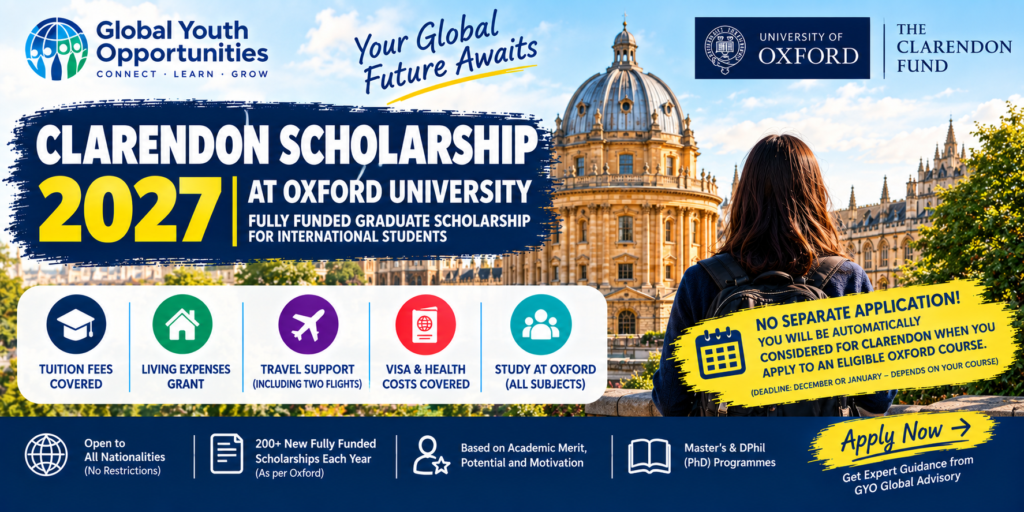
The Clarendon Fund offers around 200 new fully funded scholarships each year to outstanding graduate students from around the world.
One of the most attractive features of the scholarship is that applicants do not need to submit a separate Clarendon scholarship application.
Instead, eligible applicants who apply for a new Oxford Master’s or DPhil course by the relevant December or January graduate admissions deadline are automatically considered for Clarendon funding.
The scholarship is open across academic disciplines and has no nationality or country-of-residence restrictions.
This makes Clarendon an important opportunity for international students seeking fully funded postgraduate study in the United Kingdom.
Clarendon Scholarship 2027: Quick Overview
| Feature | Details |
|---|---|
| Scholarship | Clarendon Scholarship |
| Provider | University of Oxford / Clarendon Fund |
| University | University of Oxford |
| Country | United Kingdom |
| Academic year | 2027–28 |
| Level | Master’s and DPhil |
| Nationality | No restrictions |
| Subject | No restrictions |
| Tuition fees | Covered in full |
| Living support | Annual grant for full-time scholars |
| Application | No separate scholarship application |
| Deadline | December or January, depending on Oxford course |
| Selection | Academic merit and potential |
| Study start | 2027 |
| Official website | University of Oxford |
What Is the Clarendon Scholarship?
The Clarendon Fund is a major graduate scholarship programme at the University of Oxford.
It provides financial support to outstanding students undertaking eligible Master’s and DPhil programmes.
In addition to financial support, Clarendon scholars become part of an international and multidisciplinary community at Oxford.
The programme has supported scholars from around the world and currently has more than 700 scholars studying at Oxford from around 70 different nations.
Clarendon is particularly attractive because students do not have to compete through a separate scholarship application form.
Instead, the scholarship selection process is connected to the Oxford graduate admissions process.
Is the Clarendon Scholarship Fully Funded?
For eligible full-time Master’s and DPhil scholars, Clarendon provides:
- Full coverage of Oxford course fees
- An annual grant for living expenses
- Funding for the period of fee liability of the scholar’s course
- Access to the Clarendon scholar community
Oxford states that Clarendon scholarships cover course fees in full for both Home and Overseas fee-status students.
For full-time scholars, an annual grant for living expenses is also provided.
The published living-cost grant was at least £20,780 for the 2025–26 academic year. The amount applicable to students beginning in 2027 should be checked against the latest Oxford information when funding packages are confirmed.
Important distinction for part-time students
Clarendon also supports eligible part-time Master’s and DPhil courses, but the funding structure is different.
Part-time scholars receive a study support grant to assist with non-fee costs rather than the full-time living-cost grant.
Therefore, applicants should check the funding terms applicable to their specific course.
What Does the Clarendon Scholarship Cover?
1. Full course fees
Clarendon covers Oxford course fees in full for eligible scholars.
This applies to both:
- Home fee-status students
- Overseas fee-status students
2. Living-cost support
Full-time scholars receive an annual grant to support their living expenses in Oxford.
The current published figure is at least £20,780 for 2025–26.
The amount for 2027–28 may be different.
3. Funding for the fee-liability period
Clarendon scholarships are normally offered for the period during which the scholar is liable to pay fees, subject to the applicable scholarship conditions.
This means the total value of the scholarship depends partly on the duration and structure of the Oxford programme.
Who Can Apply for the Clarendon Scholarship 2027?
Clarendon is open to applicants from all nationalities and countries of ordinary residence.
There are also no restrictions based on academic subject.
Applicants must generally be applying for a new eligible Master’s or DPhil course at Oxford.
Eligible applicants can include students applying for:
- Full-time Master’s programmes
- Part-time Master’s programmes
- Full-time DPhil programmes
- Part-time DPhil programmes
Applicants should always check whether their particular Oxford course is eligible and identify the correct graduate admissions deadline.
Clarendon Scholarship Eligibility Requirements
Although Clarendon does not use a simple checklist of minimum grades applicable to every applicant, Oxford provides clear selection guidance.
The main factors include:
Outstanding academic record
Academic excellence is central to Clarendon selection.
Oxford states that the majority of successful scholars usually have at least a first-class honours degree or equivalent.
However, academic assessment is considered in the context of the applicant’s field and educational background.
Academic potential
Applicants should demonstrate the potential to succeed at Oxford and contribute intellectually to their field.
Motivation
Applicants need to demonstrate a strong commitment to their proposed course.
Their academic and professional direction should make sense in relation to the programme they are applying for.
Personal statement and references
Oxford considers the applicant’s personal statement and referees’ reports as part of the assessment.
Strong references should provide meaningful evidence of academic ability, potential and suitability rather than simply confirming that the applicant is a good student.
Is the Clarendon Scholarship Open to International Students?
Yes.
There are no restrictions on nationality or ordinary residence for Clarendon.
Students from around the world can be considered provided they meet the relevant Oxford graduate admissions and scholarship requirements.
This makes Clarendon particularly relevant for international applicants looking for fully funded Master’s and DPhil opportunities in the UK.
What Subjects Can You Study with Clarendon?
Clarendon has no subject-area restrictions.
Applicants can therefore pursue eligible graduate programmes across Oxford’s academic divisions.
Potential areas include:
- International Relations
- Politics
- Public Policy
- Development Studies
- Economics
- Law
- Environmental Studies
- Climate Change
- Computer Science
- Artificial Intelligence
- Engineering
- Medicine
- Public Health
- Education
- Sociology
- Anthropology
- History
- Philosophy
- Literature
- Languages
- Mathematics
- Physics
- Biology
- Chemistry
- Geography
- Area Studies
The important requirement is that the applicant must apply to an eligible Oxford graduate course.
Clarendon Scholarship 2027 Deadline
This is one of the most important things applicants need to understand.
There is no separate Clarendon Scholarship deadline.
Instead, applicants must submit their Oxford graduate course application by the December or January deadline applicable to their chosen course.
Oxford’s graduate courses have different application deadlines.
Therefore:
Your Clarendon deadline is the Oxford graduate application deadline for your chosen course, not one universal Clarendon date.
For example, one Oxford course may have a December deadline while another may have a January deadline.
Applicants should therefore never rely on a generic article stating that “the Clarendon deadline is January.”
How to find your deadline
- Go to the official Oxford graduate course directory.
- Find your intended Master’s or DPhil programme.
- Open the course page.
- Check the application deadlines.
- Submit your complete graduate application before the relevant December or January deadline.
- You will then be automatically considered for Clarendon.
Do You Need a Separate Clarendon Scholarship Application?
No.
This is one of the biggest advantages of the Clarendon Fund.
You do not need to complete a separate Clarendon scholarship application.
You also do not need to submit a separate Clarendon scholarship form.
Instead, you must:
Apply to an eligible Oxford graduate course → meet the relevant December/January deadline → automatically enter Clarendon consideration.
Oxford’s official guidance states that candidates who apply for eligible full-time or part-time Master’s or DPhil programmes by the relevant deadline are automatically considered.
How to Apply for the Clarendon Scholarship 2027
Step 1: Choose your Oxford course
Start by identifying the Master’s or DPhil programme you want to study.
Consider:
- Academic background
- Research interests
- Career objectives
- Programme structure
- Entry requirements
- Course duration
- Application deadline
Your chosen programme should be a strong academic fit rather than simply a programme selected because it is associated with Oxford.
Step 2: Check Oxford’s admission requirements
Each graduate programme has its own admission requirements.
These can include:
- Academic qualifications
- Minimum grades
- Relevant academic background
- English-language requirements
- Research proposal
- Writing sample
- References
- CV
- Personal statement
- Additional programme-specific materials
Requirements vary significantly between Oxford courses.
Step 3: Prepare your application documents
Depending on your course, you may need:
- Academic transcripts
- Degree certificates
- CV/resume
- Personal statement
- Statement of purpose
- Research proposal
- Writing sample
- References
- English-language evidence
- Additional programme-specific documents
Do not prepare every document using the same generic template.
Oxford departments assess applicants according to their specific academic requirements.
Step 4: Submit the Oxford graduate application
Submit your application through Oxford’s graduate admissions system.
Make sure you submit by the relevant December or January deadline.
Because there is no separate Clarendon application, your graduate application is what places you into consideration for the scholarship.
Step 5: Scholarship consideration
After you submit your graduate application, your proposed academic department assesses your application.
Academic staff consider:
- Academic quality
- Suitability for the proposed course
- Academic potential
- Motivation
- References
- Other relevant evidence
Departments then nominate candidates for Clarendon consideration.
Step 6: Divisional selection
Academic divisions review the nominations.
Candidates are assessed based on academic merit and future potential.
The strongest candidates are shortlisted for Clarendon funding.
Step 7: Receive the scholarship decision
Successful Clarendon candidates are normally contacted by email.
Oxford says that most initial Clarendon offers are sent by the end of April.
Unsuccessful applicants are not normally contacted individually. Oxford advises that if an applicant has not heard by mid-June, they should assume they have not been awarded Clarendon funding.
Clarendon Scholarship 2027 Timeline
The precise dates depend on the Oxford course and admissions cycle, but the general process follows this structure:
2026
Autumn 2026
Applications for many Oxford graduate courses open.
Applicants begin preparing their admissions applications.
December 2026 – January 2027
Applicants submit their Oxford graduate applications by the relevant course deadline.
This automatically places eligible applicants into consideration for Clarendon.
February–March 2027
Academic departments and Oxford divisions assess scholarship nominations.
April 2027
Most initial Clarendon scholarship offers are expected to be sent.
April–Summer 2027
Funding packages and partnership awards are finalised.
October 2027
Successful scholars begin their studies at Oxford.
What Does Clarendon Look For?
Oxford identifies two broad areas in its applicant guidance:
1. Outstanding academic record
The scholarship seeks applicants with exceptional academic ability.
Strong grades are important, but applicants should also demonstrate academic depth and potential.
2. Student motivation
Applicants should show a convincing commitment to their proposed Oxford course.
The personal statement and referees’ reports can help demonstrate this.
For research degrees, applicants should also demonstrate the intellectual strength and feasibility of their proposed research.
How Competitive Is the Clarendon Scholarship?
Clarendon is highly competitive.
Oxford states that its goal is to select the best students worldwide through academic assessment by experts in the relevant fields.
The scholarship receives a large pool of strong applicants.
Therefore, meeting the basic admission requirements does not guarantee scholarship selection.
Applicants should treat the Oxford graduate application itself as the foundation of their scholarship application.
Tips for a Strong Clarendon Scholarship Application
1. Choose the right Oxford programme
Do not select a course simply because it is highly ranked.
Your academic background and future goals should demonstrate a clear connection to the programme.
2. Build a strong academic case
Highlight:
- Academic achievements
- Research
- Publications
- Academic awards
- Relevant projects
- Dissertation work
- Relevant professional experience
Use evidence rather than unsupported claims.
3. Make your motivation specific
Avoid generic statements such as:
“I have always dreamed of studying at Oxford.”
Instead, explain:
- Why this field?
- Why this particular course?
- Why Oxford?
- What problem do you want to work on?
- What skills do you need?
- How will the programme contribute to your future work?
4. Select strong referees
Choose people who can provide detailed evidence of your academic ability and potential.
5. Follow programme-specific instructions
Oxford’s courses have different requirements.
A DPhil applicant may need a research proposal, while a taught Master’s programme may require different materials.
6. Apply before the deadline
Because Clarendon consideration is tied to the Oxford graduate application, missing your course’s deadline can mean losing consideration for the scholarship.
Common Mistakes Applicants Should Avoid
Mistake 1: Looking for a separate Clarendon application
There isn’t one.
Your Oxford graduate application automatically triggers consideration if you meet the relevant deadline.
Mistake 2: Assuming there is one Clarendon deadline
There isn’t.
The deadline depends on your Oxford course.
Mistake 3: Applying only because Oxford is prestigious
The academic fit needs to be clear.
Mistake 4: Ignoring course-specific requirements
Each programme can have different requirements.
Mistake 5: Using a generic personal statement
Your statement should be relevant to the specific course and your own academic direction.
Mistake 6: Waiting until January
Some Oxford courses have December deadlines.
Always check your course page.
Mistake 7: Assuming admission means funding
Admission to Oxford does not automatically mean you will receive Clarendon funding.
The scholarship is separately competitive.
Clarendon vs Rhodes Scholarship
Both are major Oxford funding opportunities, but their application structures are different.
| Feature | Clarendon | Rhodes |
|---|---|---|
| University | Oxford | Oxford |
| Level | Master’s & DPhil | Eligible postgraduate programmes |
| Nationality | No restrictions | Constituency-based |
| Separate scholarship application | No | Yes, through relevant route |
| Main selection emphasis | Academic merit & potential | Academic excellence, leadership, character & service |
| Deadline | Oxford course deadline | Varies by constituency |
| Tuition | Fully covered | Fully covered |
| Living support | Yes for full-time scholars | Yes |
| Start | 2027 | 2027 |
For applicants considering Oxford, both should be researched carefully because their eligibility and application mechanisms are different.
Clarendon Scholarship vs Other UK Scholarships
| Scholarship | Destination | Level | Application |
|---|---|---|---|
| Clarendon | Oxford | Master’s/DPhil | Automatic consideration |
| Rhodes | Oxford | Postgraduate | Separate constituency-based application |
| Chevening | UK | Master’s | Separate application |
| Commonwealth Master’s | UK | Master’s | Separate application |
| Commonwealth PhD | UK | PhD | Separate application |
| GREAT Scholarships | UK | Postgraduate | University-specific |
| Erasmus Mundus | Europe | Master’s | Programme-specific |
The key advantage of Clarendon from an application-management perspective is that there is no additional scholarship form.
GYO Global Advisory: Clarendon Scholarship Application Support
Applying to Oxford is highly competitive, and the absence of a separate Clarendon form does not mean that the process is simple.
Your Oxford graduate application is also your route into Clarendon consideration.
GYO Global Advisory provides structured support for applicants preparing competitive Oxford and international scholarship applications.
Our support can include:
Profile Assessment
Review your academic and professional background and identify suitable Oxford programmes.
Oxford Programme Strategy
Help you evaluate programmes based on your academic background, research interests and long-term objectives.
CV/Resume Review
Improve structure, clarity, relevance and presentation while preserving your actual experiences.
Application Strategy
Develop a coherent strategy for presenting your academic achievements, research interests, professional experience and future goals.
Personal Statement Review
Provide feedback on clarity, structure, relevance and consistency while keeping the applicant’s own ideas and voice central.
Research Proposal Review
For DPhil applicants, review the structure, research question, methodology and overall coherence of a proposal.
Reference Strategy
Help applicants identify suitable referees and prepare a clear strategy for requesting strong academic references.
Document Review
Check application materials for consistency, completeness and alignment with programme requirements.
Interview Preparation
Practice potential Oxford admission or scholarship-related interview questions.
Final Application Check
Review the final checklist before submission.
Important
GYO Global Advisory does not guarantee Oxford admission, Clarendon selection, funding or visa approval.
Applicants remain responsible for the accuracy, originality and final submission of their applications.
Clarendon Scholarship 2027 Checklist
Before submitting your Oxford application, make sure you have:
☐ Selected an eligible Master’s or DPhil course
☐ Checked the Oxford course-specific entry requirements
☐ Checked the exact December or January deadline
☐ Prepared your academic transcripts
☐ Prepared your CV/resume
☐ Prepared your personal statement where required
☐ Prepared your research proposal where required
☐ Selected appropriate referees
☐ Prepared English-language evidence if required
☐ Reviewed all programme-specific requirements
☐ Submitted your Oxford application before the deadline
☐ Confirmed that your application is eligible for Clarendon consideration
☐ Saved confirmation of your Oxford application
Frequently Asked Questions
What is the Clarendon Scholarship 2027?
The Clarendon Scholarship is a major University of Oxford graduate scholarship programme providing full course-fee coverage and living-cost support for eligible full-time scholars.
Is Clarendon fully funded?
For eligible full-time Master’s and DPhil scholars, Clarendon covers course fees in full and provides an annual living-cost grant. Part-time awards have a different study-support structure.
Can international students apply?
Yes. There are no restrictions on nationality or ordinary residence.
What is the Clarendon Scholarship deadline?
There is no single deadline. Applicants must submit their Oxford graduate application by the December or January deadline applicable to their chosen course.
Do I need a separate Clarendon application?
No. Eligible applicants are automatically considered when they apply to their Oxford graduate course by the relevant deadline.
What degrees are eligible?
Clarendon supports eligible full-time and part-time Master’s and DPhil courses.
Can I apply for Clarendon for any subject?
Yes. There are no subject-area restrictions.
How much does Clarendon pay?
The current published minimum living-cost grant for full-time scholars is at least £20,780 for the 2025–26 academic year. The amount for 2027–28 may differ.
Does Clarendon cover tuition for international students?
Yes. Oxford states that Clarendon covers course fees in full for both Home and Overseas fee-status students.
When are Clarendon decisions announced?
Most initial Clarendon offers are normally sent by the end of April, although the overall funding process can continue into the summer.
Can current Oxford students apply?
Current students continuing on the same degree are not eligible. However, some current Oxford Master’s students who are applying for a new DPhil or second eligible Master’s course can be considered.
Are deferred Oxford offers eligible?
No. Applicants holding deferred graduate offers are not eligible for Clarendon consideration.
Final Thoughts
The Clarendon Scholarship 2027 provides an important route to fully funded postgraduate study at the University of Oxford.
Its combination of full course-fee coverage, living support for full-time scholars, global eligibility and broad subject coverage makes it an opportunity worth researching carefully.
Perhaps the most important point for applicants is simple:
You do not apply separately for Clarendon. You apply to Oxford.
Your Oxford graduate application must be submitted by the relevant December or January course deadline to enter Clarendon consideration.
Because Oxford courses have different deadlines, applicants should begin by identifying their programme and checking its official admissions page.
For students planning to begin postgraduate study at Oxford in 2027, the time to prepare is now.
Official Oxford Resources
University of Oxford — Clarendon Fund
Clarendon information for applicants
Oxford Graduate Courses
Oxford Scholarships
Oxford Graduate Admissions
Always verify the latest eligibility requirements, course deadlines and funding information on the official University of Oxford website before submitting an application.
Official links to add to GYO
- Clarendon Fund — University of Oxford
- Information for Clarendon applicants
- Oxford Graduate Scholarships
- Oxford Graduate Courses
Suggested Opportunities: