
Are you dreaming of studying for a master’s degree in the United Kingdom but worried about the cost of tuition, accommodation, travel, and living expenses?
The Chevening Scholarship 2027 could be one of the most valuable opportunities available to you.
Chevening is the UK government’s international scholarship programme, funded by the Foreign, Commonwealth and Development Office (FCDO) and partner organisations. It supports outstanding emerging leaders from around the world to pursue a one-year master’s degree in the UK.
The scholarship is designed for people who demonstrate leadership potential, have a clear vision for their future, and want to use their education and professional networks to create positive change.
For the current 2027–28 scholarship cycle, applications opened on 4 August 2026 and the application deadline is 6 October 2026 at 11:00 UTC. Successful scholars are expected to begin their studies in the UK in September or October 2027.
This comprehensive guide from Global Youth Opportunities explains the Chevening Scholarship from eligibility and funding to application strategy, essays, university choices, interviews, deadlines, and common mistakes.
What Is the Chevening Scholarship?
Chevening is the UK’s flagship international scholarship programme for future leaders.
The programme enables outstanding individuals from eligible countries and territories to complete a one-year taught master’s degree at a UK university.
Chevening is particularly interested in applicants who demonstrate the potential to make an impact in areas such as:
- Economic growth and prosperity
- Climate resilience
- Global security
- Social development
- Good governance
- Inclusive societies
- International cooperation
The programme combines academic study with professional development, networking and engagement opportunities.
Rather than simply funding a degree, Chevening aims to create a global community of leaders who can use their knowledge and connections to address challenges in their countries and internationally.
Chevening Scholarship 2027 at a Glance
| Feature | Details |
|---|---|
| Scholarship | Chevening Scholarship |
| Current Cycle | 2027–28 |
| Host Country | United Kingdom |
| Degree | One-year taught Master’s |
| Funding | Fully funded |
| Provider | UK Government / FCDO and partners |
| Applications Opened | 4 August 2026 |
| Application Deadline | 6 October 2026, 11:00 UTC |
| Studies Begin | September/October 2027 |
| Applicants | Citizens of eligible countries and territories |
| Work Experience | Minimum 2,800 hours after undergraduate degree |
| Return Requirement | At least 2 years after scholarship |
| Age Limit | No upper age limit |
The exact eligibility requirements and participating countries should always be checked on the official Chevening website before applying.
What Does the Chevening Scholarship Cover?
One of the biggest reasons Chevening is considered one of the world’s leading fully funded master’s scholarships is its comprehensive financial package.
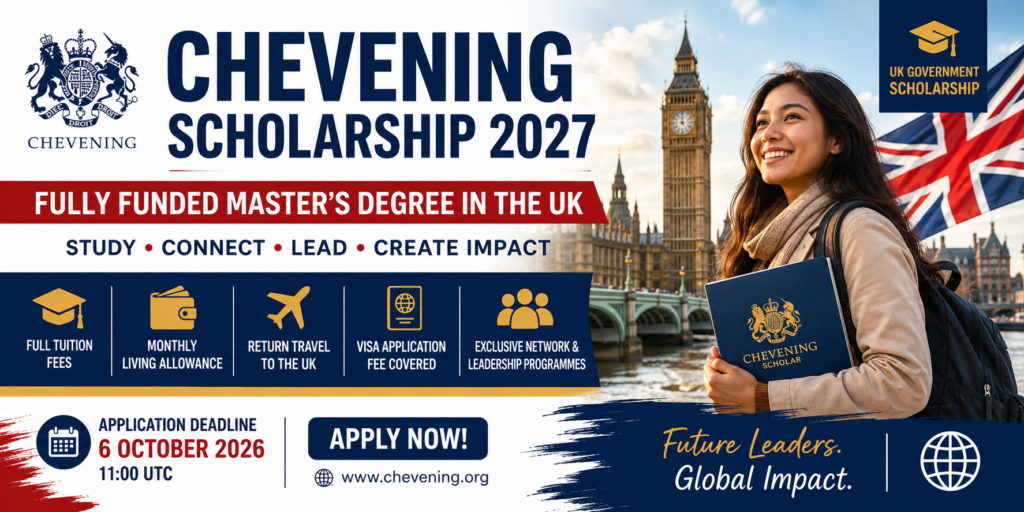
According to Chevening, scholars receive support that includes:
Full Tuition Fees
The programme covers approved tuition fees for the eligible master’s course.
Monthly Living Allowance
Scholars receive a monthly personal stipend intended to help cover accommodation and living expenses.
The amount varies depending on whether the scholar is studying in London or outside London, and rates are subject to annual review.
Return Travel
Chevening provides economy travel to and from the scholar’s country of residence through an approved route for the scholar.
Arrival Allowance
An arrival allowance is provided to help scholars with initial expenses when they arrive in the UK.
Visa Application Support
Chevening covers the cost of an eligible entry-clearance visa application for the scholar.
Departure Allowance
A departure allowance is also included as part of the scholarship package.
TB Testing Contribution
Where required for the visa application, Chevening provides a contribution of up to £75 toward TB testing.
Travel Top-Up Allowance
Additional travel support may be available under the scholarship’s terms.
Networking and Professional Development
Chevening is not simply a financial award.
Scholars participate in a tailored engagement programme that provides opportunities to connect with:
- Other Chevening scholars
- Chevening alumni
- FCDO representatives
- High-profile speakers
- Partner organisations
- Professionals from different sectors
This international network is one of the programme’s major long-term benefits.
Who Can Apply for Chevening?
Chevening is aimed at outstanding individuals who have the potential to become future leaders and influencers.
However, applicants must satisfy specific eligibility criteria.
According to the current Chevening eligibility requirements, applicants must:
- Be a citizen of a Chevening-eligible country or territory.
- Commit to returning to their country of award for at least two years after their scholarship ends.
- Have at least 2,800 hours of work experience acquired after completing their undergraduate degree.
- Hold an undergraduate degree that qualifies them for entry to a UK postgraduate programme.
- Meet the other programme-specific eligibility requirements.
Chevening Work Experience Requirement
This is one of the most important parts of the application.
Applicants need at least 2,800 hours of work experience acquired after completing their undergraduate degree. This is approximately equivalent to two years of full-time work, although the experience does not necessarily have to be completed in a conventional full-time job.
Eligible experience can include:
- Full-time employment
- Part-time employment
- Voluntary work
- Paid internships
- Unpaid internships
Applicants can enter up to 15 different work-experience periods in their application.
This means your professional experience does not necessarily need to come from one employer.
Can Volunteer Experience Count?
Yes.
Chevening recognizes several forms of work experience, including voluntary work and internships.
This can be particularly useful for applicants who have developed their professional profile through a combination of employment, volunteering, internships, community initiatives, research, or other relevant activities.
However, the experience must satisfy Chevening’s rules and be acquired after completing the undergraduate degree for the current scholarship criteria.
Is There an Age Limit for Chevening?
There is no upper age limit for applying for a Chevening Scholarship.
This makes Chevening different from many scholarship programmes that impose a maximum age.
The programme instead focuses on factors such as:
- Leadership potential
- Professional experience
- Career goals
- Impact
- Academic suitability
- Ability to contribute to the Chevening community
Do You Need a Master’s Degree Already?
No.
You do not need to have completed a master’s degree to apply.
Chevening is primarily designed to support applicants pursuing a one-year taught master’s degree in the UK.
Applicants who already hold a master’s degree may also be eligible, provided they satisfy the other requirements and their chosen UK courses meet Chevening’s criteria.
Can You Apply for a PhD Through Chevening?
No.
This is an important distinction for students searching for fully funded PhD scholarships in the UK.
Chevening Scholarships generally fund one-year taught master’s degrees. PhD programmes are not eligible for funding under the standard Chevening Scholarship.
If you’re looking for fully funded doctoral opportunities, explore alternatives such as:
- Commonwealth PhD Scholarships
- University-funded PhD positions
- Research Council funding
- Gates Cambridge opportunities
- Other UK government and university scholarships
Internal Link: Fully Funded Scholarships 2027
What Kind of Student Does Chevening Look For?
Chevening is not simply looking for applicants with excellent grades.
The programme is particularly focused on individuals who can demonstrate leadership, influence, networking ability, and a realistic vision for creating impact.
A strong applicant might have experience in:
- Government
- Business
- Civil society
- Academia
- Journalism
- International development
- Climate action
- Human rights
- Technology
- Entrepreneurship
- Public policy
- Community development
The key is not simply the job title.
Your application needs to demonstrate what you have done, how you influenced others, what you learned, and what you plan to accomplish in the future.
Why Study in the UK Through Chevening?
The United Kingdom is home to some of the world’s most internationally recognized universities.
Studying in the UK can provide access to:
- High-quality academic programmes
- Global research networks
- International faculty
- Professional organizations
- Multicultural communities
- Industry connections
- International conferences
- Career development opportunities
A one-year UK master’s degree can also allow students to complete postgraduate education faster than many comparable programmes elsewhere.
Benefits Beyond Financial Support
The value of Chevening extends well beyond tuition and living expenses.
Global Network
Chevening scholars join a global community of professionals and future leaders.
Leadership Development
The programme encourages scholars to develop their ability to influence and create meaningful change.
International Exposure
Living in the UK exposes scholars to different cultures, institutions, ideas, and professional environments.
Career Development
The combination of an internationally recognized master’s degree and a global professional network can strengthen long-term career opportunities.
Alumni Community
After completing the scholarship, scholars become part of the wider Chevening alumni community.
This creates opportunities for continued networking and collaboration long after returning home.
Chevening Scholarship 2027 Application Deadline
For the current 2027–28 cycle, the official timeline is:
Applications open: 4 August 2026
Applications close: 6 October 2026 at 11:00 UTC
Applications sifted: From October 2026
Reading committee assessment: Mid-October 2026 to January 2027
Interview shortlist: Mid-February 2027
Interviews: March–April 2027
Results: From mid-June 2027
Unconditional university offer deadline: 8 July 2027 at 17:00 BST
Studies begin: September/October 2027
Important
Do not wait until the final day to submit your application.
The Chevening application system closes at the stated deadline, and applicants cannot access the system after the closing time.
Chevening Scholarship Application Strategy
Winning Chevening is highly competitive. Simply meeting the eligibility requirements does not guarantee selection.
Your application should tell a coherent story:
Past → Present → Future
Past
What experiences shaped your leadership and professional development?
Present
Why do you need this specific master’s degree now?
Future
How will you use your education, network and skills to create measurable impact?
This narrative should be consistent throughout your application.
Also visit these Global Youth Opportunities
Links:
- Fully Funded Scholarships 2026-27
- Canada Scholarships 2026-27
- DAAD Scholarship Germany 2026
- World Bank Internship 2026
- UNICEF Internship 2026
- UNDP Jobs 2026
How to Build a Competitive Chevening Application
The Chevening Scholarship is highly competitive, so meeting the basic eligibility requirements is only the first step. A strong application needs to demonstrate leadership, influence, relationship-building, academic purpose, and a realistic plan for future impact.
For the 2027–28 cycle, applicants must complete the application online and provide information about their education, work experience, three preferred UK master’s courses, two referees, and four essay responses.
Chevening Scholarship Eligibility Checklist
Before investing significant time in your application, make sure you satisfy the core eligibility requirements.
You must:
- Be a citizen of a Chevening-eligible country or territory.
- Commit to returning to your country of award for at least two years after your scholarship ends.
- Have at least 2,800 hours of eligible work experience acquired after completing your undergraduate degree.
- Hold an undergraduate degree that qualifies you for entry to a UK master’s programme.
- Meet the applicable course and programme requirements.
- Meet Chevening’s other eligibility conditions, including restrictions relating to previous UK government-funded study.
Applicants who do not meet the eligibility criteria can have their applications rejected, so checking the official requirements before preparing the essays is essential.
The 2,800-Hour Work Experience Requirement
One of the most important Chevening requirements is work experience.
Applicants need at least 2,800 hours of work experience after completing their undergraduate degree. Chevening describes this as roughly equivalent to two years of full-time work, although the hours can be accumulated through different types of experience.
This requirement is particularly important because many otherwise strong applicants misunderstand how their experience is calculated.
What Types of Work Experience Count?
Chevening accepts several forms of work experience, including:
- Full-time employment
- Part-time employment
- Voluntary work
- Paid internships
- Unpaid internships
Applicants can include up to 15 different employment periods in their application.
This means you don’t necessarily need to have spent two continuous years working for one organization.
For example, an applicant may have accumulated qualifying experience through:
Job → Internship → NGO volunteering → Part-time employment
provided that the experience meets Chevening’s requirements.
How Is Work Experience Calculated?
The Chevening application system calculates work experience based on the number of weeks worked and the number of hours worked per week.
The system then determines whether the applicant reaches the required 2,800 hours.
Example
Suppose an applicant worked:
- 40 hours/week for 40 weeks = 1,600 hours
- 20 hours/week for 30 weeks = 600 hours
- 20 hours/week for 30 weeks = 600 hours
Total:
1,600 + 600 + 600 = 2,800 hours
The important point is to enter your experience accurately. Chevening specifically warns applicants against entering unrealistic working hours, duplicating the same experience, or incorrectly calculating weeks.
Does Work Experience Have to Match Your Master’s Degree?
Not necessarily.
Your professional experience and chosen course can be different, but if there is a significant change in direction, you need to explain the reasoning convincingly.
For example, someone with a background in economics who wants to study climate policy could explain how their previous experience exposed them to economic and environmental challenges and why specialized climate-policy training is the logical next step.
Chevening advises applicants changing career direction to explain the transferable skills they have developed and how those skills will support their studies and future career.
Choosing Your Three Chevening Courses
Applicants must select three eligible UK master’s courses in their Chevening application.
This decision should not be treated as a formality.
Your three choices should tell a coherent academic and professional story.
A strong strategy is:
Your background → Your problem/interest → Master’s degree → Future career → Impact
For example:
Public policy experience → climate governance challenges → MSc Climate Change and Development → climate-policy leadership → stronger national climate adaptation policies.
This creates a logical connection between your past, your proposed study and your future goals.
Should the Three Courses Be Similar?
Ideally, your choices should be closely connected to your career goals.
Chevening has advised applicants to choose courses that are similar in content so that their choices demonstrate commitment to a specific career direction. It also recommends considering three different universities to increase the likelihood of receiving an offer.
For example, instead of choosing:
- International Relations
- MBA
- Computer Science
a candidate focused on international development might choose:
- Development Studies
- International Development
- Public Policy and Development
This creates a much stronger narrative.
How to Research Your Courses
Before selecting a course, investigate:
1. Course Content
Read the complete course description.
Look for:
- Core modules
- Optional modules
- Research components
- Practical projects
- Assessment methods
2. Faculty Expertise
Research professors, researchers and academic centres connected to the programme.
This is especially important if your future career involves research, policy or specialist expertise.
3. Career Outcomes
Find out what graduates typically do after completing the programme.
Ask yourself:
Will this degree actually help me achieve the career goal I describe in my Chevening application?
4. University Strengths
Don’t choose a university simply because it has a famous name.
Look for institutions with genuine strengths in your chosen field.
5. Entry Requirements
Check each university’s official website for:
- Academic requirements
- English-language requirements
- Supporting documents
- Application deadlines
- Work experience requirements
- International student requirements
Chevening itself recommends checking university and course requirements carefully.
Do You Need to Apply to Universities Before Chevening?
You do not have to have already applied to your three chosen courses when submitting the Chevening application.
However, Chevening recommends applying to your chosen UK courses as soon as possible after submitting the scholarship application.
If you are successful in the Chevening process, you must eventually obtain an unconditional offer from at least one eligible UK university course by the specified deadline.
For the 2027–28 cycle, the deadline for submitting an unconditional UK university offer is 8 July 2027 at 17:00 BST.
Chevening References
Applicants are required to provide details of two referees in the application.
If you progress to the interview stage, you will need to upload reference letters from those referees.
Choose referees who can genuinely discuss your:
- Professional abilities
- Leadership
- Character
- Achievements
- Potential
- Relationship-building skills
A referee should know your work well rather than simply having an impressive job title.
What Makes a Strong Chevening Reference?
A useful reference should provide specific evidence.
Weak:
Jhon is hardworking and passionate.
Stronger:
Jhon demonstrated leadership by coordinating a multi-stakeholder youth initiative, bringing together participants from different organizations and translating the group’s recommendations into a structured policy proposal.
The second example provides evidence rather than simply describing personality.
The Four Chevening Essay Areas
The application includes four essay questions focused on:
- Leadership and influence
- Relationship-building and networking
- Your course choices and why studying in the UK matters
- Your future career plans and ambitions
These four areas correspond directly to Chevening’s assessment criteria.
Essay 1: Leadership and Influence
This section asks you to demonstrate that you have the ability to lead and influence others.
Chevening’s guidance emphasizes examples where applicants have:
- Driven change
- Improved outcomes
- Solved a specific challenge
- Implemented a project or idea
- Produced tangible results
Don’t define leadership.
Instead of writing:
Leadership means inspiring people to achieve a common goal.
Tell a story.
Explain:
Situation → Challenge → Action → Result → Reflection
The STAR + Reflection Method
A useful structure is:
Situation
What was happening?
Task
What needed to be achieved?
Action
What did you personally do?
Result
What changed because of your actions?
Reflection
What did you learn?
Chevening-related guidance emphasizes the importance of concrete examples and making your individual contribution clear.
Essay 2: Networking and Relationship-Building
Chevening is interested in how applicants build relationships and use networks to achieve meaningful outcomes.
Strong examples might include:
- Building partnerships between organizations
- Working with government institutions
- Coordinating community initiatives
- Creating professional collaborations
- Bringing different stakeholders together
- Developing international partnerships
The important question is:
What did your relationships make possible?
Don’t simply write:
I have a large professional network.
Explain how you built relationships, maintained them and used them to achieve a result.
Essay 3: Why Your Course and Why the UK?
This is where many applicants become too generic.
Avoid:
The UK has excellent universities and a rich history.
Instead, explain:
- Why this particular field?
- Why this specific course?
- Why this specific university?
- Which modules matter?
- What skills will you gain?
- How will those skills address a specific challenge?
- Why is the UK environment valuable for your goals?
Chevening’s current guidance says applicants invited to interview need to demonstrate that they researched their three courses but focus their answer on their first-choice course, explaining its connection to their background, career aspirations and intended impact. They should also identify specific modules or areas of study that will provide relevant skills and knowledge.
Essay 4: Career Plan and Future Impact
Your career plan needs to be realistic and measurable.
Think in three stages:
Short-Term
What will you do immediately after returning home?
Example:
Return to the public policy sector and work on climate governance initiatives.
Mid-Term
Where do you want to be in approximately 3–5 years?
Example:
Lead a policy programme focused on climate adaptation and digital governance.
Long-Term
What larger change do you want to create?
Example:
Contribute to national policy reform and establish a regional platform connecting policymakers and researchers working on climate resilience.
Chevening specifically looks for short-, mid- and long-term plans that are realistic, achievable and measurable.
Connect Your Career Plan to Impact
Your future plan should answer:
What problem will I help solve?
Potential areas include:
- Climate change
- Economic development
- Governance
- Education
- Public health
- Technology
- Security
- Sustainable development
- Social inclusion
Chevening’s current assessment criteria highlight shared challenges including growth and prosperity, climate resilience, security and stability, and inclusive and effective societies.
How to Make Your Chevening Essays Stand Out
1. Use Specific Examples
Avoid vague statements.
Instead of:
I have demonstrated leadership throughout my career.
Write about one specific situation where your leadership produced a measurable result.
2. Focus on Your Contribution
Use “I” when explaining what you personally accomplished.
Chevening’s application guidance specifically advises applicants to make their individual contribution clear rather than hiding behind “we.”
3. Show Results
Whenever possible, quantify your impact.
For example:
- Led a team of 12 people
- Organized an event attended by 300 participants
- Built partnerships with five organizations
- Trained 100 students
- Raised funding for a community project
- Developed a policy proposal adopted by an organization
Numbers make achievements easier to understand.
4. Don’t Repeat Your CV
Your essays should not simply reproduce your employment history.
Chevening warns that assessors can recognize material copied from CVs, personal statements or references. The essays should be tailored to the questions and use meaningful personal examples.
5. Create One Coherent Story
Your four essays should feel connected.
Think of them as four chapters:
Leadership → Network → Education → Impact
Together, they should answer:
Who are you?
What have you achieved?
Why do you need this education?
What will you do with it?
Common Chevening Application Mistakes
Avoid these common errors:
❌ Not Meeting the 2,800-Hour Requirement
This can result in rejection regardless of how strong the rest of your application is.
❌ Choosing Random Courses
Three unrelated courses can make your career narrative difficult to understand.
❌ Generic Essays
Statements that could apply to thousands of applicants are unlikely to demonstrate your unique potential.
❌ Listing Achievements Without Impact
Don’t simply say what you did. Explain what changed.
❌ Exaggerating Your Experience
Your examples should be authentic and verifiable.
❌ Waiting Until the Deadline
Give yourself enough time to proofread, verify your work experience and submit correctly.
❌ Copying Application Content
Chevening screens applications for plagiarism and evaluates applications against its criteria.
Chevening Application Process
The online application broadly follows these stages:
Step 1 — Check Eligibility
Confirm your country, degree, work experience and other requirements.
Step 2 — Register
Create your application through the official Chevening system.
Step 3 — Complete the Eligibility Checker
The system checks whether you meet the basic criteria.
Step 4 — Complete Your Application
Enter:
- Personal details
- Education
- Work experience
- Three courses
- Referees
- Four essays
- Equal-opportunity information
Step 5 — Review Everything
Check every section carefully before submission.
Step 6 — Submit
Once submitted, applications cannot simply be edited. Chevening advises applicants to make sure everything is complete before submitting.
Chevening Selection Timeline 2027–28
For readers planning their application, the current timeline is:
| Stage | Date |
|---|---|
| Applications open | 4 August 2026 |
| Applications close | 6 October 2026 |
| Application assessment | October 2026–January 2027 |
| Interview shortlist | Mid-February 2027 |
| Interviews | March–April 2027 |
| Results | From mid-June 2027 |
| University offer deadline | 8 July 2027 |
| Studies begin | September/October 2027 |
These dates are from Chevening’s official 2027–28 timeline.
Chevening Interview Preparation
If shortlisted, the interview becomes your opportunity to demonstrate that the person described in your essays is authentic.
You should be prepared to discuss:
- Your leadership examples
- Your networking experiences
- Your three course choices
- Your career plans
- Your intended impact
- Your reasons for choosing the UK
- The examples used in your application
Chevening specifically advises interview candidates to be prepared to discuss their essays, how the scholarship supports their goals, and their course choices and university application status.
The Most Important Chevening Strategy
Don’t try to present yourself as perfect.
Present yourself as someone who has:
Experienced a challenge → Taken action → Learned → Developed → Identified a larger problem → Sought education → Planned future impact.
That is much more persuasive than simply listing achievements.
Quick Chevening Application Checklist
Before submitting, ask yourself:
Eligibility
☐ Am I from an eligible country?
☐ Do I have at least 2,800 eligible hours?
☐ Did I acquire the required experience after my undergraduate degree?
☐ Do I meet the degree requirement?
☐ Can I commit to returning home for at least two years?
Courses
☐ Are my three courses eligible?
☐ Are they connected to my career goals?
☐ Have I researched the first-choice course thoroughly?
☐ Do I understand the relevant modules?
Essays
☐ Have I demonstrated leadership?
☐ Have I demonstrated influence?
☐ Have I demonstrated relationship-building?
☐ Have I explained why the UK and my course matter?
☐ Is my career plan measurable?
☐ Have I explained my future impact?
Application
☐ Are my referees appropriate?
☐ Is my work experience accurate?
☐ Have I checked every section?
☐ Have I proofread my essays?
☐ Have I submitted before the deadline?
Study in the UK and Life as a Chevening Scholar
Winning the Chevening Scholarship 2027 is not simply an opportunity to receive financial support for a master’s degree. It is an opportunity to study in the United Kingdom, develop an international professional network, gain specialized knowledge, and become part of a global community of future leaders.
For many international students, the biggest advantage of Chevening is the combination of academic education, leadership development, professional networking, cultural exposure, and financial support.
What Can You Study Through Chevening?
Chevening Scholarships support eligible one-year, full-time, taught master’s degrees at UK universities.
Applicants can choose courses from a wide range of disciplines, including:
- International Relations
- International Development
- Public Policy
- Political Science
- Economics
- Business Administration
- Finance
- Law
- Environmental Science
- Climate Change
- Sustainability
- Public Health
- Education
- Journalism
- Media and Communications
- Technology
- Data Science
- Engineering
- Human Rights
- Peace and Conflict Studies
The key consideration is not simply whether a subject is popular. Your chosen course should make sense within your professional background and future career plan.
Chevening requires applicants to select three eligible master’s courses and encourages applicants to choose courses that are closely connected to their career goals.
What Courses Are Eligible for Chevening?
Your selected courses generally need to meet several conditions.
A Chevening-eligible course must be:
- Full-time
- Taught at master’s level
- Based in the UK
- Starting during the autumn term
- Between nine and twelve months in duration
- Leading to a master’s degree qualification
Courses that are generally not eligible include:
- Part-time programmes
- Distance-learning programmes
- PhD or DPhil programmes
- Research-focused MRes programmes
- Courses lasting less than nine months
- Courses lasting more than 12 months
- Courses beginning in January
- Programmes involving more than one month of study outside the UK
Always check the official Chevening course finder before finalizing your choices because course eligibility can change.
How to Choose the Best Chevening Course
Choosing the right course may be one of the most important strategic decisions in your application.
Don’t simply select a university because it appears high in a global ranking.
Instead, ask:
Will this course give me the knowledge and skills I need to achieve my future goals?
1. Start With Your Career Problem
First identify the challenge you want to address.
For example:
Problem: Climate change is increasing risks for vulnerable communities.
Career goal: Work in climate policy and adaptation.
Potential master’s: Climate Change and Development.
Future impact: Develop evidence-based climate adaptation policies.
This creates a logical chain between your experience, education and future.
2. Research the Modules
Don’t stop at the course title.
Read the actual curriculum.
Look for modules related to:
- Your professional interests
- Skills you currently lack
- Your proposed career
- The challenge you want to address
Chevening specifically expects applicants to explain how their first-choice course and specific areas of study will provide the knowledge and skills needed to achieve their goals.
3. Research the University
Consider:
- Faculty expertise
- Research centres
- Industry connections
- Alumni network
- International partnerships
- Location
- Career services
- Student organizations
Your university choice should support your professional objectives rather than simply provide a prestigious name.
4. Choose Three Related Courses
Your three choices should ideally demonstrate a clear academic direction.
For example, an applicant interested in climate governance might choose:
- Climate Change and Development
- Environmental Policy
- Sustainable Development
These courses may have different titles but can tell the same professional story.
Chevening currently allows applicants to select three courses at up to three different UK universities and recommends choosing similar courses as backup options.
Three-Course Strategy for Chevening
A useful strategy is:
Choice 1 — Dream Course
Your preferred programme and strongest academic fit.
Choice 2 — Strong Alternative
A similar programme at another university.
Choice 3 — Strategic Backup
Another eligible programme that still supports your long-term career plan.
The goal is not to select three completely different degrees.
Your choices should demonstrate commitment to a particular career direction.
Do You Need to Apply to UK Universities Separately?
Yes.
Your Chevening application and university applications are separate processes.
You need to apply directly to your selected universities through their own application systems. Chevening recommends applying as early as possible because university deadlines vary and some courses may fill before their stated deadline.
You do not necessarily have to have already applied to the universities when submitting your Chevening application.
However, you eventually need an unconditional offer from at least one of your selected courses by the relevant Chevening deadline.
What Is an Unconditional Offer?
An unconditional offer means the university has confirmed your place without outstanding academic or other requirements, subject to the conditions permitted under Chevening’s rules.
For the 2027–28 cycle, successful candidates must submit an unconditional UK university offer by:
8 July 2027 at 17:00 BST.
This is why applicants should not wait until they receive their Chevening result before thinking seriously about university applications.
Best UK Study Destinations for International Students
The UK offers universities across England, Scotland, Wales and Northern Ireland.
Popular destinations include:
London
London provides access to:
- International organizations
- Government institutions
- NGOs
- Financial institutions
- Think tanks
- Media organizations
- Global companies
However, living costs can be significantly higher than in many other UK cities.
Edinburgh
Scotland’s capital offers strong opportunities in:
- Politics
- International affairs
- Public policy
- Business
- Law
- Sustainability
Manchester
Manchester is a major academic and economic centre with opportunities across:
- Business
- Development
- Engineering
- Technology
- Social sciences
Birmingham
Birmingham offers a large international student community and strong academic opportunities across multiple disciplines.
Glasgow
Glasgow is known for its universities, research environment and diverse international community.
Bristol
Bristol has strengths in areas including:
- Engineering
- Sustainability
- Technology
- Social sciences
- Business
Life as a Chevening Scholar
Life as a Chevening scholar extends beyond the classroom.
You will study alongside people from different countries and professional backgrounds, creating opportunities to exchange perspectives and develop international relationships.
You may interact with:
- Other Chevening scholars
- UK academics
- Policymakers
- Researchers
- Business leaders
- NGO professionals
- Government representatives
- Chevening alumni
Chevening also operates a tailored engagement programme designed to connect scholars with alumni, the FCDO, speakers and partner organizations.
Networking Opportunities
Networking is one of the defining features of the Chevening experience.
The scholarship brings together people working across:
- Government
- Diplomacy
- Business
- Academia
- Civil society
- International development
- Technology
- Media
- Climate action
For ambitious professionals, this network can become valuable long after the master’s degree ends.
What Does a Chevening Scholar Learn Outside the Classroom?
Studying in the UK can help you develop:
Critical Thinking
You will encounter different perspectives and approaches to solving complex problems.
Communication
Working with international classmates strengthens written and verbal communication.
Collaboration
Group projects and multicultural environments require effective teamwork.
Leadership
You learn to lead people with different experiences, expectations and perspectives.
Adaptability
Living abroad develops independence and the ability to operate in unfamiliar environments.
These transferable skills can complement the technical knowledge gained through your master’s programme.
Career Opportunities After Chevening
A Chevening master’s degree can support careers across a wide range of sectors.
Potential areas include:
- Government
- International organizations
- Diplomacy
- NGOs
- Consulting
- Academia
- Research
- Journalism
- Technology
- Business
- Development
- Climate policy
- Public health
- Education
However, Chevening does not guarantee employment after graduation.
The value of the scholarship depends significantly on how scholars use their education, experience and professional network.
Returning Home After Chevening
An important condition of the scholarship is the commitment to return to your country of award for at least two years after the scholarship ends.
This requirement is central to Chevening’s objective of developing leaders who can apply their knowledge and networks to challenges in their own countries.
Therefore, your career plan should not be based primarily on remaining in the UK.
Instead, explain how your UK education can contribute to your professional development and future impact after returning home.
How to Turn a UK Master’s Into Long-Term Impact
Consider this model:
Education
Acquire specialized knowledge in the UK.
↓
Network
Build relationships with academics, professionals and international peers.
↓
Experience
Apply your knowledge through professional or community initiatives.
↓
Leadership
Take responsibility for projects and organizations.
↓
Policy/Impact
Use your expertise to influence systems, institutions or communities.
This is the type of long-term progression that can make your Chevening career plan more convincing.
Chevening Scholarship Frequently Asked Questions
Is Chevening completely free?
Chevening is a fully funded scholarship programme with financial support that includes tuition fees, a monthly living allowance and several additional allowances and travel-related benefits. The exact package is governed by the programme’s terms and conditions.
How much does Chevening pay per month?
Chevening provides a monthly personal living allowance to help cover accommodation and living expenses. The rate depends on whether you study inside or outside London and is subject to annual review.
Rather than publishing an outdated figure, applicants should check the latest official Chevening information for the relevant scholarship year.
Can I study in London with Chevening?
Yes. Eligible master’s courses at UK universities can be selected, including eligible courses in London.
However, applicants should consider London’s higher living costs when planning their finances.
Can I apply to three different universities?
Yes.
Applicants can select three eligible master’s courses at up to three UK universities. Chevening recommends choosing similar courses that support a coherent career direction.
Can all three courses be at the same university?
Yes. Chevening’s current course guidance allows applicants to choose three different eligible master’s courses at the same institution or similar courses at up to three universities.
Can I change my course choices after submitting the application?
Generally, applicants cannot change their course choices after submitting the application unless permission is granted in exceptional circumstances, including at the interview stage.
This is why course research should be completed before submission.
Does Chevening fund PhD programmes?
No. The standard Chevening Scholarship is designed for eligible one-year taught master’s programmes. PhD and DPhil programmes are not eligible under the standard scholarship.
Can I apply if I already have a master’s degree?
Yes. Holding a previous master’s degree does not automatically prevent you from applying, although you must still satisfy the eligibility criteria and meet the admission requirements of your chosen UK course.
Can internships count as Chevening work experience?
Yes. Eligible work experience can include paid and unpaid internships, as well as full-time employment, part-time employment and voluntary work, provided the experience meets Chevening’s rules.
Can volunteer work count toward the 2,800 hours?
Yes. Voluntary work can count toward the required work experience if it meets the programme’s requirements.
Do I need IELTS for Chevening?
Chevening itself no longer uses a separate English-language test requirement as a general scholarship eligibility criterion, but your chosen university may require proof of English proficiency.
Therefore, applicants should check the requirements of each university and course before applying.
Can I work while studying in the UK?
Whether you can work and under what conditions depends on your UK immigration status and applicable regulations. Students should check the latest official UK immigration guidance rather than relying on outdated scholarship blogs.
How competitive is Chevening?
Chevening is highly competitive. Applicants are assessed on areas including leadership and influence, networking and relationship-building, course choice, and future career plans.
The strongest applications provide specific evidence of achievements and clearly connect past experience with future impact.
Chevening Scholarship 2027 Deadline
For the current cycle:
Application opening: 4 August 2026
Application deadline: 6 October 2026 at 11:00 UTC
Interview shortlist: Mid-February 2027
Interviews: March–April 2027
Results: From mid-June 2027
Unconditional university offer deadline: 8 July 2027 at 17:00 BST
Studies begin: September/October 2027.
Applicants should verify dates on the official Chevening timeline because scholarship schedules can change between cycles.
High-Value Long-Tail Keywords to Target
For SEO, Global Youth Opportunities can build supporting content around these searches:
Core Keywords
- Chevening Scholarship 2027
- Chevening Scholarship
- UK Government Scholarship
- Fully Funded UK Scholarships
- UK Scholarships for International Students
Eligibility Keywords
- Chevening Scholarship eligibility
- Chevening Scholarship requirements
- Chevening work experience requirement
- 2800 hours Chevening
- Chevening age limit
- Chevening eligible countries
Application Keywords
- How to apply for Chevening Scholarship
- Chevening application 2027
- Chevening Scholarship deadline
- Chevening application tips
- Chevening essays
- Chevening interview questions
Course Keywords
- Chevening eligible courses
- Chevening universities
- Best courses for Chevening
- Chevening master’s courses
- Chevening UK universities
Country-Specific Keywords
- Chevening Scholarship for Pakistani students
- Chevening Scholarship for Indian students
- Chevening Scholarship for African students
- Chevening Scholarship for international students
- Chevening Scholarship eligible countries
Recommended Supporting Articles
To turn this pillar page into a powerful SEO content cluster, publish dedicated articles targeting specific search intent.
Article 1
Chevening Scholarship Essays 2027: Complete Guide to All Four Essays
Target keywords:
- Chevening essays
- Chevening essay examples
- Chevening leadership essay
- Chevening career essay
Article 2
Chevening Scholarship Interview Questions 2027: Complete Preparation Guide
Target keywords:
- Chevening interview questions
- Chevening interview
- Chevening interview preparation
Article 3
Chevening Scholarship for Pakistani Students 2027
Target keywords:
- Chevening Pakistan
- Chevening Scholarship Pakistan
- UK scholarships for Pakistani students
Article 4
Chevening 2,800 Hours Work Experience: How to Calculate Your Eligibility
Target keywords:
- Chevening 2800 hours
- Chevening work experience
- Chevening internship experience
Article 5
Best Chevening Courses and Universities in the UK 2027
Target keywords:
- Chevening universities
- Chevening courses
- best UK universities for Chevening
Article 6
Chevening Scholarship Career Plan: How to Write a Strong Future Plan
Target keywords:
- Chevening career plan
- Chevening career goals
- Chevening future plans
Internal Linking Structure
Your main Chevening article should link outward to these supporting articles.
The supporting articles should then link back to:
Chevening Scholarship 2027: Complete Guide
This creates a hub-and-spoke structure.
Main Pillar
Chevening Scholarship 2027
↓
Supporting Pages
Chevening Essays
Chevening Interview
Chevening Pakistan
Chevening Work Experience
Chevening Courses
Chevening Career Plan
↓
Related Scholarship Pillars
DAAD Scholarship Germany
Erasmus Mundus Scholarship
Commonwealth Scholarship
Australia Awards Scholarship
Canada Scholarships
Fully Funded Scholarships
This structure can help Global Youth Opportunities establish stronger topical relevance around international scholarships.
Important Editorial Note for Global Youth Opportunities
Because Chevening explicitly states that AI-generated answers are prohibited in its scholarship application, your article should never encourage applicants to copy AI-generated essays into their applications.
Instead, position your content as an educational guide explaining:
- What Chevening assesses
- How to identify strong personal examples
- How to structure ideas
- How to research courses
- How to calculate work experience
- How to prepare for interviews
Chevening’s official guidance explicitly says applicants should write their application answers in their own words and states that AI-generated answers are prohibited.
Search Intent
The article should satisfy several types of search intent simultaneously.
Informational
Users want to know:
What is the Chevening Scholarship?
Eligibility
Users want to know:
Can I apply for Chevening?
Application
Users want to know:
How do I apply?
Commercial/Resource Intent
Users are looking for:
Scholarship guides, application resources, university information and study-abroad opportunities.
Navigational
Users may specifically search:
Chevening official website
Chevening application
Chevening deadline
This makes the article valuable as a pillar page rather than just a short scholarship announcement.
Chevening Scholarship 2027 Deadline
For the current 2027–28 cycle, applications opened on 4 August 2026 at 11:00 UTC and close on 6 October 2026 at 11:00 UTC. The current timeline lists interviews for March–April 2027, results from mid-June 2027, and the deadline for submitting at least one unconditional UK university offer as 8 July 2027 at 17:00 BST. Studies are scheduled to begin in September/October 2027.
Important Deadline Box
Chevening Scholarship 2027
📅 Applications Open: 4 August 2026
⏰ Applications Close: 6 October 2026 at 11:00 UTC
🎓 Studies Begin: September/October 2027
📌 Unconditional University Offer Deadline: 8 July 2027 at 17:00 BST
Applicants should always verify dates on the official Chevening timeline before submitting.
Chevening Scholarship 2027 Eligibility Snapshot
Applicants should satisfy the core eligibility conditions, including:
- Citizenship of a Chevening-eligible country or territory.
- Commitment to return to the country of award for at least two years after the scholarship.
- At least 2,800 hours of qualifying work experience acquired after completing the undergraduate degree.
- An undergraduate degree that qualifies the applicant for a UK master’s programme.
- Application to three different eligible UK university courses.
- An unconditional offer from at least one selected course by the applicable deadline.
There are also additional eligibility restrictions, so applicants should review the complete official criteria before applying.
Chevening Scholarship Benefits
Chevening describes its scholarships as fully funded and designed to enable scholars to focus on their academic and professional development in the UK.
The programme also provides opportunities to:
- Study for a one-year master’s degree.
- Develop professionally and academically.
- Build an international network.
- Experience UK culture.
- Connect with other emerging leaders.
- Develop relationships with UK institutions and organizations.
- Become part of a global alumni community.
Applicants should check the official scholarship terms for the exact financial package applicable to their award.
Important: Chevening Does Not Require an IELTS Score
A common search query is:
“Can I apply for Chevening without IELTS?”
The answer requires an important distinction.
Chevening removed its own English-language test requirement in 2020. However, applicants still need to satisfy the English-language requirements of their chosen UK university and course.
Therefore, don’t write:
“IELTS is not required for studying in the UK.”
Instead write:
“Chevening does not impose a separate English-language test requirement, but your university may require proof of English proficiency.”
This distinction makes the article more accurate and trustworthy.
Important AI Warning for Chevening Applicants
This should be included prominently in your article.
Chevening explicitly states that applicants must not use AI-generated answers for their scholarship essays.
Applicants must submit their own original work. Chevening states that AI-generated answers, plagiarism and fraudulent content can result in disqualification.
Editorial Recommendation for Global Youth Opportunities
Your website can provide:
- Application guidance
- Essay planning techniques
- Questions applicants should consider
- Leadership frameworks
- Networking guidance
- Career planning resources
- Proofreading advice
But do not encourage applicants to copy AI-generated essays into their Chevening application.
This is particularly important for maintaining the credibility and trustworthiness of Global Youth Opportunities.
Chevening Application Checklist
Before submitting, applicants should work through this checklist.
Eligibility
☐ I am from an eligible country/territory.
☐ I meet the work-experience requirement.
☐ I completed my undergraduate degree within the required timeframe.
☐ I understand the return-home requirement.
☐ I have checked the other eligibility restrictions.
Courses
☐ I researched my three courses.
☐ All three courses are eligible.
☐ The courses support my career goals.
☐ I researched the modules.
☐ I researched the universities.
☐ I checked each university’s admission requirements.
Application
☐ I completed the application in English.
☐ My work-experience information is accurate.
☐ My leadership examples are genuine.
☐ My networking examples are specific.
☐ My career plan is realistic.
☐ My future impact is measurable.
☐ My two referees are appropriate.
☐ I reviewed the entire application before submission.
☐ I submitted before the deadline.
How to Strengthen Your Chevening Application
A competitive application should demonstrate four things clearly.
1. Leadership
Don’t simply say:
“I am a good leader.”
Demonstrate a situation where you took action and influenced an outcome.
2. Networking
Show how you built relationships and how those relationships helped achieve something meaningful.
3. Academic Purpose
Explain why your selected course is the logical next step in your professional development.
4. Future Impact
Explain exactly what you intend to do after your studies.
Chevening’s assessment criteria emphasize leadership and influence, relationship-building, course choice, and realistic future plans.
FAQ: Chevening Scholarship 2027
What is the Chevening Scholarship?
Chevening is the UK government’s international scholarship programme for emerging leaders. It enables successful scholars to pursue eligible one-year master’s degrees in the UK.
Is Chevening fully funded?
Yes. Chevening describes its standard scholarships as fully funded, with financial support designed to allow scholars to focus on their studies and professional development.
When does Chevening 2027 open?
Applications for the 2027–28 cycle opened on 4 August 2026 at 11:00 UTC.
When is the Chevening 2027 deadline?
The application deadline is 6 October 2026 at 11:00 UTC.
How many hours of work experience are required?
Applicants need at least 2,800 hours of qualifying work experience acquired after completing their undergraduate degree.
Is there an age limit?
There is no upper age limit for Chevening applicants.
Can I apply with a master’s degree?
Yes. Having a master’s degree does not automatically make you ineligible for another master’s through Chevening, provided you meet the other requirements.
Can I apply for a PhD?
No. The standard Chevening Scholarship is primarily for eligible one-year taught master’s programmes. PhDs are not eligible under the standard scholarship.
Can internships count as work experience?
Yes. Chevening recognizes eligible paid and unpaid internships, alongside other forms of qualifying experience.
Can volunteer work count?
Yes, qualifying voluntary work can contribute toward the work-experience requirement.
How many university courses do I need to select?
Applicants must apply to three different eligible UK university courses.
Do I need to have a university offer when I submit my Chevening application?
No. You can submit your scholarship application before receiving a university offer, but you must eventually obtain an unconditional offer from at least one of your selected courses by the relevant deadline.
Can I change my application after submission?
Chevening states that applicants cannot make changes to the contents of their application after submission, including essays, course choices and work experience.
Does Chevening require IELTS?
Chevening itself removed its English-language requirement in 2020. However, individual universities may require an English-language test or other evidence of proficiency.
Can AI write my Chevening essays?
No. Chevening explicitly prohibits using AI software to generate answers to its essay questions. Applicants must submit their own original work.
Final Conclusion
The Chevening Scholarship 2027 represents a major opportunity for emerging leaders who want to pursue a master’s degree in the United Kingdom while developing international professional relationships and preparing to create meaningful impact in their home countries.
However, Chevening is much more than a scholarship based on academic achievement.
A strong applicant needs to demonstrate leadership, influence, relationship-building skills, a well-researched academic choice and a realistic long-term career plan.
Applicants should begin by confirming their eligibility, particularly the 2,800-hour work-experience requirement, and then carefully research three eligible UK master’s courses. Their application should tell a consistent story connecting their previous experiences, current academic ambitions and future impact.
The most important advice is simple: be specific, be authentic and use your own experiences.
Don’t try to create an application that sounds impressive but does not reflect who you are.
Instead, identify the moments where you genuinely led, influenced people, built relationships, solved problems and created results. Then show how a UK master’s degree will help you take those experiences to the next level.
For the 2027–28 cycle, applications close on 6 October 2026 at 11:00 UTC, giving prospective applicants a clear deadline around which to organize their preparation.
If you believe you have the leadership potential, professional experience and vision to create positive change, Chevening can provide much more than a degree—it can provide an international platform from which to build your future.
Start your research early, choose your courses carefully, and make your application genuinely yours.
Official Resources
Readers should always verify current requirements and deadlines through official Chevening sources.
Official Chevening Scholarship:
Chevening Scholarships
Official Application Timeline:
Chevening Application Timeline
Eligibility Requirements:
Chevening Eligibility Criteria
Application Guidance:
Chevening Application Guidance
Chevening Course Information:
Chevening Course Finder and Guidance